
WHO have just released some guidelines for the prevention and control of carbapenem-resistant Enterobacteriaceae, Acinetobacter baumannii, and Pseudomonas aerugionsa. This guideline builds on the excellent WHO core components for IPC guidelines.
WHO have just released some guidelines for the prevention and control of carbapenem-resistant Enterobacteriaceae, Acinetobacter baumannii, and Pseudomonas aerugionsa. This guideline builds on the excellent WHO core components for IPC guidelines.

It probably won’t have escaped your attention that it’s World Antibiotic Awareness Week (#WAAW). Here’s a quick summary of what’s going on this week that may be of interest. Please feel free to add to this shared resource in the comments section.
The next iteration of the annual ESPAUR report has been published. It’s a comprehensive, epic tome (almost 200 pages, plus an online appendix if that’s not enough for you!) so, I’ve summarised a few key points here – but the whole report is well worth a read. The number of Gram-negative BSIs is increasing (and we don’t know why); overall antibiotic prescribing is down driven by GP reductions; there’s a small increase in antibiotic prescribing in hospitals overall but early success in reducing broad spectrum agents (pip/tazo and carbapenems); and the results of the national PPS are out!
 #
#
A quick post to highlight that it’s International Infection Prevention Week (IIPW). IPS and APIC have published a few useful resources:
I heard an eye-opening talk at IPS about the cost of HCAI-related litigation to the NHS. This is something that gets talked about a lot in economic analyses (“these figures do not include the cost of litigation”), but it is difficult to find accurate figures on the scale of the expense. Data from NHS Resolution* suggests that HCAI-related litigation costs the NHS in the region of £60m per annum, which accounts for around 4% of all harm settlements from NHS Resolution each year.
There has been a lot of concern in scientific journals and the mainstream media about colistin resistance in Enterobacteriaceae caused by plasmid-mediated resistance genes (the mcr genes). However, an article published today by our group suggests that mutational colistin resistance rather than plasmid-mediated mcr genes is a more pressing clinical threat.
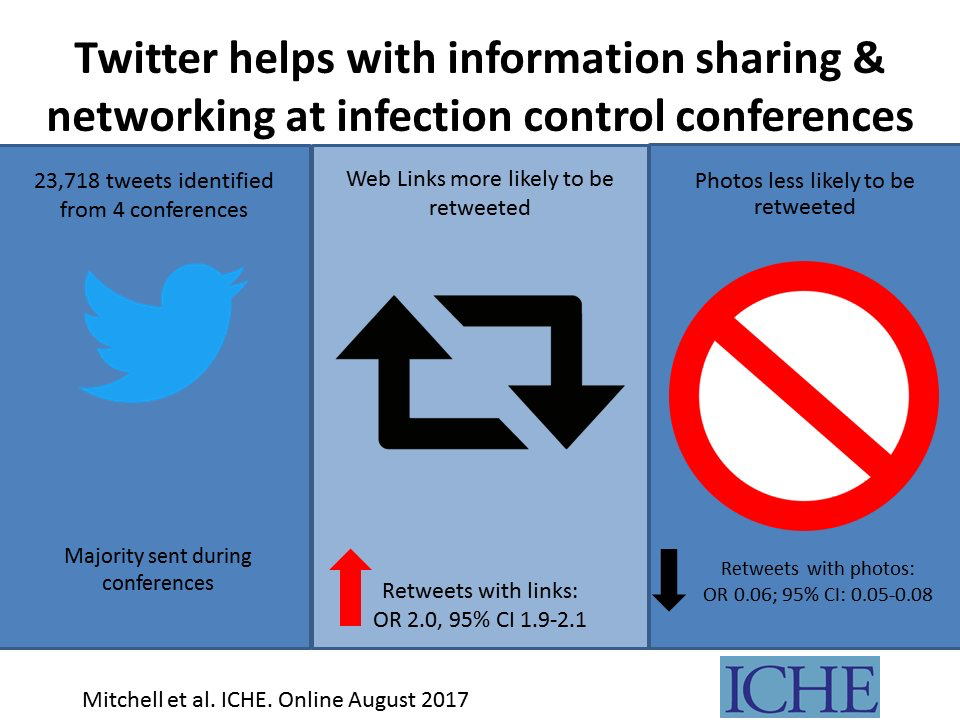
This visual abstract has appeared to summarise the findings of our article about tweeting and infection-related conferences (previous post about the article here):
Earlier this year, CMI published our article on the cost of a CPE outbreak in London, which cost 1.1m (Euros) over 10 months. EID have recently published a similar article, reporting a 0.6m (Euro) outbreak of CPE in the Netherlands.

If I’m still around in 2027 (which I hope to be by the way), you have my advance express permission to throw this post back in my direction. I thought an interesting way to summarise the key themes from IP2017 would be to think about how the IPC landscape will look 10 years from now.
I am heading home from an outstanding Infection Prevention 2017. There was a fair bit of discussion about hospital-associated pneumonia (HAP). HAP does not get the attention it deserves and there is more that we can and should be doing to prevent it. Although, we need to keep an eye out for unintended consequences in tackling HAP.
 Reflections on Infection Prevention and Control