Perspectives from ECCMID 2014: the box set

eccmid 2014

I’ve published a few ‘Perspectives from ECCMID’ on the blog over the last few days, so thought it would be useful to post a summary:

You may also be interested in some other updates from ECCMID elsewhere in the blogosphere:

Perspective from ECCMID Part IV: We need to stop polluting our planet with antibiotics

Effluent

Professor Joakim Larsson gave a frankly chilling lecture on antibiotic pollution and its impact on the environmental resistome. Antibiotic resistance genes are fairly common in soil bacteria, and indeed, pre-date the use of antibiotics. Furthermore, the reservoir of resistance genes in soil bacteria seems to have increased since the 1940s when we began using antibiotics. This creates a huge reservoir of resistance determinants to the tune of some 1030 bacteria, an unimaginably massive number that we can only begin to understand through analogy. Fortunately, there is not a free flow of antibiotic resistance genes from environmental to hospital bacteria. However, where there’s close contact and selective pressure, transfer of resistance genes from environmental bacteria to hospital pathogens does occur. Prof Larsson introduced the idea of ‘minimal selective concentration (MSC)’, the cost-benefit equation for bacteria carrying antibiotic resistance genes.

This problem is driven by the appropriate and inappropriate use of antibiotics in human medicine, agriculture and aquaculture. Indeed, we all know about the high rates of NDM-1 in the New Delhi water supply; the modern day John Snow’s water pump handle (although the solution is not as obvious)? Another important driver is antibiotic contaminated effluent from pharmaceutical factories producing antibiotics. A large amount of pharmaceutical production of antibiotics occurs in emerging markets, such as India. There are tight regulations on what factories are allowed to release into their surrounding environment in many countries, but some are largely unregulated. One plant in India released phenomenal amounts of one particular antibiotic, ciprofloxacin, in waste water: 44kg per day. To put this in context, that’s almost 5x the amount of the same antibiotic consumed by the whole of Sweden per day, and the concentration of the antibiotic in the waste water was higher than therapeutic levels of the drug in humans! Unsurprisingly, this provides a strong selective pressure for the development of antibiotic resistance in the bacteria surrounding the factories. There are special treatments available to reduce or eliminate antibiotic contamination of factory waste (e.g. active carbon filtration or ozone treatment). But incentives are required to ensure that these technologies are implemented in the resource-limited settings where the factories are based.

Prof Larsson is planning some research to help to understand the relationship between environmental bacteria and hospital pathogens, for example, through his ‘NoCURE’ (Novel Carbapenemases – UnRaveling the Environmental reservoir) project, and the BacMet database for registering biocide and metal resistance genes, which are both worth checking out. As we come towards the end of antibiotics, the last thing we need to be doing is polluting our planet with antibiotics, which provides a selective pressure for the development of resistant bacteria, some of which will find their way into hospitals sooner or later.

You can view some other ‘Perspectives from ECCMID’ here.

Image: ‘Effluent tank’ by Bob Shand.

SHEA 2014 Spring Conference: Out with contact precautions. In with faecal transplantation

shea 2014

The organizing committee of SHEA should be congratulated for putting together an interesting and engaging agenda for their Spring Meeting, based around the recent ICHE special edition. Sadly, I was only able to make it for ‘From MRSA to CRE: Controversies in MDROs’ at the tail end of the meeting.

Global perspective on CRE evolution – Dr Arjun Srinivasan

Dr Srinivasan kicked off with a frankly frightening status update on the ‘nightmare bacteria’. KPC and NDM-producing Enterobacteriaceae have spread globally and rapidly since 2006.1 The prevalence of carbapenem-resistant K. pneumoniae in the US has risen from 1% in 2001 to a whopping 10% in 2011.2 More worryingly, the prevalence of CRE colonization in long-term acute care hospitals (LTACHs) in Illinois was 30% in a recent point prevalence survey.3 Arjun gave some useful perspectives on the mortality associated with CRE. The odds ratio for mortality attributable to CRE was remarkably similar in studies from Israel and the US at around 4 (which is approximately twice that of MRSA).4-6

Arjun made the point that 10% of CRE reported to the CDC are “community-acquired”. I find this hard to believe and I suspect they’d be healthcare-associated if you searched hard enough for risk factors. The picture would be different in areas of really high prevalence like New Delhi or Greece, but I don’t think the US is quite there yet.

Arjun highlighted some practical limitations of implementing strategies to control CRE, in particular around staff cohorting. “Today you’re assigned to work on the unit dedicated to patients with the nightmare bacteria”; not a popular message to our staff.

The key questions from Arjun’s viewpoint are: the focus has been on K. pneumoniae and E. coli, but should Enterobacter be in the mix? Are we doing enough to control CRE (or possibly, too much)? What are the right policy solutions in terms of reporting and guidelines? And finally, can we control CRE? An updated national report from Israel suggests yes.7 But uncontrolled spread elsewhere (e.g. Greece and increasingly Italy) suggest no.

Lab Identification & Surveillance for MDROs – Dr Daniel Diekema

Dr Diekema gave a timely and thoughtful overview of lab diagnostics for MDROs. One problem hampering clear lab diagnosis and surveillance is how to define an MDRO, and MDR-GNR in particular. Do we go by phenotype or by genotype? Clearly, there are arguments either way; there’s a tendency for clinicians to gravitate towards phenotype and scientists towards genotype I think, so we need to look out for our own biases.

The keynote was “don’t throw away the agar plates just yet”. Molecular diagnostics has a role, but it does not replace agar plates. Molecular diagnostics are great, but do not deal with changing epidemiology; struggle with target variability; are expensive; rely on validation of carriage sites; do not tell you about phenotypic susceptibility; have a limit of detection often around a couple of logs; and need to manage shared resistance genes between species, especially for MDR-GNR. Dan concluded by questioning whether molecular diagnostics remain the realm of reference, referral and research labs!

CRE in LTCF, LTACH, Regional Control – Drs Kerri Thom & Michael Lin

Dr Thom gave a rather disturbing overview of the involvement of long-term care facilities (LTCFs) and LTACHs as reservoirs for the spread of CRE. She began by providing evidence, albeit from outbreaks, that standard hand hygiene focus and contact precautions do not control CRE spread.8,9 You need to do more: active surveillance cultures plus cohorting has worked in a number of studies.8,10,11 Several studies suggest a significant LTCF / LTACH reservoir.3,12-14 A study from 2011 carefully studying regional spread of CRE through analysis of inter-facility “social networks” suggests that a connected regional approach to control is required.12

Dr Lin, working in the “CRE battleground of Illinois”3 continued the theme for a regional approach by presenting a regional collaborative to register CRE carriers: the XDRO registry. Dr Lin referred to a successful CRE LTACH bundle, which was presented at ID Week 2013, and provides some hope that CRE can be controlled in LTACHs.

Posters and oral presentations

The SHEA Spring Meeting had some posters for the first time, which was a welcome addition. The highlights from the posters were:

  • Dr Lesho: 75 million person years of surveillance in US military yields 300 CRE cases; 1 per 100,000 person years.
  • Dr Mann: Sharklett pattern surfaces performed better than copper for reducing bacterial persistence and transfer.
  • Southard: Pulsed-xenon UV disinfection of ICU rooms following ALL discharges associated with 20 v 6 cases of unit-attributable CDI.
  • Nicole Kenny: If your microfiber is too absorbent, you can forget about a 10 minute contact time.

Four impressive submitted abstracts were presented:

  • Dr Assadian performed an RCT of antimicrobial surgical gloves, demonstrating an impressive microbiological reduction – but will this translate to clinical benefit?
  • Dr Cluzet found that recurrent MRSA colonization occurred in 40% of 200 patients with uncomplicated MRSA skin and soft tissue infection in the community, and was associated with colonized household contacts and some antibiotics.
  • Dr Decker found that CRE colonization duration was a mean 241 days (range 38-649). Worrying, a few patients followed a ‘pos-neg-pos’ colonization pattern, which supports a “once colonized, always colonized” approach.
  • Dr Kwon performed a beautiful RCT of Lactobacillus probiotics, but sadly found that it did not reduce GI MDRO colonization or acquisition.

Contact Isolation Precautions: Unanswered Questions – Dr Daniel Morgan

Dr Morgan gave a very balanced and data-led overview of the pros and cons of contact isolation precautions. On the one hand, gloves and gowns are frequently contaminated with MDROs (which would be hands and clothes if no gloves and gowns).15 On the other hand, the somewhat equivocal findings of the BUGG study do not exactly provide resounding support for contact isolation precautions.16 Also, patients under contact precautions have less contact with healthcare personnel, delayed discharge, an increased risk of adverse events, potential for psychological problems, and reduced patient satisfaction. Dr Morgan’s conclusion was complex (matching the data), with a graded approach to contact isolation precautions advocated: CRE > C. difficile > MRSA > VRE.

Success Stories in MRSA Control – Drs Sarah Haessler, Michael Edmond, Steven Gordon and Jeffrey Stark.

This session was not quite what I was expecting. It turns out that all four speakers have stopped using contact precautions for MRSA colonized patients, so this became a collective justification for this practice. The arguments are compelling: none of the speakers’ MRSA rates skyrocketed when they stopped isolating MRSA patients. The alternative approach to traditional contact precautions seems to be a ‘syndromic approach’: basically, only isolate them if they’re oozing. I can see the logic here, but there may be exceptions. For example, MRSA colonized patients with respiratory viruses can enter a “super-spreader” state and would most certainly not be obviously oozing.17 Also, I wonder whether the faculty would feel differently about contact precautions if they were working outside the US in a healthcare system that is mainly composed of 4 and 6 bed bays (like most NHS hospitals)?

Top 10 MDRO Papers – Drs Susan Huang & Ebbing Lautenbach

Dr Huang selected:

  • Sivert NHSN data, demonstrating high rates of carbapenem resistance in CLABSI: 23% of Klebsiella, 26% of Pseudomonas and 65% of Acinetobacter.18
  • Rutala study showing that reflective paint results in rapidly reduced UVC cycle times and thus improves feasibility.19 (I think there’s probably two views on this study. Either the reflective paint resulted in more reflective bouncing of the UVC around the room and genuinely improved things. Alternatively, the reflective paint could have reflected the UVC directly back to the sensor more rapidly and actually reduced the dose delivered to the microbes on the surfaces.)
  • Harris BUGG study, which is testament to securing big funding for definitive studies (though with frustratingly equivocal results).16
  • Huang etc universal intervention studies.20-22 Universal chlorhexidine bathing: YES (provided resistance is monitored). Universal mupirocin decolonization: NO!

Dr Lautenbach chose:

  • van Nood faecal transplant for preventing C. difficile recurrence.23 ‘Transpoosions’ work, but we need to work on finding the right synthetic bug mix. Dr Lautenbach described the findings of the faecal transplant study as a “penicillin moment”; it’s a concept that could transform medicine.
  • Eye Oxfordshire C. difficile whole genome sequencing study: how much CDI is hospital-acquired?24 The study did not consider asymptomatic carriers or environmental contamination and 25% of patient isolates were not available for analysis. So, there was a pretty large potential burden from which hospital-acquisition could have occurred.
  • Lin LTACH CRE colonization study.3 30% of patients carried CRE; this figure was 55% in one of the facilities included in the survey.
  • Daneman selective decontamination study.25 I can’t help thinking that ‘selective decontamination’ is misnamed: it’s not very selective at all. Perhaps ‘scorched earth decontamination’ would be more accurate. My view is that, regardless of efficacy, we should be giving faecal transplantation before a cocktail of antibiotics. Let’s save the antibiotics for treating infections.
  • Gerber community-based antibiotic stewardship cluster RCT, which showed an impressive reduction in broad spectrum antibiotic prescribing.26

Fecal Transplant for C. difficile Infection – Dr Michael Edmond

Dr Edmond gave a passionate and first-hand case for the effectiveness and value of faecal transplantation for recurrent CDI. It’s not a new concept: ‘faecal therapy’ was documented in Chinese medicine in 300AD; the first modern use was in 1957, with impressive results.27 Faecal microbiota transplantation (FMT) cures recurrent CDI by complementing reduced microbiota diversity.28 Indeed, a recent systematic review of FMT reported an overall cure rate of 91% for recurrent CDI.29 The regulatory position is in flux currently, meaning that purchasing carefully tested stool from the ‘brown cross’ (www.openbiome.org) may be more challenging in future. (Indeed, it may even come to DIY FMT, which is possible: first you collect it, then you blend it and then you stick it…) The bottom line is that fresh or frozen, yours or somebody else’s, stool bank or lab donor, NG tube or enema: FMT works for recurrent CDI. The only question is whether it could be a front-line treatment for CDI.  

The Microbiome and Its Role in Infection Prevention – Dr Clifford McDonald

Dr McDonald gave a mind-bending talk on the hugely underestimated role of the microbiome in human disease. The gut microbiome is dominated by the Bacteroidetes or Firmicutes, depending on diet; coliforms are surprisingly minor players.30 Antibiotic therapy results in profound disruption of the gut microbiome;31 thus we need to carefully tend the microbiome.32 We need to consider ways to manipulate the gut microbiome for good, using perhaps ‘advanced’ probiotics or modulating bacterial inter-cell communication. Cliff finished with a thought-proving vision of the future involving extensive testing of the patient’s microbiome, a “tending” consultation and treatment with a course of the appropriate advanced probiotic therapy.

Pro-Con: Should We Be Bare Below the Elbows? Drs Michael Edmond & Neil Fishman

The recently published SHEA guidelines on attire provide some useful background.33 Dr Edmond began with the pro position: clothing becomes contaminated with MDROs, which can be transmitted from clothing in laboratory studies; white coats are rarely washed; there is limited evidence but potential benefit. When evidence is limited, we need to avoid ‘methodolatry’, the worship of the hallowed RCT. It seems that a doctor’s appearance is the least important performance measure from a patient’s viewpoint.34 They are much more concerned with whether their doctor knows their stuff. Perhaps the most powerful argument of all for the pro is that Dr Edmond recently won an award for the best beside manner whilst dressing down.

Dr Fishman began his con in entertaining fashion: by undressing to bare below the elbow and replacing his neck tie for a fetching bow-tie. His argument was: unattractive bingo wings; bug-trapping hairy arms; may be some unintended harm; reduced patient experience; is it consistent when you consider policies for hand-held electronics; and, of course, no evidence.

The UK has been bare below the elbow for several years now. There has been some resistance: in fact, the debate reminded me of a London surgeon going apoplectic when the Prime Minister’s camera crew were not bare below the elbow during a hospital visit. So, should we be bare below the elbow? In my view, yes; it makes it easier to wash your hands. However, the manner in which you interact with you patient is far more important than what you wear.

Key issues

  • Can we control CRE and, if so, how?
  • Related to this, how to deal with the (apparently sizable) CRE reservoir in LTACHs?
  • Do molecular diagnostics remain the realm of reference, referral and research labs?
  • Has our focus on CRE taken our eye off multidrug-resistant non-fermenters (particularly A. baumannii), which are a greater ‘clear and present danger’ for many facilities?
  • Can we risk abandoning contact precautions for MRSA patients? In a US hospital with 100% single rooms, perhaps. In the NHS composed of 4 and 6 bed bays, no.
  • FMT works for recurrent CDI and regulators should not block access to it.
  • Could FMT work as a front-line treatment for CDI?
  • How can we modify the gut microbiome most effectively to confer infection prevention and control benefits?
  • Is microbiome modulation more effective than antibiotic ‘selective decontamination?

References

1.       Molton JS, Tambyah PA, Ang BS, Ling ML, Fisher DA. The global spread of healthcare-associated multidrug-resistant bacteria: a perspective from Asia. Clin Infect Dis 2013; 56: 1310-1318.

2.       Centers for Disease C, Prevention. Vital signs: carbapenem-resistant Enterobacteriaceae. MMWR Morb Mortal Wkly Rep 2013; 62: 165-170.

3.       Lin MY, Lyles-Banks RD, Lolans K et al. The importance of long-term acute care hospitals in the regional epidemiology of Klebsiella pneumoniae carbapenemase-producing Enterobacteriaceae. Clin Infect Dis 2013; 57: 1246-1252.

4.       Cosgrove SE, Sakoulas G, Perencevich EN, Schwaber MJ, Karchmer AW, Carmeli Y. Comparison of mortality associated with methicillin-resistant and methicillin-susceptible Staphylococcus aureus bacteremia: a meta-analysis. Clin Infect Dis 2003; 36: 53-59.

5.       Patel G, Huprikar S, Factor SH, Jenkins SG, Calfee DP. Outcomes of carbapenem-resistant Klebsiella pneumoniae infection and the impact of antimicrobial and adjunctive therapies. Infect Control Hosp Epidemiol 2008; 29: 1099-1106.

6.       Borer A, Saidel-Odes L, Riesenberg K et al. Attributable mortality rate for carbapenem-resistant Klebsiella pneumoniae bacteremia. Infect Control Hosp Epidemiol 2009; 30: 972-976.

7.       Schwaber MJ, Carmeli Y. An ongoing national intervention to contain the spread of carbapenem-resistant enterobacteriaceae. Clin Infect Dis 2014; 58: 697-703.

8.       Palmore TN, Henderson DK. Managing Transmission of Carbapenem-Resistant Enterobacteriaceae in Healthcare Settings: A View From the Trenches. Clin Infect Dis 2013; 57: 1593-1599.

9.       Kochar S, Sheard T, Sharma R et al. Success of an infection control program to reduce the spread of carbapenem-resistant Klebsiella pneumoniae. Infect Control Hosp Epidemiol 2009; 30: 447-452.

10.     Agodi A, Voulgari E, Barchitta M et al. Containment of an outbreak of KPC-3-producing Klebsiella pneumoniae in Italy. J Clin Microbiol 2011; 49: 3986-3989.

11.     Ben-David D, Maor Y, Keller N et al. Potential role of active surveillance in the control of a hospital-wide outbreak of carbapenem-resistant Klebsiella pneumoniae infection. Infect Control Hosp Epidemiol 2010; 31: 620-626.

12.     Won SY, Munoz-Price LS, Lolans K et al. Emergence and rapid regional spread of Klebsiella pneumoniae carbapenemase-producing Enterobacteriaceae. Clin Infect Dis 2011; 53: 532-540.

13.     Marquez P, Terashita D. Editorial commentary: long-term acute care hospitals and carbapenem-resistant Enterobacteriaceae: a reservoir for transmission. Clin Infect Dis 2013; 57: 1253-1255.

14.     Marchaim D, Perez F, Lee J et al. “Swimming in resistance”: Co-colonization with carbapenem-resistant Enterobacteriaceae and Acinetobacter baumannii or Pseudomonas aeruginosa. Am J Infect Control 2012; 40: 830-835.

15.     Morgan DJ, Liang SY, Smith CL et al. Frequent multidrug-resistant Acinetobacter baumannii contamination of gloves, gowns, and hands of healthcare workers. Infect Control Hosp Epidemiol 2010; 31: 716-721.

16.     Harris AD, Pineles L, Belton B et al. Universal glove and gown use and acquisition of antibiotic-resistant bacteria in the ICU: a randomized trial. JAMA 2013; 310: 1571-1580.

17.     Sheretz RJ, Reagan DR, Hampton KD et al. A cloud adult: the Staphylococcus aureus-virus interaction revisited. Ann Intern Med 1996; 124: 539-547.

18.     Sievert DM, Ricks P, Edwards JR et al. Antimicrobial-resistant pathogens associated with healthcare-associated infections: summary of data reported to the National Healthcare Safety Network at the Centers for Disease Control and Prevention, 2009-2010. Infect Control Hosp Epidemiol 2013; 34: 1-14.

19.     Rutala WA, Gergen MF, Tande BM, Weber DJ. Rapid hospital room decontamination using ultraviolet (UV) light with a nanostructured UV-reflective wall coating. Infect Control Hosp Epidemiol 2013; 34: 527-529.

20.     Climo MW, Yokoe DS, Warren DK et al. Effect of daily chlorhexidine bathing on hospital-acquired infection. N Engl J Med 2013; 368: 533-542.

21.     Milstone AM, Elward A, Song X et al. Daily chlorhexidine bathing to reduce bacteraemia in critically ill children: a multicentre, cluster-randomised, crossover trial. Lancet 2013; 381: 1099-1106.

22.     Huang SS, Septimus E, Kleinman K et al. Targeted versus Universal Decolonization to Prevent ICU Infection. N Engl J Med 2013; 368: 2255-2265.

23.     van Nood E, Dijkgraaf MG, Keller JJ. Duodenal infusion of feces for recurrent Clostridium difficile. N Engl J Med 2013; 368: 2145.

24.     Eyre DW, Cule ML, Wilson DJ et al. Diverse sources of C. difficile infection identified on whole-genome sequencing. N Engl J Med 2013; 369: 1195-1205.

25.     Daneman N, Sarwar S, Fowler RA, Cuthbertson BH, Su DCSG. Effect of selective decontamination on antimicrobial resistance in intensive care units: a systematic review and meta-analysis. Lancet Infect Dis 2013; 13: 328-341.

26.     Gerber JS, Prasad PA, Fiks AG et al. Effect of an outpatient antimicrobial stewardship intervention on broad-spectrum antibiotic prescribing by primary care pediatricians: a randomized trial. JAMA 2013; 309: 2345-2352.

27.     Eiseman B, Silen W, Bascom GS, Kauvar AJ. Fecal enema as an adjunct in the treatment of pseudomembranous enterocolitis. Surgery 1958; 44: 854-859.

28.     Chang JY, Antonopoulos DA, Kalra A et al. Decreased diversity of the fecal Microbiome in recurrent Clostridium difficile-associated diarrhea. J Infect Dis 2008; 197: 435-438.

29.     Sha S, Liang J, Chen M et al. Systematic review: faecal microbiota transplantation therapy for digestive and nondigestive disorders in adults and children. Aliment Pharmacol Ther 2014; in press.

30.     De Filippo C, Cavalieri D, Di Paola M et al. Impact of diet in shaping gut microbiota revealed by a comparative study in children from Europe and rural Africa. Proc Natl Acad Sci U S A 2010; 107: 14691-14696.

31.     Dethlefsen L, Relman DA. Incomplete recovery and individualized responses of the human distal gut microbiota to repeated antibiotic perturbation. Proc Natl Acad Sci U S A 2011; 108 Suppl 1: 4554-4561.

32.     Tosh PK, McDonald LC. Infection control in the multidrug-resistant era: tending the human microbiome. Clin Infect Dis 2012; 54: 707-713.

33.     Bearman G, Bryant K, Leekha S et al. Healthcare personnel attire in non-operating-room settings. Infect Control Hosp Epidemiol 2014; 35: 107-121.

34.     Aitken SA, Tinning CG, Gupta S, Medlock G, Wood AM, Aitken MA. The importance of the orthopaedic doctors’ appearance: a cross-regional questionnaire based study. Surgeon 2014; 12: 40-46.

ICHE special edition on CRE and MDROs

CRE medium

Infection Control and Hospital Epidemiology have once again excelled themselves in putting together a fine special edition on CRE and MDROs. Around this time last year I posted an article on the ICHE special edition on the role of the environment, and this special edition is equally important. I strongly recommend that you read the special edition from cover to cover, but I’ve picked out a few of my personal highlights below:

  • A thoughtful editorial by Drs Lautenbach and Perencevich sets the scene. They reflect on our ‘woeful unpreparedness’ to address both current and future MDROs.
  • A number of articles provide updates on surveillance and prevalence. Brennan et al. report findings from a 6-month CRE point-prevalence survey based on voluntary reporting in the state of Michigan, finding a crude rate of 1.07 cases per 10,000 patient days. Interestingly, this rate was almost 3 cases per 10,000 patient days in long-term acute care facilities. Isolates were not collected and analyzed, so carbapenemase genes were not confirmed; the fact that close to 10% of isolates were susceptible to meropenem suggests that a good number of the CRE were not carbapenemase producers. Indeed, another state-level point-prevalence survey (Pfeiffer et al., from Oregon) found that only 3 of the 60 CRE isolates reported were carbapenemase producers. Another state-level survey of CRE (Johnson et al., from Michigan) identified regional clustering of CRE colonization of mechanically ventilated patients in the central region of the state.
  • Analysis through the SHEA Research Network found that contact isolation policies for multidrug-resistant Gram-negative rods (MDR-GNR) are surprisingly variable. Worryingly, almost 20% of facilities surveyed did not isolate patients infected or colonized with MDR Pseudomonas or Acinetobacter, and 6% do not isolate patients with CRE. Policies for de-escalation of contact precautions were equally variable. Contact isolation policies seem to be even more lax in long-term care facilities based on data from Pfeiffer et al., reporting that only half of patients colonized with MDROs are placed on contact precautions.
  • A number of studies evaluated risk factors for CRE. For example, Bhargava et al. identified high acute morbidity score, immunosuppression, presence of indwelling medical devices and prior antimicrobial exposures to be consistent risk factors for CRE in the various patient populations they evaluated.
  • A survey of the kitchen in a Swiss hospital identified ESBL-producing Enterobacteriaceae in 92% of raw chicken and 6% of rectal samples from food handlers.
  • The efficacy of chlorhexidine bathing for MDR-GNR has been questioned, so data from Lin et al. on this issue are particularly welcomed. In a study of 62 patients in a long-term acute care facility, daily chlorhexidine gluconate (CHG) bathing halved the chances of culturing CRE from the body sites analyzed. However, it’s worth noting that the measured CHG skin concentration (15-312 mg/L before the daily bath and 78-1250 mg/L after the daily bath) was much lower than the applied CHG concentration (10,000 mg/L). This potentially brings the subtly reduced susceptibility to CHG reported in MRSA into play.
  • Several studies evaluated the potential for environmental contamination with MDR-GNR. Rosa et al. found that exposure to surfaces contaminated with MDR A. baumannii increased the risk of acquisition by almost 3-fold. Although the design of the study was fundamentally different, it is interesting to note that the increased risk from admission to a room previously occupied by a patient with MDR A. baumannii was also around 3-fold in a previous study. Havill et al. reported that the survival time for CRE (including K. pneumoniae) on dry surfaces is measured in weeks not days. Rock et al. carefully observed 220 unique interactions between healthcare workers (HCW) and patients with KPC or non-KPC producing K. pneumoniae, finding that HCW gloves or gowns became contaminated during 14% of the 220 interactions, and 26% of 43 environmental samples were positive. There was no significant difference between HCW or environmental contamination rates for KPC vs. non-KPC producing K. pneumoniae.
  • There was not much on therapy for CRE – perhaps because there is little to say for pan-drug resistant CRE! An article discussing the challenges of managing CRE infections by Drekonja et al. through surveying the CDC funded Emerging Infections Network highlighted the common problems due to toxicity from using “last-line” antimicrobials colistin and tigecycline.

It seems that the prevalence of CRE is patchy in the USA at present, and that long-term care, and long-term acute facilities are an integral part of the story. Given the limited evidence base, interventions need to cover all bases: active surveillance, rapid and accurate diagnostics, environmental (and perhaps food) hygiene, contact isolation and perhaps antiseptic decolonization, all combined with facility-wide education and communication initiatives. The most effective – and cost-effective – interventions to prevent and control the spread of CRE and other MDR-GNR are controversial so to this end I am looking forward to the SHEA ‘From MRSA to CRE: Controversies in MDROs’ and joint HIS / IPS ‘What’s that coming over the hill: rising to the challenge of resistant Gram-negative rods’ Spring meetings next month!

Photo credit: Enterobacter cloacae NDM-1 growing on Oxoid Brilliance CRE Agar by Nathan Reading.

A postcard from São Paulo, Brazil: thank goodness for the NHS

sao paulo traffic mediumI recently had the opportunity to spend a week in São Paulo, Brazil, to meet with some infection control and infectious diseases folks. I came away feeling pretty disturbed and very grateful for the NHS.

Brazil is a massive country, with almost 200m inhabitants. São Paulo is Brazil’s largest city, with more than 20m inhabitants making it the 7th largest city in the world. I have lived in London and close to New York, and spent quite some time in Tokyo but nothing comes close to the traffic in São Paulo. It took me 3 hours to travel the 30km from the airport to the hotel, not because it was the middle of the rush hour or because there was a problem, just because the volume of traffic is too big for the infrastructure to handle.

Brazil has around 7000 hospitals; 70% are private with a healthcare insurance system for those who can afford it. The public hospitals are the only option for those who cannot afford healthcare insurance. I visited a number of public and private hospitals and was struck by the following:

  • Rates of antibiotic resistance are eye-wateringly high. Around 40% of healthcare-associated Klebsiella pneuomoniae are carbapenem-resistant and of these, around 20% are colistin-resistant. More than 50% of K. pneumoniae produce ESBLs. The situation with Acinetobacter baumannii is even worse, with >80% resistant to carbapenems. Whilst there is usually some treatment option left, pan-drug resistant Gram-negative bacteria are a daily reality on the ICUs. To top it off, around 60% of S. aureus are MRSA, 80% of E. faecium are VRE and C. difficile is chronically under-reported due to lack of testing infrastructure and limited awareness about sending specimens. There’s an excellent 2011 review on antibiotic resistance in Brazil here, although a lot has happened since 2011.
  • The public hospitals are chronically overcrowded. This is best illustrated by a quick visit to the Emergency Department, where patients on stretchers line the corridors as far as the eye can see. These patients usually stay for days, not hours. The problem is so endemic that ICUs have been established in the ED. The wards are crowded too, with very small distances between beds. Plus, there are not enough staff to cover their beds, especially during nights and weekends. Following one meeting at a very large public hospital (2000 beds), we literally could not leave the building due to the sheer volume of patients trying to get in. Just like the roads, the volume of patients is too high for the infrastructure to handle.
  • The contrast between public and private hospitals is stark. Instead of being met by patients on stretchers when you arrive at public hospitals, you’re met by glass fronted healthcare insurance offices.

So, what can be done? The various strategies to curb the growing threat of antibiotic resistance are as relevant in Brazil as elsewhere: prevention is better than cure; reduce antibiotic use; improve accurate and timely diagnosis; perform surveillance for action; embrace novel solutions; highlight the financial burden; and develop new antibiotics. Some progress has been made, for example, antibiotics are no longer available without prescription over-the-counter. The commitment and enthusiasm of the infection control and infectious diseases folks that I have met here is inspiring. However, they are limited by poor healthcare infrastructure, virtually no investment in microbiology laboratory facilities, lack of national reporting, the widespread availability of poor-quality antibiotics and extensive use of antibiotics in the veterinary sector, which makes progress difficult.

Next time you have the misfortune of visiting an Accident & Emergency Department in an NHS hospital, rather than moan if you have to wait a few hours to access world-leading healthcare free at the point of care, instead be thankful for the NHS.

Photo credit: Fred Inklaar.

“Dirty money”: are you getting the right change from microbe-contaminated money?

SONY DSCThe phrase “Dirty money” may have different meanings for different people…but as far as microbiology is concerned….have you ever thought about what else you are getting back along with your change when you’re doing your shopping? I’m sure most of us are more concerned about getting the correct change rather than what microbes come for free with our change. For the few who have thought about what else they may be getting, I suspect that even fewer would answer: “pathogenic and sometimes multidrug-resistant bacteria, fungi and human parasites.”

In reality, we shouldn’t be surprised that bank notes and coins are contaminated with various bacteria. After all, we hardly expect them to be sterile. Our own hands are colonized with millions of bacteria and money is the most frequently passed item in the world. All studies that I have come across investigating bacterial contamination on money (paper notes or coins) have found a significant proportion to be contaminated (53-100%). I suspect that the microbiological techniques used in the various studies impacted on the results and my personal view is that the majority if not all money commonly exchanged between people will be contaminated.

The level of contamination and type or organisms on the money vary depending on the country, season, environmental conditions, type of money (paper vs coins), the type of material the money is made off, local community flora, the general hygiene level of the population and who is likely to be handling the money. Also dirty/damaged money (indication of frequent exchange) has been shown to be significantly more contaminated than clean and mint condition currency notes, and low denomination notes were more likely to be contaminated than higher denomination notes (probably reflecting frequency of use and socio-economic factors).1

The question to be asked, given the above, is: does it matter if money is contaminated with organisms? After all, this is not a new problem, as early as 1949, Nisbet and Skeoch2 have highlighted this issue. To answer this we need to look at a number of factors. These include: what type of organisms are on the money, how long are they able to survive and are they able to be transmitted to people and throughout the community from these contaminated currencies.  So let’s look at these factors in more detail:

1-  The type of organisms found on money

It is expected that bacteria will be found on bank notes and coins regardless of which country the money is from. Studies from Mexico, USA, India, Saudi Arabia, Nigeria, Kenya, Burma, China and Turkey to name few have all found significant contamination on their money. The type or bacteria found on money includes [deep breath]: E. coli, Vibrio spp., Klebsiella spp. including K. pneumoniae, Serratia spp., Enterobacter sp., Salmonella spp., Acinetobacter spp., Enterococcus spp., Staphylococcus including S. aureus, Bacillus spp., Staphylococcus epidermidis, Streptococcus pneumoniae, Proteus spp., Pseudomonas spp. including P. aeruginosa, Shigella spp.,  Corynebacterium, Lactobacillus spp., Burkholderia cepacia, Micrococcus spp. and Alcaligenes.

Looking at this list, it is clear that some of these bacteria are common environmental bacteria considered non-pathogenic. However, many are either potentially pathogenic or common human pathogens. For example, K. pneumoniae is a virulent organism and may cause both community and hospital-acquired infections. Even those organisms not commonly associated with disease in healthy hosts can cause clinically significant infections in immuno-compromised and hospitalised patients. These include even the natural inhabitants of the human skin such as Staphylococcus spp.

The story doesn’t end there since a number of studies have found multidrug-resistant and virulent strains on money. These have the potential to cause serious infections that are hard to treat, to disseminate in healthcare and community settings, and to spread antimicrobial resistant determinants to other bacteria. For example, one study3 found substantial S. aureus colonies on all 8 of the $1 and $5 bank notes collected from and around a University hospital in the USA. Tests for the presence of β-lactamases were positive and a significant number of the colonies showed resistance to erythromycin, tetracycline, chloramphenicol and vancomycin. Two isolates showed high-level resistance to vancomycin were found to harbour a plasmid conferring resistance to the drug. Taking that vancomycin is one of the last line antibiotics for treating multidrug resistant infection, this finding is very alarming. [A cautionary aside though – this work was published in the ‘Journal of Young Investigators’, so I can’t help thinking that the high-level resistance to vancomycin warrants some further investigation.] In another study,4 virulence genes were detected in S. aureus isolated from paper currency in India. Four virulence genes (cna, icaA, hlg and sdrE) were found in the isolates with 8 isolated possessing all 4 genes. Isolates harbouring these virulence genes showed higher antimicrobial resistance than those which didn’t contain these genes.

Bacteria are not the only organisms found on money. A number of studies show that fungal contamination of money is also common. Some of these are potentially pathogenic to humans and other life forms including plants. This may have implications far beyond human health to economic consequences if non-native pathogenic species are introduced into different countries via money carried during travel. For example, studies have found Penicillium spp., Aspergillus niger and A. flavus, Candida spp., Fusarium spp., Rhizopus spp., Alternaria spp, Trichoderma virie and white and brown mycelium on money.5.6 Some of these fungi can cause serious infections in humans and diseases in plants. In some countries, even parasites have been identified on bank notes. One study1 from Nigeria found that of the 250 currency notes collected from 4 major cities in the country, 21.6% were contaminated with enteric parasites including Ascaris lumbricoides, Enterobius vermicularis, Trichuris trichiura and Taenia spp. This parasite-contaminated currency was most frequently found in notes obtained from butchers and beggars. In another study,7 60.2% of 103 banknotes and 56.6% of 99 coins obtained from food-related workers in Egypt were found to be contaminated with one or more parasitic species. Protozoa were the predominant parasites, with microsporidia and Cryptosporidium spp. being the most prevalent.

2-  How long are organisms able to survive on money?

The survival of organisms on money depends on the type of the organism and their environmental resilience, the environmental conditions and the type of material the money is made of. Banknote paper is manufactured from cotton fibre, which gives the paper its strength and durability. Other additional elements maybe added to the cotton. Ploymer (or plastic) bank notes were developed to improve durability and incorporate some security features. One study8 investigated survival of MRSA, VRE and ESBL-producing E. coli on various bank notes from around the world including Euro, Croatian Kuna, Romanian Leu, Moroccan Dirham, US Dollar, Canadian Dollar, and the Indian Rupee. They found that the 3 organisms survived on the Romanian Leu for 6 hours after drying and VRE was isolated from the same notes after one day of drying. Other currencies had variable survival rates. Another in-vitro study4 found that S. aureus was able to survive on Indian paper currency for 8 days at room temperature.

3-  Are organisms able to be transmitted from money?

Transmission of organisms from money is highly significant if it occurs. For example, transmission from the community to the hospital setting is relevant because normally non-pathogenic, or opportunistic pathogens can have a serious clinical impact in such settings. On the other hand, transmission from the healthcare environment to the community is relevant when antimicrobial resistant strains (commonly found in hospitals) are involved. A study mentioned above,3 found vancomycin-resistant S. aureus on bank notes. The resistant determinant was located on a plasmid, hence easily transferrable. Notwithstanding my reservations about this study (see above), the interesting point about this investigation was the sources of the bank notes tested. These were collected from a University Hospital’s gift shop, a snack cart outside the hospital’s door and a convenience store near the hospital. The vancomycin-resistant isolates have likely originated from the hospital where the antibiotic is commonly used and had been transmitted to outside the hospital on money. In another study,8 investigators artificially contaminated bank notes of a number of countries with S. aureus and E. coli, and investigated transmission after 3 subjects with disinfected hands came into contact with these notes. Transmission was not successful for the Euro notes but transmission from US Dollars and the Romanian Leu was observed.

So we probably should be concerned with contamination of money especially when virulent, pathogenic or multidrug-resistant strains are concerned. Transmission between the healthcare and community settings can also have important implications. What’s the solution? Disinfection of the currencies in banks with UV light, supersonic or chemical means, producing bank notes from materials which inhibit bacterial growth or material with antimicrobial activity as well as replacement of traditional methods of trading with electronic money transactions,  have all been proposed. Personally I think for now, proper hand hygiene and overall hygiene remain the best ways to counter this problem.

References

  1. Uneke CJ, Ogbu O. Potential for parasite and bacteria transmission by paper currency in Nigeria. J Environ Health. 2007;69:54-60.
  2. Nisbet BR, Skeoch T. Bacteria on bank notes. Med Off. 1949;81:225.
  3. Bhalakia N. Isolation and plasmid analysis of vancomycin-resistant Staphylococcus aureus. J Young Investigators. 2005.
  4. Kumar JD, Negi YK, Gaur A, Khanna D. Detection of virulence genes in Staphylococcus aureus isolated from paper currency. Int J Infect Dis. 2009;13:e450-5
  5. Wanule D, Jalander V, Gachande BD, Sirsikar AN. Currency notes and coins as a possible source of transmitting fungal pathogens of man and plants. J Environ Sci Eng. 201;53:515-8.
  6. Kuria JK, Wahome RG, Jobalamin M, Kariuki SM. Profile of bacteria and fungi on money coins. East Afr Med J. 2009;86:151-5.
  7. Hassan A, Farouk H, Hassanein F, Abdul-Ghani R. Currency as a potential environmental vehicle for transmitting parasites among food-related workers in Alexandria, Egypt. Trans R Soc Trop Med Hyg. 201;105:519-24.
  8. Gedik H, Voss TA, Voss A. Money and transmission of bacteria. Antimicrob Resist Infect Control. 2013;2:22.

Photo credit: Sam Setzler.

A postcard from Latin America; carnivals, tango and carbapenem resistance

postcard panama

Recently, I spent some time in Latin America, first in the “Tango” country, Argentina, attending the International Federation of Infection Control (IFIC) 2013 conference and then in Panama giving a talk at a symposium. Talking to doctors and other healthcare workers from across Latin America during these two events, it was clear that multidrug resistance, especially carbapenemase and ESBL production in Enterobacteriaceae and other Gram-negative bacteria, are major problems in the region.

This prompted me to review the status of carbapenem resistance among the major nosocomial Gram-negatives in Latin America and ESBL production in E. coli and Klebsiella. Unlike the US and Europe, data on antimicrobial resistance from Latin American countries is limited. Some Latin American countries, such as Argentina, Chile and Colombia, do possess a nationwide surveillance program for monitoring antimicrobial resistance. However, the data are rarely in the public domain. Other countries such as Brazil and Mexico don’t yet have such monitoring programs. This makes it difficult to estimate the accurate prevalence and burden of diseases caused by antimicrobial-resistant bacteria in this part of the world.

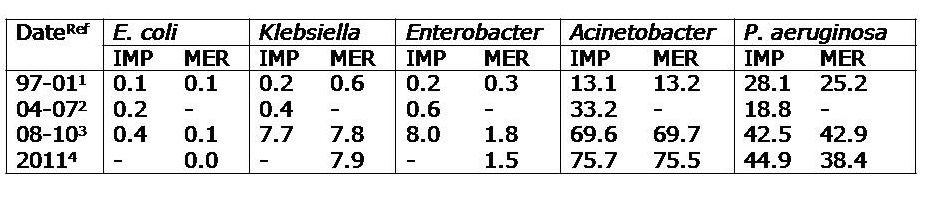
Thankfully, some data are flittering through from several national and international reports, including the SENTRY antimicrobial surveillance program (Table). SENTRY has been monitoring the predominant pathogens and antimicrobial resistance patterns of nosocomial and community-acquired infections via a broad network of sentinel hospitals since 1997 using validated, reference-quality identification and susceptibility testing methods performed in a central laboratory. Data from the SENTRY reports identify the five most frequently isolated Gram-negatives in Latin America as the Enterobacteriaceae (E. coli, Klebsiella and Enterobacter), P. aeruginosa and Acinetobacter.3

Table. Percentage of carbapenem resistance among the main nosocomial Gram-negatives in Latin America.CRE latinIMP; imipenem, MER; meropenem

Resistance of these organisms to carbapenems has been increasing over the years, especially among Klebsiella, P. aeruginosa and Acinetobacter. The 1997-2001 SENTRY program reported on the antimicrobial resistance of 8,297 isolates of the 5 above organisms for 7 Latin American countries (Brazil, Argentina, Chile, Colombia, Mexico, Uruguay and Venezuela).1 The data found carbapenems to be effective against Enterobacteriaceae (<1% resistance level). Resistance among Acinetobacter and P. aeruginosa was around 13% and 26% respectively. In 2001, carbapenem resistance among the Enterobacteriaceae remained <1%, while resistance for Acinetobacter and P. aeruginosa rose to around 17% and 36% respectively.

The Tigecycline Evaluation and Surveillance Trial (TEST)2 reported  the antimicrobial resistance of bacteria from 33 centres in Latin America (Argentina, Brazil, Chile, Colombia, Guatemala, Honduras, Jamaica, Mexico, Panama, Puerto Rico and Venezuela) between 2004 and 2007, finding that imipenem-resistance among Enterobacteriaceae remained stable at <1%. However, resistance of Acinetobacter to imipenem increased to 33.2%.

The 2008-2010 SENTRY report from 10 Latin American medical centres located in Argentina, Brazil, Chile and Mexico, found a marked increase in imipenem and meropenem resistance among Klebsiella (7.7% and 7.8% respectively) and Enterobacter (8% and 1.8% respectively).3 KPC-2 was prevalent in Klebsiella but OXA-163, IMP and VIM were also detected. There was an important increase in KPC-2 producing K. pneumonia noted in Argentina and Brazil. Colistin resistance was highest among Klebsiella and Enterobacter with resistance rates of 3.1% and 17.6%, respectively. Nearly 70% of Acinetobacter were resistant to carbapenems and 1.2% were resistant to colistin. There was a marked increase in resistance in this organism particularly in Argentina and Brazil. OXA-23 and OXA-24were the most frequent OXA-carbapenemase genes detected. In P. aeruginosa, 42% of the isolates were resistant to carbapenems and 0.3% were resistant to colistin.

A recent article reported the antimicrobial resistance among 3,040 Gram negatives collected in 2011 from 11 countries in Latin America (Argentina, Brazil, Chile, Colombia, Costa Rica, Ecuador, Guatemala, Mexico, Panama, Peru and Venezuela).4 With the exception of Mexico (1.1%), all other countries had high rates of Carbapenem-Resistant Enterobacteriaceae (CRE) (10-20%). Panama, Colombia and Brazil had particularly high rates of 20%, 18.2% and 17.3% respectively. Resistance in Enterobacter was 2.9% with the highest rates in Colombia and Venezuela (10-12.5%). KPC-2 was identified in Brazil, Ecuador and Venezuela, KPC-3 in Colombia and Panama while NDM-1 was also found in Colombia.

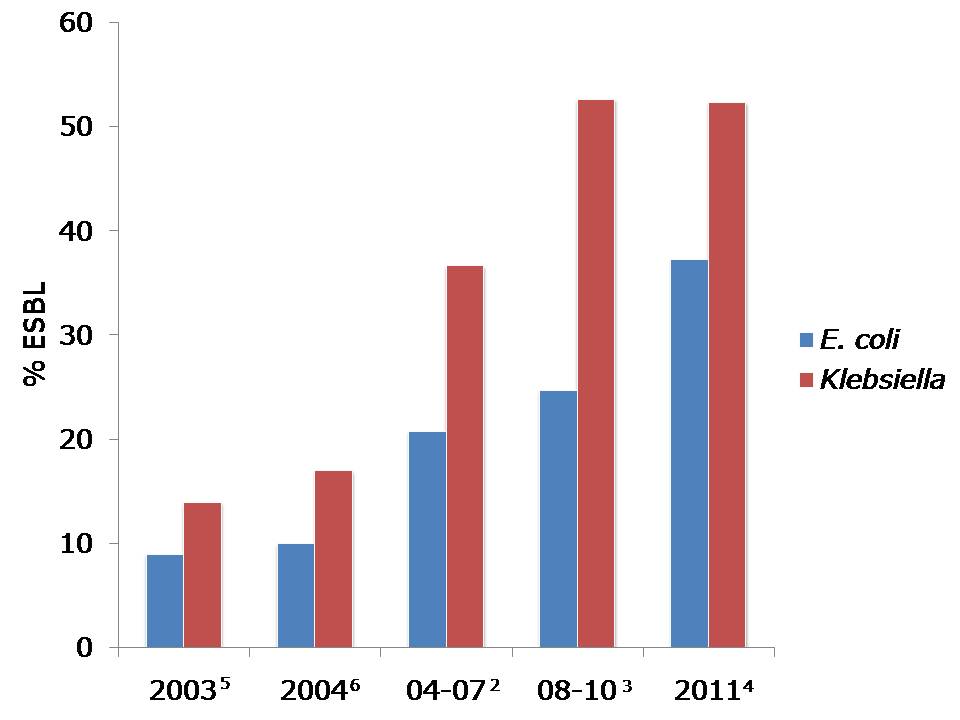
ESBL production by E. coli and Klebsiella isolated from Latin America is a well-recognized problem. The prevalence of ESBL-producers in Latin America has progressively increased over the years (Figure). The rates of these isolates in the region are now in excess of 50% in some regions.4 Peru, Guatemala and Chile have the highest ESBL-producing Klebsiella rates (70%, 69% and 59% respectively), while Mexico, Guatemala and Peru have the highest rates of ESBL-producing E. coli (71%, 59% and 54% respectively).

Latin americaFigure. Inexorable rise in rate of of ESBL-producing E. coli and Klebsiella in Latin America. 

It is clear that increasing antimicrobial resistance among Gram-negatives is a major problem in Latin America. The spread of carbapenem resistance is particularly troubling with increase prevalence of KPC and NDM carriage. Steps to reduce the transmission of these pathogens in Latin America require strategies at the institutional, community, national and international levels. For a start, it is important that true the prevalence rate of antimicrobial resistance among Gram-negatives in Latin America is determined at national levels with robust surveillance systems. Effective antibiotic stewardship and the control of inappropriate antibiotic use are important to slow the proliferation of resistant strains and should be targeted at both hospital and community levels. Strict infection control measures and targeted screening and isolation of patients with problematic strains should also help to slow the spread of resistant Gram-negatives in Latin America.

References

  1. Sader HS, Jones RN, Gales AC et al. SENTRY antimicrobial surveillance program report: Latin American and Brazilian results for 1997 through 200. Braz J Infect Dis 2004;8:25-79.
  2. Rossi F, García P, Ronzon B et al. Rates of antimicrobial resistance in Latin America (2004-2007) and in vitro activity of the glycylcycline tigecycline and of other antibiotics. Braz J Infect Dis 2008;12:405-15.
  3. Gales AC, Castanheira M, Jones RN, Sader HS. Antimicrobial resistance among Gram-negative bacilli isolated from Latin America: results from SENTRY Antimicrobial Surveillance Program (Latin America, 2008-2010). Diagn Microbiol Infect Dis 2012;73:354-60.
  4. Jones RN, Guzman-Blanco M, Gales AC et al. Susceptibility rates in Latin American nations: report from a regional resistance surveillance program (2011). Braz J Infect Dis 2013 Oct 10.
  5. Paterson DL, Rossi F, Baquero F et al. In vitro susceptibilities of aerobic and facultative Gram-negative bacilli isolated from patients with intra-abdominal infections worldwide: the 2003 Study for Monitoring Antimicrobial Resistance Trends (SMART). J Antimicrob Chemother 2005;55:965-73.
  6. Rossi F, Baquero F, Hsueh PR et al. In vitro susceptibilities of aerobic and facultatively anaerobic Gram-negative bacilli isolated from patients with intra-abdominal infections worldwide: 2004 results from SMART (Study for Monitoring Antimicrobial Resistance Trends). J Antimicrob Chemother 2006;58:205-10.

European Antibiotic Awareness Day: how do we get out of this mess?

eaad antibiotics

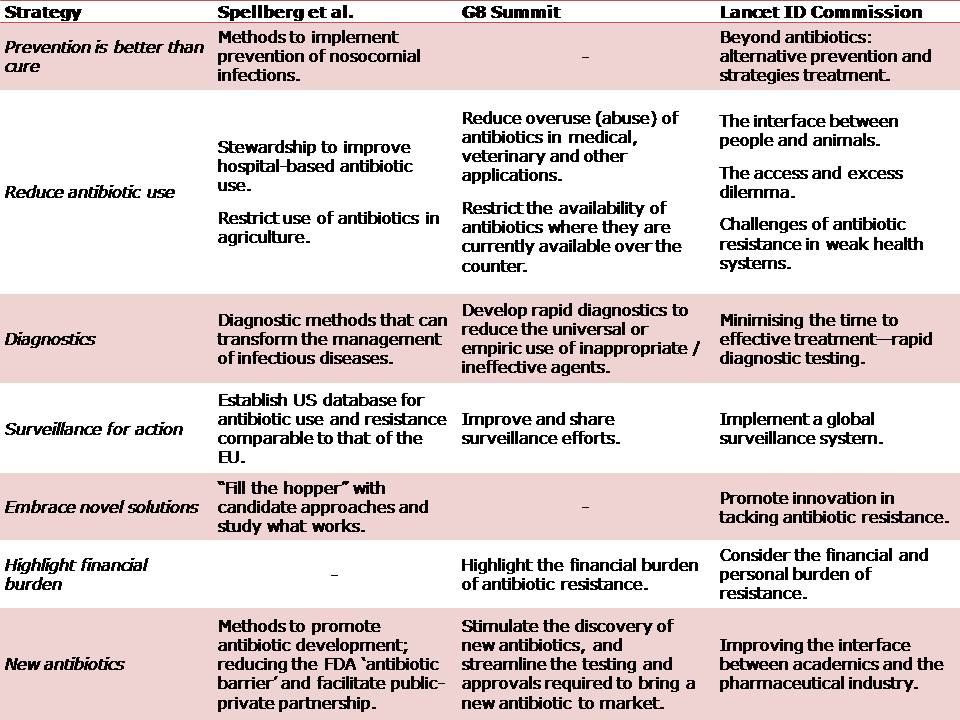
During Alexander Fleming’s Nobel Lecture on December 11th 1945 he said ‘It is not difficult to make microbes resistant to penicllin in the laboratory by exposing them to concentrations not sufficient to kill them, and the same thing has occasionally happened in the body.’  Almost 70 years later, we find ourselves towards the end of antibiotics. In honour of ‘European Antibiotic Awareness Day’, I thought I’d compare several attempts to outline approaches to curb antibiotic resistance:

EAAD Table: Comparing strategies to curb antibiotic resistance.  

I’ve listed the common themes that emerged in my order of priority (see Table above):

  • Prevention is better than cure. We have a reasonably good understanding of what works to prevent the spread of many hospital pathogens, so we need to implement effective strategies. However, there are still important questions about what works to prevent transmission, particularly outside of hospitals, so this area should be prioritised for research. It seems to me there’s an imbalance in the Lancet ID Commission report between prevention and treatment, with a disappointing lack of focus on prevention.
  • Reduce antibiotic use. Stop selling antibiotics at the cost of Smarties. Otherwise they will be consumed like Smarties.
  • Improve diagnostics. Targeted use of the right antibiotic will help to reduce inappropriate and empiric antibiotic use. The proposed universal use of antibiotics does not fit well with this.
  • Implement effective surveillance for action. I very much like the idea of a global antibiotic resistance surveillance network proposed by the Lancet ID Commission, and, in the mean time, a US national ‘EARS-Net’-like network.
  • Embrace novel approaches. Table 1 in this open-access NEJM article outlines the key novel approaches available, and their current status in terms of research.
  • Highlight the financial burden of resistance. This comes low down the list for me, not because it’s unimportant, but because the burden of resistance is now pretty well characterised.
  • Facilitate the development of new antibiotics. Perhaps somewhat controversially, I’ve listed the development of new antibiotics at the bottom of the list. Most bacterial targets have now been covered and even if we do succeed in bringing truly novel antibiotics to market, resistance will emerge eventually.

The noises coming from the global opinion leading healthcare authorities, such as ECDC, CDC and national Departments of Health give me some confidence that the problem of antibiotic resistance is at least now firmly on the agenda. Furthermore, the fact that the solutions mooted by the G8 politicians align closely with those proposed by the expert academics is encouraging. However, the challenges of antibiotic resistance will only grow is left unchecked. We are facing a complex, multifaceted problems, which demands a complex, multifaceted solution. In the pre-antibiotic era, prevention was all we had and we may be there again before too long.

Look out: resistance outbreaks about!

We are all familiar with the idea of outbreaks. A noteworthy pathogen rears its ugly head leaving a trail of destruction in its wake (as in ‘Contagion’, or before that, ‘Outbreak’). (I credit ‘Outbreak’ with getting me into microbiology and epidemiology as an impressionable 15 year old by the way.) Or more commonly in hospitals, a ward experiences an increased incidence of a particularly resistant or virulent clone. But a recent study from some colleagues at the Centre for Clinical Infection and Diagnostics Research at St. Thomas’ Hospital in London turns the idea of ‘outbreak’ on its head by identifying surprisingly common outbreaks of resistance to a particular antibiotic across different species.

The horizontal transfer of resistance genes is generally considered to be a rare event relative to horizontal, clonal transmission of an outbreak pathogen (see Figure below). But the findings of this study suggest more promiscuous spread of resistance genes than you may expect.

ICU resistance

Figure: Horizontal transfer of resistance genes is generally considered to be the least common cause of ICU resistance.  

The team used some outbreak scanning software to interrogate laboratory reports from two ICUs between 2002 and 2009. Analysis of the large dataset, comprising almost 90,000 patient days, found that outbreaks occurred for two thirds of the 26 ‘species-groups’ studied. Only three of these were recognized at the time. Thirty-nine outbreaks of resistance were detected, the majority of which (87%) did not coincide with an increase in a particular ‘species-group’, supporting the fact that these were due to horizontal gene transfer between species.

The clustering of individual species into ‘species-groups’ is somewhat problematic, and may serve to over-emphasize the number of outbreaks that occurred. Quite a number of the outbreaks of the same ‘species-group’ and of resistance were very small – with 2 cases over a day or two. Also, clustering of the same species does not necessarily mean clonal transmission has occurred – you’d need to do molecular typing to prove that. Similarly, clustering of resistance across species to the same antibiotic does not necessarily mean horizontal gene transfer has occurred; multiple mechanisms could be involved. Notwithstanding these limitations, this is an important study and has changed the way that I think about hospital outbreaks.

Infection control interventions implemented to control recognized outbreaks on the ICU appeared to reduce the overall number of outbreaks of the same ‘species-group’, but did not affect the number of resistance outbreaks. So, it seems that different measures are necessary to control outbreaks of resistance. Perhaps the best weapon we have to combat outbreaks of resistance is to restrict our use of antibiotics. If we can reduce the selective pressure driving resistance, we should see less clonal outbreaks of resistant bacteria and less resistance outbreaks across species.

Article citation: Vlek AL, Cooper BS, Kypraios T, Cox A, Edgeworth JD, Auguet OT. Clustering of antimicrobial resistance outbreaks across bacterial species in the intensive care unit. Clin Infect Dis 2013; 57: 65-76.

Is treating surfaces rather than patients with colistin a good idea?

PillsAntimicrobial resistance is a worldwide problem and the emergence of multi-drug resistant (MDR) bacteria and the lack of therapeutic options have led to the revival of old antibiotics such as colistin.1 This antibiotic is now considered as a “last line” antibiotic used to treat infection with MDR strains especially those cause by Gram-negative pathogens.2 Unfortunately, resistance to colistin has already been documented among a number of problematic pathogens such as Pseudomonas aeruginosa, Acinetobacter baumannii and Klebsiella pneumoniae, although the exact mechanism of resistance is not yet well defined.3

Within this context, I was surprised to come across a study4 presented at the 23nd European Congress of Clinical Microbiology and Infectious Diseases (ECCMID) conference held in Berlin in April 2013, by a Portuguese group aimed at covalently immobilizing colistin on biomaterials to prevent biomaterial-associated infection.

The use of antimicrobial materials and materials coated or impregnated with antimicrobial agents in healthcare settings is a flourishing field of research. This is driven by an increased recognition of the role of environmental surfaces in the transmission of nosocomial pathogens5 as well as the age old problem of bacterial colonisation of indwelling medical devices.6  With few exceptions, such materials have yet to be proven effective in reducing infection in practice. In addition, the possibility of the development of resistance to the active agents within these materials and surfaces has not yet been well investigated.

The Portuguese study,4 successfully covalently immobilized colistin onto a polycarbonate surface using a polydopamine dip-coating methodology. They used two strains of P. aeruginosa to test for the ability of the bacteria to attach to these colistin coated surfaces and the antimicrobial activity of these surfaces. The results showed that colistin coated surfaces had no effect on bacterial attachment and that the majority (but not all) of the bacterial cells were killed. So, some cells were still viable after 24 hr incubation on the colistin coated surfaces. The concentration of colistin used was not reported, but it is clearly not sufficient to inactivate all the cells on the surfaces which can potentially lead to the development of resistance to the drug, especially in a versatile organism such as P. aeruginosa.

I believe that in an era of MDR and pan-resistant strains and virtually untreatable bacterial infections, the idea of using one of our last line antibiotics to coat biomedical surfaces potentially breading colistin and other antimicrobial resistant strains is the last thing the healthcare community needs.

References

  1. Bergen PJ, Landersdorfer CB, Lee HJ, Li J, Nation RL. ‘Old’ antibiotics for emerging multidrug-resistant bacteria.Curr Opin Infect Dis. 2012 Dec;25(6):626-33
  2. Biswas S, Brunel JM, Dubus JC, Reynaud-Gaubert M, Rolain JM. Colistin: an update on the antibiotic of the 21st century. Expert Rev Anti Infect Ther. 2012 Aug;10(8):917-34.
  3. Lim LM, Ly N, Anderson D, Yang JC, Macander L, Jarkowski A 3rd, Forrest A, Bulitta JB, Tsuji BT. Resurgence of colistin: a review of resistance, toxicity, pharmacodynamics, and dosing. Pharmacotherapy. 2010 Dec;30(12):1279-91
  4. Alves D, Lopes S, Pereira MO. A colistin coating to prevent biomaterial-associated infections. ECCMID. 2013. Berlin. Abstract P1105.
  5. Otter JA, Yezli S, French GL. The role played by contaminated surfaces in the transmission of nosocomial pathogens. Infect Control Hosp Epidemiol. 2011 Jul;32(7):687-99
  6. Nicolle LE. Urinary catheter-associated infections. Infect Dis Clin North Am. 2012 Mar;26(1):13-27.