Journal Roundup July 2014

longitude

The July Journal Roundup is now available at the Journal of Hospital Infection website.

Topics this month include:

  • The Longitude Prize.
  • Randomized controlled trials of two novel glycopeptide antibiotics.
  • Developments in antimicrobial therapy, including several new approaches to augmenting the activity of existing agents.
  • Using chemicals for the prevention and treatment of skin wounds.
  • Updates on antibiotic cycling (which does seem to work afterall).
  • Commentary on ‘Mass Gatherings Medicine’.
  • Further updates to the SHEA Compendium.
  • Consideration of ‘horizontal’ (universal) vs. ‘vertical’ (targeted) strategies.
  • A randomized controlled trial on the effectiveness of issuing mobile phone reminders for HIV appointments.
  • A video surveillance study reporting a truly shocking level of hand hygiene compliance among anesthesiologists: 2.9%!
  • Reviews on colistin, rapid nucleic acid based diagnostics, and the hithertofore unrecognised importance of free living amoebae in some healthcare-associated infection.
  • And finally…what makes Twitter light up with antibiotic chat more than anything else?

Enjoy, and let me know if you have any questions or comments.

Should every body have a silver lining (inside and out)?

silver lining

sense about science

sense about science have asked me to meet one of their ‘Ask for Evidence’* requests about ‘Silver Shield’.

‘Silver Shield’ comes in two forms. A gel for topical application on wounds and an oral suspension. It seems that these two products are different formulations of the same biocide. It is true that silver has long been known to have antimicrobial properties, which is, of course, dose dependent. There’s a big difference in whether you apply the silver-containing gel to a wound versus drinking a silver-containing oral suspension in the hope of preventing or treating an infection.

There is some evidence that topical application of silver can help to disinfect wounds, which improves their healing. A number of well-designed randomised controlled studies have shown that silver containing dressings can help to improve wound healing. However, there is less evidence for gels (such as Silver Shield), and most literature is restricted to burns.

The real problem with claims around these products relate to the oral suspension. The audio recording on the website includes detailed dosing information for the oral suspension to prevent and treat MRSA wounds. There is no evidence to my knowledge in the peer-reviewed literature that ingesting an oral suspension of silver confers any health benefit for the prevention or treatment of MRSA or any other microbial infections. The product claims to be ‘non-toxic’ but there is some evidence of toxicity through ingesting silver suspensions in animal models.

The patent includes some laboratory (in vitro) data showing that silver inactivates a range of microbes, which is already known from other studies. It also references a number of case series of patients who took an oral suspension and recovered from various conditions. Details on these patients are scant, and there is no mention of a placebo control group, which is necessary to determine whether improvements were really due to the treatment or explained wholly or in part by the natural disease progression or a placebo effect. Indeed, the ‘case report’ for HIV betrays a frightening lack of understanding: to claim that a 5 day course of oral silver suspension can ‘resolve’ HIV is utterly scandalous:

‘Retrovirus Infection (HIV). The method comprises the step of administering a silver composition, comprising 5 to 40 ppm silver one to five times a day orally area until there was a response. One patient exhibiting HIV (human immunodeficiency virus) was treated with about 5 ml (approximately one teaspoon) of a composition of the present invention two times per day. The patient’s symptoms resolved within five days.’

As we come towards the end of antibiotics, we need to open our eyes to the potential of non-antibiotic treatments, and silver-based wound gels and dressings are a promising candidate. However, more evidence is required before widespread adoption of Silver Shield gel. As for taking an oral suspension of silver to prevent and treat microbial infections: this is likely to cause more harm than good and toxicity studies are required before considering testing this product on humans, let alone buying it online for £19.95!

*Sense about science ‘Ask for Evidence’ campaign:

ask for evidence

Every day, we hear claims about what is good for our health, bad for the environment, how to improve education, cut crime and treat disease. Some are based on reliable evidence and scientific rigor. Many are not. These claims can’t be regulated; every time one is debunked another pops up – like a game of whack-a-mole. So how can we make companies, politicians, commentators and official bodies accountable for the claims they make? If they want us to vote for them, believe them, or buy their products, then we should ask for evidence. Read about our Ask for Evidence campaign.

Image: ‘Silver lining’ by Bruce Turner.

Summer 2014 Update

summer 2014

It’s been another busy quarter on the blog, with some updates from ECCMID and APIC, the inaugural ‘Journal Roundup’ plus a few key studies.

Please keep your responses coming – and let me know if you’d like to contribute a guest blog!

Photo: ‘Summer’ by Matteo Angelino

ESCMID MDR-GNR guidelines

ESCMID experts recently released comprehensive guidelines for the control of MDR-GNR. Working with a limited evidence base, the experts managed to compile a coherent set of guidelines with graded recommendations. Given the important differences in the epidemiology of the various species and resistance patterns of MDR-GNR, this is really a 6-for-the-price-of-one set of guidelines, with separate recommendations for: ESBL-producing Enterobacteriaceae, MDR K. pneumoniae, MDR A. baumannnii, MDR P. aeruginosa, Burkholderia cepacia and Stenotrophmonas maltophilia.

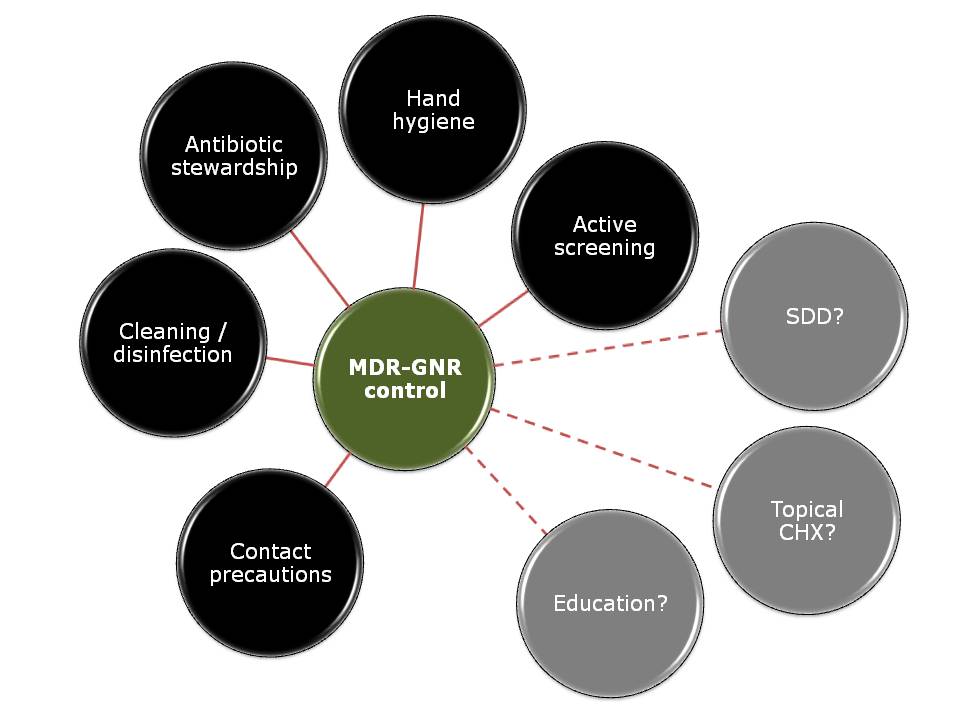
Five key interventions are identified: hand hygiene measures, active screening cultures, contact precautions, environmental cleaning, and antimicrobial stewardship. ‘Selective’ decontamination using antibiotics, topical ‘source control’ using chlorhexidine, and infrastructure / education are also reviewed. Which of these is most important? Most studies included multiple interventions simultaneously, so it’s difficult to tell and it will probably depend on species and setting.

MDR-GNR controlFigure: The cornerstones of MDR-GNR control (but we don’t have enough data to say which is most important, and which are redundant).

A few points for discussion:

  • We still don’t really know what works to control MDR-GNR. Reflecting on my recent blog on influenza transmission, where the relative importance of various transmission routes varies by context, this also seems likely for MDR-GNR. The relative importance of say, environment vs. hands, is likely to vary by setting for a given MDR-GNR species. This makes definitive guidelines difficult to write!
  • The guidelines begin with a useful review of the differing transmission routes for the various MDR-GNR species. This shows that person-to-person spread of Klebsiella species and some other Enterobacteriaceae (such as Enterobacter species and Serratia species) seems to be more important than for E. coli. The non-fermenters A. baumannii and P. aeruginosa have some fundamental differences with one another and with the Enterobacteriace in terms of transmission routes. If I had to rate the importance of patient-to-patient spread vs. other routes for the various MDR-GNR I would say A. baumannii > Klebsiella species > other Enterobacteriaceae > P. aeruginosa > E. coli. But don’t hold me to it!
  • It seems odd that all of the recommendations are ‘strong’ but the evidence is graded mainly as ‘moderate’, ‘low’ or ‘very low’. Perhaps more ‘conditional’ recommendations would be a better fit with the quality of the evidence?
  • The recommendations are stratified by organism-group and setting (endemic or outbreak), which is a workable approach. What you’d do in an outbreak does probably differ from what you’d do in an endemic setting.
  • There’s a useful recommendation for the identification of a new CRE case to prompt contact tracing and enhanced local surveillance, in line with PHE and CDC recommendations.
  • There’s a little fence sitting when it comes to a recommendation for active surveillance cultures in the endemic setting: ‘the implementation of ASC [active surveillance cultures] should be suggested only as an additional measure and not included in the basic measures to control the spread of MDR-GNB in the endemic setting.’ Still not clear whether this is a recommendation for or against ASC in the endemic setting!
  • I was surprised not to see a recommendation to use a disinfectant to help bring A. baumannii outbreaks under control. I appreciate that there is little evidence in endemic settings, but controlling the environmental reservoir does seem to be important in controlling A. baumannii outbreaks.
  • The remit of the guidelines is for adult patients, but what to do on neonatal units and in paediatrics?
  • The guidelines are restricted to hospitalized patients, but what about long-term acute care facilities (that are riddled with CRE in some parts of the world) and long-term care facilities (that have an unknown but probably sizable burden of resistance)?
  • The searches were restricted to MDR bacteria according to ECDC criteria, but what about all those literature on preventing the transmission of resistant (but not multiresistant) and sensitive GNR? If something works to control GNR, there’s no reason why it shouldn’t work to control MDR-GNR (except, perhaps, for antibiotic stewardship).
  • Finally, if all else fails (and only then), consider closing the ward!

In summary, these guidelines are very well written and will provide useful guidance for those on the front line try to deal with endemic and epidemic MDR-GNR. However, above all else, they highlight the need for high-quality studies telling us what works to control MDR-GNR.

Article citation: Tacconelli E, Cataldo MA, Dancer SJ et al. ESCMID guidelines for the management of the infection control measures to reduce transmission of multidrug-resistant Gram-negative bacteria in hospitalized patients. Clin Microbiol Infect 2014; 20 Suppl 1: 1-55.

Inaugural ‘Journal Roundup’ (June 2014)

JHI

I’ve been asked by the Editor of the Journal of Hospital Infection to begin writing a monthly column providing an overview of key updates in the infection prevention and control literature. I’m pleased to say that the first edition (June 2014) is now available on the Journal of Hospital Infection website, and I’m delighted that the Journal Roundup is open access.

I thought it would be useful to outline how I produced this roundup. I began by scanning the tables of contents of the following journals, pulling out articles of interest: AJIC, Ann Intern Med, BMJ, CID, ICHE, JAMA, JAMA Intern Med, JHI, JID, JIP, Lancet, Lancet ID, NEJM. This was easy for the “big five” (Lancet, BMJ, AIM, JAMA and NEJM) because only a handful of articles are directly relevant. It was more tricky for the specialist journals, since all articles are likely to be of interest. I’ve tried to avoid focusing solely on my own research interests, but these doubtless come through. One way to mitigate this in future is for others to provide a Journal Roundup now and then – or at least make some contribution. If you’re interested in this, please do let me know.

Highlights of this inaugural issue include a spike in MERS-CoV cases, coverage of the WHO report on antimicrobial resistance, more evidence that faecal microbiota transplantation works for curing recurrent CDI, the impact of nursing education on patient mortality, individualized antibiotic dosing, CA-MRSA in US Fire Stations, a successful community-based hand hygiene intervention, an outbreak of CRE in Ireland, updated SHEA guidelines for SSI and CDI, the identification of ‘optimum outlier’ (aka ‘positive deviant’) cleaners, a disturbing patient story, an update on the move towards ‘bare below the elbow’ in the US, an overview of the regulatory environment for healthcare apps, conference abstracts from APIC and ECCMID, and the use of Yelp (a customer review website) to identify cases that would otherwise have gone unreported during a foodborne outbreak.

Please feel free to share this with your colleagues, and let me know if you have any thoughts or comments.


What works to control antibiotic-resistant bacteria in the ICU? A two-for-the-price-of-one study

Not content with a single well-planned study to provide information on what works to control multidrug-resistant organisms (MDROs) in the ICU, the MOSAR study group published an interrupted time series and a cluster randomized trial of various interventions in the Lancet ID. This makes the study rather complex to read and follow, but there are a number of important findings.

Interrupted time series – ‘hygiene’ intervention (chlorhexidine and hand hygiene)

Following a 6-month pre-intervention period, a 6-month interrupted time series of a ‘hygiene’ intervention (universal chlorhexidine bathing combined with hand-hygiene improvement) was performed. The key outcomes were twofold: whether there was a change in trend during each phase, and whether there was a step-change between the phases. The hygiene intervention effected a trend change reduction in all MDROs combined and MRSA individually, but not in VRE or ESBLs (Table). However, there was no step-change compared with the baseline period.

Table: Summary of reduced acquisition of all MDROs combined, or MRSA, VRE and ESBLs individually.

Derde table

Cluster RCT – screening and isolation

In the 12-month cluster RCT of screening and isolation, the 13 ICUs in 8 European countries were randomized to either rapid screening (PCR for MRSA and VRE plus chromogenic media for ESBL-Enterobacteriaceae) or conventional screening (chromogenic media for MRSA and VRE only). When analysed together, the introduction of rapid or conventional screening was not associated with a trend or step-change reduction in the acquisition of MDROs (Table).  In fact, there was an increase in the trend of MRSA acquisition. When comparing rapid with conventional screening, rapid screening was associated with a step-change increase in all MDROs and ESBLs.

Discussion

  • The study suggests, prima facie, not to bother with screening and isolation. Indeed, the authors conclude: “In the context of a sustained high level of compliance to hand hygiene and chlorhexidine bathing, screening and isolation of carriers do not reduce acquisition rates of multidrug-resistant bacteria, whether or not screening is done with rapid testing or conventional testing”. However, the major limitation here is that many of the ICUs were already doing screening and isolation during the baseline and hygiene intervention phases! I checked the manuscript carefully (including the supplemental material) to determine exactly how many units were, but it is not disclosed. To make this conclusion, surely the cluster RCT should have been ‘no screening and isolation’ vs. ‘screening and isolation’.
  • The increasing trend of MRSA associated with screening and isolation by either method, and step-change increases in all MDROs and ESBLs associated with rapid screening are difficult to interpret. Is an increase in acquisition due to screening and isolation plausible? Can more rapid detection of carriers really increase transmission (the turnaround time was 24 hours for rapid screening, and 48 hours for chromogenic screening)? The rapid screening arm also included chromogenic screening for ESBLs, whereas the conventional screening arm did not, so perhaps this apparent increase in acquisition is due to improved case ascertainment somehow?
  • Looking at the supplemental material, a single hospital seemed to contribute the majority of MRSA, with an increasing trend in the baseline period, and a sharp decrease during the hygiene intervention. There’s a suspicion, therefore, that an outbreak in a single ICU influenced the whole study in terms of MRSA. Similarly, a single hospital had a sharp increase in the ESBL rate throughout the screening intervention period, which may explain, to a degree, the increasing trend of ESBL in the rapid screening arm.
  • There was an evaluation of length of stay throughout the study phases, with a significant decrease during the hygiene intervention (26%), a significant increase during the rapid screening intervention, and no significant change during the conventional screening intervention. It seems likely that improved sensitivity of rapid screening identified more colonized patients who are more difficult to step down, resulting in an overall increase in length of stay.
  • The carriage of qacA and qacB was compared in the baseline and hygiene intervention phase, finding no difference in carriage rate (around 10% for both). This does not match our experience in London, where carriage rates of qacA increased when we introduced universal chlorhexidine bathing. However, this was restricted to a single clone; the acquisition of genes associated with reduced susceptibility to chlorhexidine seems to be clone-specific.
  • ICUs varied from open plan to 100% single rooms. Whilst the average proportion of patients in single rooms (15-22%) exceeded the average requirement of patients requiring isolation (around 10%), there was no measure of unit-level variation of single room usage. Since the study was analysed by cluster, the lack of single rooms on some units could have been more important than would appear from looking at the overall average. Put another way, a 100% open plan unit would have been forced to isolate all carriers on the open bay, and vice versa for a 100% single room unit.
  • The impact of the various interventions was moderate, even though a ‘high’ MRDO rate was necessary for enrollment (MRSA bacteraemia rate >10%, VRE bacteraemia rate >5%, or ESBL bacteraemia rate >10%). Would the impact of screening and isolation be different on a unit with a lower rate of MDROs? It’s difficult to tell.
  • Some of the microbiology is quite interesting: 8% of MRSA were not MRSA and 49% of VRE were not VRE! Also, 29% of the ESBLs were resistant to carbapenems (although it’s not clear how many of these were carbapenemase producers).

In summary, this is an excellent and ambitious study. The lack of impact on ESBL transmission in particular is disappointing, and may lead towards more frequent endogenous transmission for this group. The results do indicate screening and isolation did little to control MDRO transmission in units with improved hand hygiene combined with universal chlorhexidine. However, we need a ‘no screening and isolation’ vs. ‘screening and isolation’ cluster RCT before we ditch screening and isolation.

Article citation: Derde LP, Cooper BS, Goossens H et al. Interventions to reduce colonisation and transmission of antimicrobial-resistant bacteria in intensive care units: an interrupted time series study and cluster randomised trial. Lancet Infect Dis 2014; 14: 31-39.

Highlights from APIC 2014

APIC 2014I couldn’t make it to APIC this year, but I have picked out a few highlights. More than 300 abstracts were presented so I can only scratch the surface here, but the good news is that they’re all available in an AJIC supplement.

Multidrug-resistant Gram-negative rods

One of the oral presentations was on controlling CRE in Texas (Cifelli et al). The interventions comprised improvements in lab identification and patient electronic tagging, and front-line infection prevention and control practices (dedicated rooms, equipment and staff etc). It’s difficult to know which of these approaches (if any!) made the difference: we still don’t know what works to control CRE.

A group from Louisville explored transmission of CRE in an LTAC (Kelley et al). LTACs have previously been shown to be a hotbed for CRE transmission in some parts of the USA. They found that almost half of patients that acquired CRE were admitted to beds that had been previously occupied by a CRE patient, which brings a new meaning to ‘hotbed!’ This links in with previous studies showing that admission to a room previously occupied by a patient with MDROs is a risk factor for acquisition. It also shows that CRE (K. pneumoniae at least) can survive for long enough on surface to bring indirect transmission via environmental contamination into play.

Definitions and terminology surrounding CRE and MDR-GNR in general are in a state of confusion. Both require urgent clarification. A survey of 79 hospitals by Jadin et al for their definitions of MDR-GNR yielded virtually 79 different definitions! This makes it challenging for facilities to communicate clearly about MDR-GNR, since what qualifies as MDR-GNR may not make the cut in another hospital. And this is not even accounting for variations in lab diagnostics!

A small prevalence survey of CRE carriage in Michigan by Berriel-Cass et al found that 2 (3.8%) of 53 patients were colonized. Neither patient had history of CRE, but one who did have a history of CRE screened negative! It’s difficult to know who is at high risk for CRE carriage, and even more difficult to know how long they will carry it for. However, we probably know enough to conclude that “once positive always positive” is a sensible (if somewhat conservative) approach.

The rest

A fascinating study from Arizona by Sifuentes et al evaluated a hygiene intervention in a LTCF. A number of bacteriophages were used as markers for pathogenic virus transmission and inoculated onto hands and surfaces. The viruses spread rapidly throughout the faculty over a short time period (measured in hours), and a hygiene intervention significantly reduced the level of contamination of hands and surfaces. Most similar work has been performed in the acute setting, so some data from the non-acute setting is particularly welcome. This study illustrates the dynamic interplay between hand and surface contamination. In a way, hands are just another highly mobile fomite that are not disinfected frequently enough!

Jinadatha et al performed a very timely study exploring whether serial passage of bacteria with sub-lethal UV exposure prompts reduced susceptibility to UV. The study demonstrates that 25 serial exposures to UV did not affect bacterial UV susceptibility. However, the study did not explore whether other useful mutations may have occurred in the “survivors”; perhaps this is a job for whole genome sequencing in a follow-up study?

Faecal microbiota transplantation (FMT) is quickly becoming the standard of care for recurrent CDI. A study by Greig et al tells the story of implementing a FMT programme. The literature for FMT are impressive, but the ‘nuts and bolts’ of implementation are challenging. Where do you get the donor stool form? How do you screen the donors? Who performs the procedure? Who pays? Will it work here? Are just some of the questions that need to be negotiated for successfully implementing an FMT programme. The message from this study: it’s worth it – 83% of patients with recurrent CDI had resolved within 30 days.

Finally, I remain rather skeptical that “CA-CDI” is really on the rise. I may have to revise my opinion based on this abstract by Rogers and Rosacker, showing that a community-based educational intervention reduced the rate of CA-CDI!

Which transmission route is most important for influenza?

influenza (2)

“We are no more in the aerosol camp than the contact camp” conclude the authors. And this seems to be how it is in terms of influenza transmission routes – you’re either in one camp or the other. This 2010 PLoS Computational Biology paper is hardly hot off the press, but it is important and it does, to an extent, put the question of which camp you are in for influenza transmission to bed: you need to pitch your tent in different camps depending on the circumstances.

The paper describes a model to compare the various transmission routes for influenza, principally airborne, droplet and contact. The study evaluates four transmission routes: ‘respirable particles’ (<10 µm), ‘inspirable particles’ (>10 µm, <100 µm), ‘direct droplet spray’ (>100 µm) and ‘contact’. The model tests 10,000 scenarios, considering possible variation in virus properties, host susceptibility and environmental factors (such as the number of influenza shedders).

The key finding is that contact transmission had the highest average basic reproduction number (R0) (1.7) followed by droplet (0.27), respirable (0.05) and inspirable (0.006) particles (Figure). However, that is only part of the story. Of the 10,000 scenarios evaluated, contact only was associated with high transmission in 3,069, all four routes in 342 and none in 4,765. In high host density settings, all routes were more frequently important. Conversely, when self-inoculation was more common (i.e. when simulated individuals touched their simulated nose, eyes and mouths more frequently), contact transmission was more important.

Spicknall

Figure: Basic reproduction number (R0) of four influenza transmission routes, ‘respirable particles’ (<10 µm), ‘inspirable particles’ (>10 µm, <100 µm), ‘direct droplet spray’ (>100 µm) and ‘contact’.

The findings are interesting and probably very important. It’s a shame they were not able to evaluate the relative importance of contact transmission involving contaminated surfaces compared with contact transmission that occurs independent of surface transmission (this has been evaluated elsewhere). Also, I remain suspicious of modeling in general. If simplifying assumptions are too simplistic (which is often the case), the model spits out garbage, which is worse than useless. Put another way, Bertha can produce anything if she’s given the right inputs! Plus, it’s difficult to know how applicable these findings are to other respiratory viruses.

Still, the paper does shed light on the relative importance of influenza transmission routes. Which is most important? Well, that depends on the context. If you’re in a small room, airborne and droplet transmission is key. If you’re admitted to a room following the discharge of a patient with influenza, then contact transmission is key. Hence, we need to be flexible when considering influenza transmission routes and ‘contextualize’ our interventions accordingly.

Citation: Spicknall IH, Koopman JS, Nicas M, Pujol JM, Li S, Eisenberg JN. Informing optimal environmental influenza interventions: how the host, agent, and environment alter dominant routes of transmission. PLoS Comput Biol 2010; 6: e1000969.

Image: Sanofi Pasteur.

MERS-CoV: a survival guide for you and your patients

This time last week, we were on red alert that a MERS-CoV pandemic was gathering pace. The news over the last few days has been more encouraging, with no new cases reported in Saudi Arabia, the epicenter of the MERS-CoV cases. However, there are still plenty of patients with MERS-CoV who need to be cared for around the world. Like SARS-CoV, but unlike the “usual suspects” that cause HCAI such as MRSA and C. difficile, MERS-CoV has the capacity to affect both healthcare workers and patients. Thus, I hope that this ‘survival guide’ will prove useful to those on the front line.

I presented a webinar on ‘MERS-CoV: coming to a hospital near you? Infection prevention and control challenges’. You can download the slides here. I came across a fantastic blog whilst preparing the webinar: ‘Virology Down Under’ by Dr Ian Mackay. I’ve used some of his excellent images in the slides, with his kind permission.

There are two transmission routes to consider for MERS-CoV: droplet / aerosol and contact / fomite. CDC recommends both airborne and contact isolation procedures to reflect these transmission routes. This involves placement of the patient in a negative pressure airborne infection isolation room, and the use of gloves, gowns, eye protection and N95 (FFP3) mask, and, of course, hand hygiene. PHE recommends a similar approach.

First and foremost, as a respiratory virus, inhalation of infected droplets is likely to be the most important transmission route. However, whilst not an ‘airborne’ virus (such as measles), aerosols can be generated by MERS-CoV patients that comprise small droplet nuclei that travel for long distances. A recent study of influenza suggests that the generation of aerosols is surprisingly common, to the extent that ‘living and breathing is an aerosol generating procedure’. Indeed, a recent study showed that a MERS-CoV aerosol diminished by only 7% over 10 minutes (compared with 95% for influenza). The use of an N95 (FFP3) mask will prevent direct inhalation of droplets / aerosols, and gloves, gowns and eye protection will prevent contact with mucous membranes and contamination of clothing or hands for subsequent nasal inoculation. But, if MERS-CoV aerosol is generated in the patient’s room (which seems likely), how long will it last and will the subsequent admission to the next room be at risk?

Let’s assume a patient sheds a MERS-CoV infectious aerosol of 6-log. I’m not aware of any infectious dose data for MERS-CoV yet, but for SARS-CoV it can be as low as <20 plaque forming units. Given the decay rate of 7% over 10 minutes, infectious aerosol above the infectious dose could be present after the discharge of the patient for a little under 26 hours! Even if the virus was shed at a lower titre, infectious aerosol times would still be considerable (Table). Could this be a job for automated room disinfection systems, which address both surface and airborne contamination? One such system, hydrogen peroxide vapour, has recently been shown to inactivate the SARS-CoV surrogate, TGEV.

Shed titre Time to reach 20 virus particles
1000000 26 hours
100000 20 hours
10000 15 hours
1000 9 hours
100 4 hours

Table: Relationship between shed titre of MERS-CoV and time to reach 20 virus particles.

Whilst respiratory viruses are not that great at surviving on surfaces compared with C. difficile spores and some vegetative bacteria, they can survive long enough to bring contact / fomite transmission into play. A number of reviews have concluded that contact / fomite transmission is an important route for influenza and other respiratory viruses such as rhinovirus. The SARS-CoV and surrogates exhibit unusual survival properties compared with other respiratory viruses, with survival times often measured in days, weeks or even months. Recent data suggests that MERS-CoV shares this property, surviving for >2 days when dried onto hard surfaces compared with only a few hours for influenza tested in the same study. Fortunately, these enveloped viruses are inactivated rapidly by usual hospital disinfectants, so I can understand the CDC’s recommendation for standard environmental disinfection.

So, how to protect yourself and your patients? The answer is simple for direct patient care: wear your gown, gloves, goggles and N95 (FFP3) mask, and wash your hands! It’s simple in theory, compliance with these measures in practice is not as good as you may expect. Prof Seto published a study in the Lancet in 2003 about compliance with personal protective equipment (PPE) and hand hygiene during the SARS epidemic. Remarkably, even when caring for patients known to be infected with SARS, <30% of healthcare workers self-reported that they wore a mask, glove, gown and washed their hands as they should have done. And this was self-reported, so you’d expect there to be a bias towards compliance! Most importantly, none of the healthcare workers who complied with all four measures became infected.

Seto Lancet SARS PPE

Figure: Healthcare worker compliance with mask, glove, gown use, and hand washing during the SARS epidemic, stratified by those who became infected with SARS.

To summarise: how to protect you and your patients from MERS-CoV:

  • Place patient in negative pressure airborne infection isolation room, where available.
  • Wear the correct PPE when in the room (gloves, gown, N95 / FFP3 mask, goggles), and wash your hands.
  • Pay attention to the potential for contaminated surfaces and air, particularly following the discharge of the patient.
  • Oh, and if you go on holiday to Saudi Arabia, don’t kiss any camels!

Perspectives from ECCMID 2014: the box set

eccmid 2014

I’ve published a few ‘Perspectives from ECCMID’ on the blog over the last few days, so thought it would be useful to post a summary:

You may also be interested in some other updates from ECCMID elsewhere in the blogosphere: