Do you know your CRE from your CRAB?

I gave a talk today at a meeting on combating carbapenem-resistant organisms. My angle was to clearly differentiate the epidemiology of the Enterobacteriaceae (i.e. CRE) from the non-fermenters (most importantly carbapenem-resistant A. baumannii – CRAB), and you can download my slides here.

I’ve blogged before about how confusing the terminology surrounding multidrug-resistant Gram-negative rods has become. Non-expert healthcare workers have little chance in distinguishing CRE from CPE from CRO from CPO. So we need to help them by developing some clear terminology, given the gulf in epidemiology between CRE and CRAB (see below).

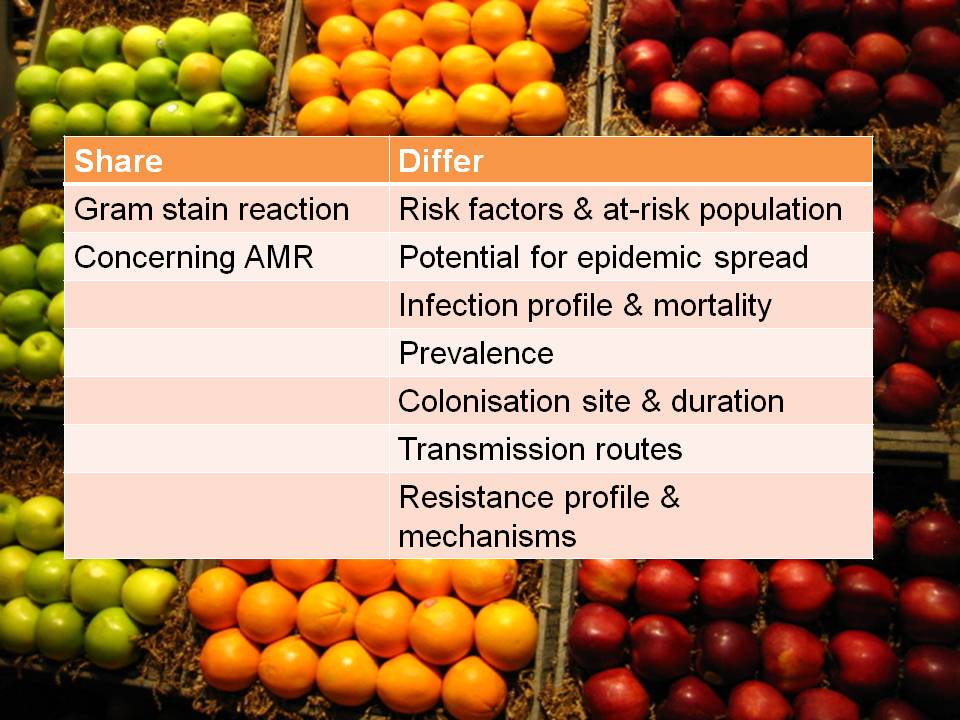
CRE and CRAB are like apples and pears: they share some basic microbiology but that’s about where the comparison ends!CRE CRAB

So, I think we should talk in terms of CRE (and CPE for confirmed carbapenemase carriers), and CRNF (or CRAB for A. baumannii and CRPA for P. aeruginosa). I don’t think that CRO is a useful term – in fact, I find it rather confusing. Carbapenem resistance in Enterobacteriaceae (CRE) and A. baumannii (CRAB) are both emerging problems, but they are not the same problem.

How big is C. difficile infection in the USA?

Clostridium-difficileThe New England Journal of Medicine recently published an article evaluating the burden of CDI in the USA. The huge CDC-led initiative collected data from 10 geographically distinct regions, identifying more than 15,000 cases. Around two-thirds of cases were classified as healthcare-associated (although only 25% were hospital-onset). This means that, prima facie, a third of CDI cases were community-associated. I find this proportion difficult to believe: I strongly suspect that many of these cases would have had healthcare-associated risk factors if the team were able to look hard enough. For example, they used a fairly standard 12 week look-back period to evaluate previous hospitalisation, but how would the data look if they’d used 12 months? Also, it’s usually only possible to evaluate previous hospitalisation in a single healthcare system, but many patients commute between various healthcare systems. The authors acknowledge in the discussion that this designation of “community-acquired” may be inaccurate based on the finding from a previous study whether healthcare-associated risk factors were identified in most patients, but only be a detailed phone interview.

Scaling up from the figures from the 10 regions, national estimates were around 500,000 cases and 29,000 deaths due to CDI per annum in the US. This estimate is approximately double previous estimates for the national CDI burden in the USA, probably reflecting the adoption of molecular methods for the detection of CDI. This scaling up included an interesting statistical adjustment to see how prevalence varied depending on how many sites use sensitive molecular methods to detect CDI.

A sub-study included the culture of C. difficile from 1625 patients. More than 15% of stool specimens from patients diagnosed as CDI failed to grow C. difficile, probably illustrating the limitations of culture methods more than anything else. NAP1 (027) represented around half of cases, and was significantly more common in healthcare-associated CDI. I think it’s fair to say that the initial fears that NAP1 was a super-strain have been allayed by the fact that it’s now so common and there hasn’t been a surge in CDI mortality.

Finally, around 21% of healthcare-associated cases suffered at least one recurrence. Thus, there is a real need to the roll out of the uber successful faecal microbiota transplantation for recurrent CDI. In fact, there should be around 70,000 faecal microbiota transplantations each year in the US right now (500,000 x 0.66 x 0.21); I suspect there are far fewer.

Journal of Hospital Infection Special Edition on the 2014 Healthcare Infection Society (HIS) Conference

HIS_Web_Banner_Jpeg

JHI have published a Special Edition featuring write-up from the 2014 HIS Conference (you can see my reflections from HIS here).

I’m all for special editions, and I think that JHI should do more of them. I know that compiling this Special Edition has been a considerable undertaking for the Journal, but well worth the effort: it’s a very useful read. Particular thanks to Dr Mark Walker who was the editor for this Special Edition, and to Dr Jenny Child who initiated it.

Over the top and into the trenches

moving IIAfter 12 years working for Bioquell (and part-time at Guy’s and St. Thomas’ / King’s College London since commencing my PhD in 2005), it’s time for me to move onto pastures new. Next week I’ll start working in a leadership role in Infection Prevention and Control at Imperial College NHS Trust in London. It’s a very exciting move for me and I can’t wait to get going. I thought that now would be a good time to reflect on the water under the bridge of the last decade or so (and I hope you’ll forgive my self-indulgence).

Over the last decade, the rate of MRSA and C. difficile infection (CDI) in the UK have fallen dramatically.1,2 At the peak of the MRSA epidemic in the early 2000s, there were more than 2000 MRSA bloodstream infections per quarter in England; now there are 10-fold less.2 It’s not certain how this has been achieved, but a combination of factors, including increased governmental focus, are likely responsible. Whilst MRSA is now rare in the UK this is not the case in other European countries and in many other parts of the world, where MRSA remains common.3

In recent years, a new and more troublesome bacterial threat has emerged: carbapenem-resistant Enterobacteriaceae (CRE).4 CRE present the “triple threat” of high levels of antibiotic resistance (including pan-drug resistant strains against which no antibiotics are left), severe clinical consequences (around half of patients with a CRE bloodstream infection will die), and the potential for rapid regional and national spread (illustrated by national outbreaks in Italy, Greece and Israel).4-6 CRE have been described as “nightmare bacteria” by the US CDC and have prompted unprecedented action from CDC, Public Health England (PHE) and other public health agencies, including a national Patient Safety Alert and a letter to all hospital Chief Executives in the UK to ensure that new CRE guidelines are implemented.7,8

Continue reading

CRE diagnosis: current status

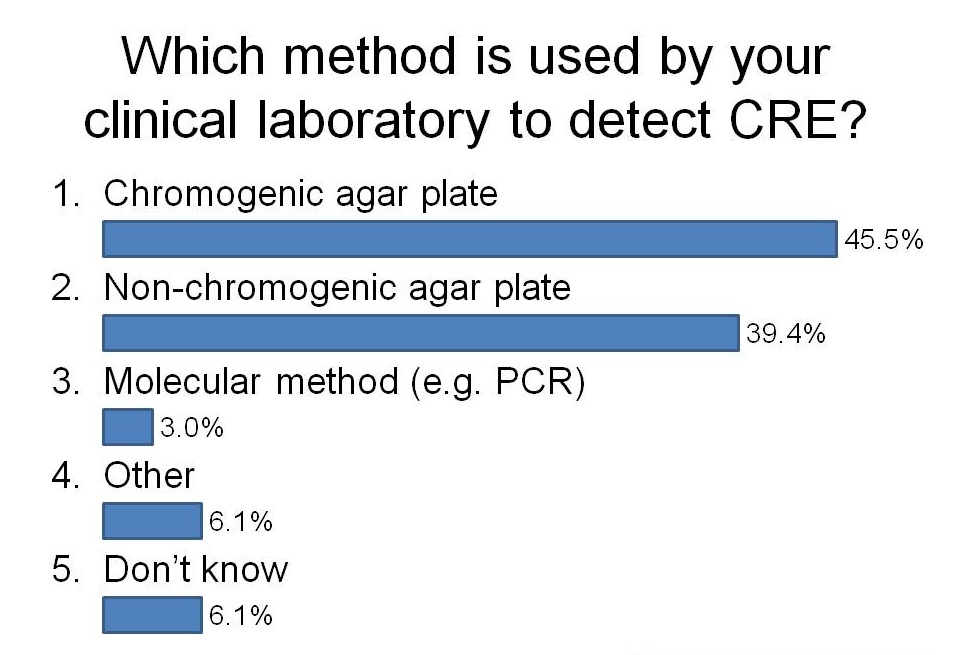
I had the opportunity to ask the audience how they were detecting CRE in their diagnostic clinical labs during a talk last week. It was an audience of around 50 laboratory and clinical folk, mainly from the UK but a few from continental Europe. And here’s what I found:

CRE diagnosis which method

I was a little surprised that more labs have switched to using chromogeneic agar plates than use non-chorogeneic agar plates. In the case of our lab in London, we are currently using non-chromogenic media for clinical samples, but in the process of evaluating chromogenic media. Although the purchase costs of chromogenic media are higher, they are more sensitive and substantially reduce the amount of time required to confirm a negative or positive culture, so I suspect they actually work out cheaper when you factor in labour costs.

I was not surprised that so few labs are using PCR. The costs are considerably higher but turnaround time is faster and they are more sensitive. There are now a number of PCRs on the market for the detect of CRE direct from rectal swabs (e.g. Checkpoints and Cepheid). We are currently in the process of evaluating the Checkpoints assay and after sharing our preliminary data, this was the feeling in the room about using PCR to detect CRE:

CRE diagnosis_PCR

I think I’ll leave it there for now…

Diagnosis of CRE: time to throw away those agar plates?

CRE are an emerging threat to healthcare systems worldwide. Most guidelines recommend screening and isolation of carriers. But relying on conventional agar-based culture presents a dual threat of poor sensitivity (depending on which method is used) and slow turnaround time, with a minimum overnight incubation before a presumptive positive result. PCR solves both of these problems – but at a cost. I gave a talk today at a BD seminar considering whether it’s time to switch to PCR diagnostics for the detection of CRE. You can download my slides here. (The title of the talk “Time to throw away those agar plates” was inspired by a talk by Dr Dan Diekema at a recent SHEA conference.)

There are a number of options for CRE screening, summarized in the flow chart below:

Flow chart: Overview of laboratory methods for the diagnosis of CRE. (To be precise, throughout the blog I really mean CPE most of the time, but I’m using CRE for consistency with other blogs…)CPE diagnosis

Continue reading

The English MRSA Miracle

If, in 2004, I’d told an MRSA expert that there would be around only 200 MRSA bloodstream infections (BSI) per quarter in England throughout 2014 they’d have laughed out loud. This is because, back in 2004, there were sometimes more than 100 MRSA BSI per month in some London hospitals (and around 2000 per quarter nationally), combined with a general perception that only around 30% of MRSA BSI are preventable. How wrong we were.

The reduction of MRSA BSI in England has been dramatic, with a reduction in the region of 90% achieved over a 5 year period. I was asked to speak on “The English MRSA Miracle” at a conference in Portugal today, so thought I’d share my thoughts. You can download my slides here.

It’s difficult to pin down exactly what is behind the ‘MRSA Miracle’ since quite a number of interventions occurred at more or less the same time (Figure 1):

Figure 1: National interventions aimed at reducing MRSA BSI.mrsa bacteraemia whats made the differecnce

Some have postulated that the national cleanyourhands campaign is responsible for the dramatic success. Indeed, there is a BMJ study that makes this case, showing that the national significant increase in the use of soap and water and alcohol gel correlated with the reduction in MRSA BSI. However, I contend that this can’t be the case because what has happened to the rate of MSSA and E. coli BSI over the same period? Nothing – no reduction whatsoever. If increases in hand hygiene compliance really do explain the reduction in MRSA BSI, then they should also reduce the rate of MSSA BSI (unless the increase in hand hygiene compliance only occurred after caring for MRSA patients, which seems unlikely).

There’s a more important epidemiological point here though. High-school tells us to change one variable at a time in science experiments. And yet in this case multiple variables were modified, so it’s not good science to try to pin the reduction to a single intervention, no matter how strong the correlation. (I should add that the authors of the BMJ study do qualify their findings to a degree: ‘National interventions for infection control undertaken in the context of a high profile political drive can reduce selected healthcare associated infections.’)

There has been much discussion about whether we should be investing in a universal or targeted approach to infection control. The failure of improved hand hygiene to make any impact on MSSA BSI suggests that targeted interventions are behind the reduction in MRSA. So what targeted interventions were implemented that may have contributed to the decline? MRSA reduction targets were introduced in 2004, a series of ‘high-impact interventions’ focused mainly on good line care in 2006 and revised national guidelines in 2006 (including targeted screening, isolation and decolonization) all contributed to a surge of interested infection control. Infection control teams doubled in size. Infection control training became part of mandatory induction programmes. And hospital chief executives began personally telephoning infection control to check “how many MRSA BSIs” they had left.

The ‘English MRSA Miracle’ has not been matched in most parts of Europe, except in France, which has had a rather more steady ‘MRSA Miracle’ of its own (Figure 2).

Figure 2: Rate of methicillin-resistance in invasive S. aureus infections, from EARS-Net.MRSA europe rates 
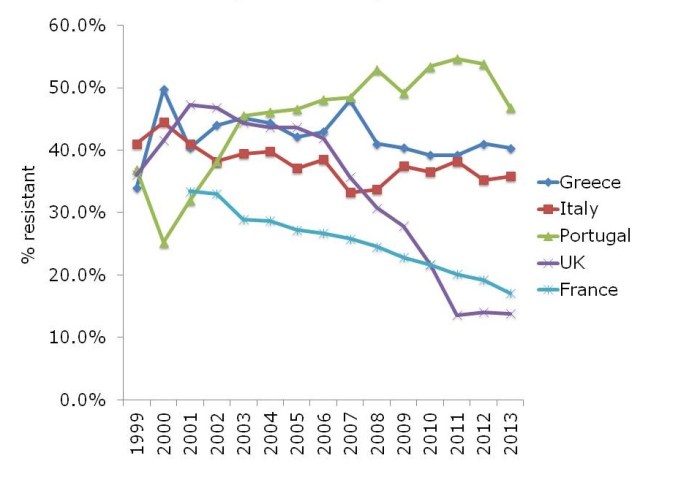
What is behind the failure of most European countries in controlling MRSA? The barriers are multifactorial, but include high levels of antibiotic use, a lack of single rooms for isolating patients, infection control staffing, and, of course, crippling national debt (Figure 3).

Figure 3: Barriers to infection prevention and control in Europe.barriers to IC Europe

If the English MRSA Miracle is to be replicated across Europe, it will take concerted national initiatives to raise the profile of infection control, combined with considerable investment, which is challenging in these times of austerity.
Journal Roundup: Ebola, antibiotic abuse, and the usual suspects

bacterial spores

The latest edition of Journal Roundup is now available on the Journal of Hospital Infection website, freely accessible here.

Some highlights:

Journal Roundup is changing! As a result of feedback received from six months of Journal Roundup, I’ve decided to change the format to write a little more detail on fewer articles. This gives me a good opportunity to accept submissions from others to include in the Roundup. So, Journal Roundup is seeking submissions! If you read an article that you think should be included in the Journal Roundup, please submit a short critique (100 to 300 words) of the article as a comment below to be considered for inclusion in a future edition of the Roundup. I won’t publish the comment on this blog, but your contribution will be acknowledged, of course!

Let’s get those submissions rolling in!

Image: Bacterial spores.

Twitter for healthcare professionals: useful or a waste of time?

twitter

An unusual review has just been published by Clinical Infectious Diseases by Debra Goff, Ravina Kullar and Jason Newland entitled Review of Twitter for Infectious Diseases Clinicians: Useful or a Waste of Time?”. As a keen reader of the journal, and a keen Twitter user, I found the article to be a fascinating read.

The authors make a strong argument that Twitter is a better fit with our “always on” culture than traditional forms of communication: and cite the fact that ‘UpToDate’ has pretty much replaced textbooks. However, I was interested to read that around 1.5% of all Twitter users are healthcare professionals (75,000 / 5,000,000). Does this mean that healthcare professionals are underrepresented on Twitter, since around 6% of the UK workforce work in the healthcare sector (1.4 m / 23 m)?

One interesting section addresses the accuracy of data on Twitter, which you’d expect to be somewhat flaky. However, an interesting analysis of tweets related to the H1H1 swine flu outbreak identified a surprising degree of accuracy. For example, 90% of the tweets contained a reference to source information where considered necessary, and <5% of tweets were classified as misinformation / speculation.

The article serves as a “how-to” guide, with a basic overview of what Twitter is and how it works. There’s also a useful list of people and organizations to follow to get you started (including ‘lil old me, I’m delighted to say)! The table of ‘Twitter Terminology’ is especially useful: this would have been a much-used resource for me if available when I started out on Twitter and didn’t know my retweet from my favorite!

From a personal viewpoint, I was pretty resistant to the idea of Twitter. How did I feel about putting myself ‘out there’ is such a public space? I have to admit though, my experience of Twitter for professional use has been unanimously positive:

  • It’s a very personalized newsfeed – I pick up on a lot of useful new data.
  • I’ve not had any ‘trolling’ whatsoever. Yes, some challenging, frank discussions. But nothing nasty.
  • I try hard to fit Twitter into my schedule and not let it take over my life. My general rule is that what goes out on Twitter is what I do anyway – so it’s pretty much time-neutral. In reality, it’s not quite time-neutral, but it’s pretty close.
  • It goes hand in hand with this blog. Sometimes 140 characters just won’t do – and that’s where this blog comes in!
  • I’ve made some really useful new contacts (not least Debbie Goff and Jason Newland, two of the review’s authors).
  • Live-tweeting conferences is a lot of fun; it has added a lot of value to my conference experience, and has served as notes for more comprehensive reports. (My conference experience has been enhanced further by Symplur Healthcare Hashtags analytics, which is also mentioned in the review.)

So, ‘Twitter for healthcare professionals: useful or a waste of time?’ It’s unrealistic to expect Twitter use to be completely time-neutral, but I do think that you can get close to that and add a new dimension to your worklife.

Image: Charis Tsevis.

What’s lurking in the NYC subway? “City-scale metagenomics” brings unprecedented resolution

pathomap

A remarkable study published last week in Cell Systems has described the ‘environmentome’ of the subway system in NYC. The study has attracted a fair bit of attention in the mainstream press, not least due to claims of Bubonic Plague and Anthrax lurking in the NYC subway system (more on this later)…

The authors took a ‘microbiomic’ approach to characterize the DNA found on surfaces, similar in concept to the Hospital Microbiome Project. Since the collection of microbes in and on our bodies outnumbers our own cells by 10:1, and accounts for up to a third of active molecules in the bloodstream, this sort of approach to microbiology is going to become more and more common.

The study is mind-blowing in many ways, with 1457 samples collected from subways, public parks and alongside a canal. The headline findings are:

  • DNA from pathogens (including Yesinia pestis and B. anthracis and some antibiotic resistant bacteria) were found on some surfaces.
  • Human DNA identified in subway stations mirrors the demographics of the local region.
  • The microbiome of surface in a station is far from stable: hourly sampling over a single day at Penn Station (a busy rail hub) identified considerable ebb and flow in predominant bacterial species.

I have a lingering concern that the techniques available for bioinformatic analysis have not yet caught up with our ability to sequence vast amounts of DNA. Put another way, the identification of bacteria in metagenomic samples is a surpassingly and rather unnervingly approximate science.

In order to identify bacteria in the sample, very many short reads of DNA are produced and then compared with databases. (This results in particular difficulty in distinguishing plasmid from genomic DNA, the subject of a recent post.) Almost half of the DNA identified in the study from New York did not match any known sequences. Furthermore, some of the species identified seem rather unlikely. For example, two of the most common Eukaryotic DNA species identified were the Mountain Pine Beetle and Mediterranean Fruit flies. Now, I’ve spent many-a-weekend in NYC from my time living in Connecticut, and I’ve never seen a Mountain Pine Beetle down there. So, this seems almost certain to be a mis-match with a closely related species due to imperfect databases. And yet when it comes to Y. pestis and B. anthracis, the authors seem more certain that the matches are correct, unlikely as they seem. (There is an acknowledgement in the discussion that these apparent “best hits” may be erroneous.)

Another key limitation is the degree of viability associated with the DNA identified. It could be that much of the DNA is a shadow of ancient contamination that is no longer viable. Whilst the authors did do a small amount of conventional sampling, and did grow some antibiotic resistant bacteria, there is no real sense of how much of the DNA identified is from viable microbes.

Quite a few years ago, I took some similar samples from buses and tube trains in London, and found no MRSA whatsoever and only a few sites grew S. aureus. It would be fascinating to see how a metagenomic analysis of these samples would look. Would there be a vastly different ‘environmentome’ in the London Underground compared with the NYC subway? Probably, but I suspect you wouldn’t find many Mountain Pine Beetles, Y. pestis or B. anthracis in either!

One of the best parts of the study is the accompanying website, which provides an interactive overview of the ‘environmentome’ of NYC: pathomap.org. Related to this, an interesting future application of these data is to derive a persons’ recent or ancient geographical location based on their current microbiome. Criminals beware – analysis of the ‘environmentome’ on the sole of your foot could invalidate your alibi!

The authors should be credited for describing the microbial ecology of the NYC subway in unprecedented detail – and this study will serve as a marker in the sand for future approaches to exploring where we fit into our inanimate environment.