CRE – too weak to spread!?

superbug

(Photo: thinkprogress.org)

In the May issue of ICHE, Weber et al. published their findings of a study looking at the environmental contamination of rooms occupied  by patients colonized or infected with CRE. In addition to their observations they actively inoculated test surfaces with 102 CRE (which I find rather low). They found that the contamination in the patients’ room was infrequent (8.4%) and at low levels (5.1 CFU/120cm2). With the single exception of K. pneumoniae on formica, alle CRE had a less than 15% survival at 24 hours and a 0% survival after 72 hours.

Should we just conclude that the chance of CRE transmission from the environment is very low?

I believe that this conclusion would be too early and probably wrong. The survival of micro-organisms in the environment is clearly strain dependent and while the authors used clinical isolates they did not mention if they included a strain that has proven its ability to spread (eg. outbreak isolates). In general multi-resistant bacteria may loose some of their fitness – including the ability to survive in the environment – but survival studies like those of Kramer et al. show survival of multiple weeks for E. coli and Klebsiella spp.

Continue reading

European approaches to MDR-GNR prevention and control

HISME

I was privileged to be asked to speak at the inaugural Healthcare Infection Society Middle East Summit in Dubai this week on ‘European approaches to MDR-GNR prevention and control’. You can download my slides here.

I began with a (probably too lengthy) preamble outlining some overall points:

  • CRE is a big deal in Europe, especially in the UK, and has prompted unprecedented action on a national level in the form of a Toolkit, a Patient Safety Alert and a letter to all CEOs requesting (demanding?) an action plan. The political picture is similar elsewhere in Europe and in the USA. Although this level of government scrutiny can be challenging, on the whole I think it’s beneficial, and is probably a sizeable factor in the successes achieved with MRSA and CDI.
  • Do we go universal or targeted? There’s been much discussion recently about abandoning traditional targeted (aka vertical) approaches in favour of universal (aka horizontal). Interesting, all guidelines that I could lay my hands on favoured a targeted approach for MDR-GNR, centred around screening and isolation of carriers.
  • Where is the evidence? We are hamstrung by the lack of high quality studies telling us with any certainty what works to control MDR-GNR. Pretty much all studies to date are either performed in an outbreak setting (regression to the mean…) or include multiple interventions (which worked?), or both. The few studies that evaluated a single intervention in an endemic setting are underpowered to deliver a meaningful conclusion. So, we need bigger and better studies!
  • How do you produce good guidelines – who is on the guideline writing dream team, and what are the key pitfalls to avoid. Plus, importantly, how to good guidelines translate through a good policy into good practice?

Continue reading

Dispatches: Pan-drug-resistant doom – are we there yet?

Old_Testament_prophet-1

Guest blogger and Acute Medicine trainee Dr Nicola Fawcett (bio below) writes…As the local Prophet of Antibiotic Resistance Doomsday to our population of hospital physicians, I’m always interested in finding out if the pan-drug-resistant superbug has emerged that is going to wipe us all out, for credibility purposes if nothing else. (Resistance Is Coming! Prepare thyself! Wash thy hands and document thy indication and duration or face Everlasting audits and perpetual personal protective equipment!). For the record – I’m actually a Registrar in Acute and General (Internal) Medicine. I’m doing some time in the world of ID/Micro/Genomics in the hope that it will help me work out whether it’s ok to just hand out co-amoxifrusiclavamide + nebs to everyone if not sure what’s going on. However  this question seems rather inextricably linked to antibiotic resistance, and having spent some time now with people who seem to know what they’re doing,  I’m increasingly flabbergasted at the massive divide between the views of microbiologists who see the latest data, and the views of the common garden hospital physician. Therefore my side-mission, if you like, has become to spread the good, or rather, spectacularly bad news that antimicrobial resistance is currently spreading around our biosphere at a scale and speed at which we simply cannot react fast enough.

Continue reading

CRE: coming to a hospital near you

carbapenemase

I thought for quite some time about whether the title to this post ought to be a statement or a question. I decided on a statement: pretty much wherever you are in the world, I am certain that CRE is now one (hospital) degree of separation from you.

I gave this talk yesterday at the imaginatively named “Darling Bugs of May” IPS conference, and you can download my slides here. I’ve given similar talks before, but the whole thing took on greater significance now I have had some first hand experience of making decisions around the management of CRE patients.

Continue reading

Do you know your CRE from your CRAB?

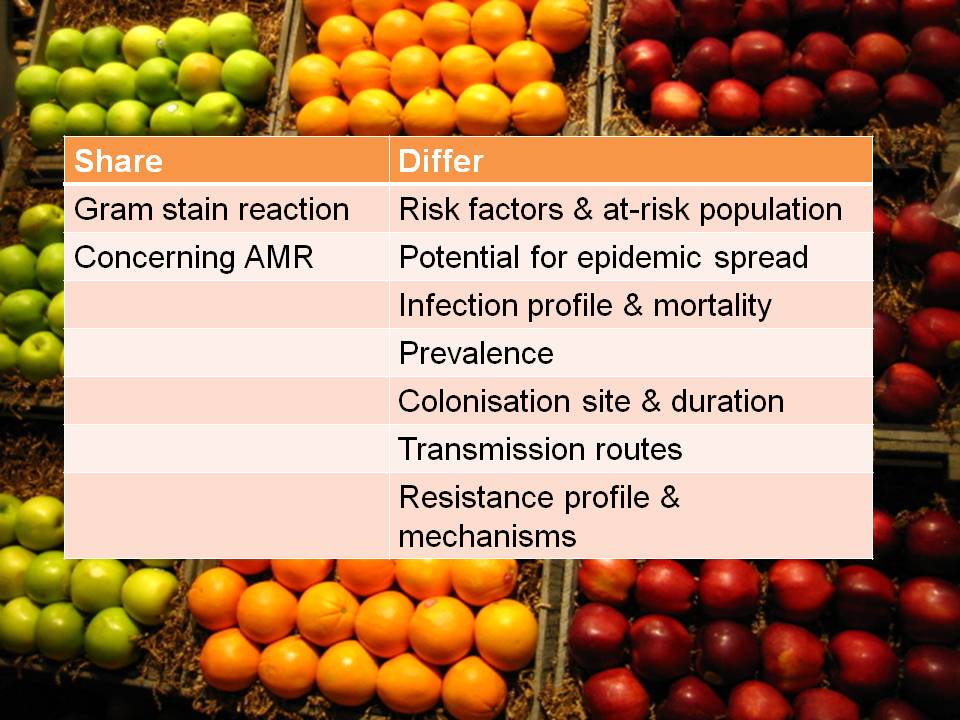
I gave a talk today at a meeting on combating carbapenem-resistant organisms. My angle was to clearly differentiate the epidemiology of the Enterobacteriaceae (i.e. CRE) from the non-fermenters (most importantly carbapenem-resistant A. baumannii – CRAB), and you can download my slides here.

I’ve blogged before about how confusing the terminology surrounding multidrug-resistant Gram-negative rods has become. Non-expert healthcare workers have little chance in distinguishing CRE from CPE from CRO from CPO. So we need to help them by developing some clear terminology, given the gulf in epidemiology between CRE and CRAB (see below).

CRE and CRAB are like apples and pears: they share some basic microbiology but that’s about where the comparison ends!CRE CRAB

So, I think we should talk in terms of CRE (and CPE for confirmed carbapenemase carriers), and CRNF (or CRAB for A. baumannii and CRPA for P. aeruginosa). I don’t think that CRO is a useful term – in fact, I find it rather confusing. Carbapenem resistance in Enterobacteriaceae (CRE) and A. baumannii (CRAB) are both emerging problems, but they are not the same problem.

Over the top and into the trenches

moving IIAfter 12 years working for Bioquell (and part-time at Guy’s and St. Thomas’ / King’s College London since commencing my PhD in 2005), it’s time for me to move onto pastures new. Next week I’ll start working in a leadership role in Infection Prevention and Control at Imperial College NHS Trust in London. It’s a very exciting move for me and I can’t wait to get going. I thought that now would be a good time to reflect on the water under the bridge of the last decade or so (and I hope you’ll forgive my self-indulgence).

Over the last decade, the rate of MRSA and C. difficile infection (CDI) in the UK have fallen dramatically.1,2 At the peak of the MRSA epidemic in the early 2000s, there were more than 2000 MRSA bloodstream infections per quarter in England; now there are 10-fold less.2 It’s not certain how this has been achieved, but a combination of factors, including increased governmental focus, are likely responsible. Whilst MRSA is now rare in the UK this is not the case in other European countries and in many other parts of the world, where MRSA remains common.3

In recent years, a new and more troublesome bacterial threat has emerged: carbapenem-resistant Enterobacteriaceae (CRE).4 CRE present the “triple threat” of high levels of antibiotic resistance (including pan-drug resistant strains against which no antibiotics are left), severe clinical consequences (around half of patients with a CRE bloodstream infection will die), and the potential for rapid regional and national spread (illustrated by national outbreaks in Italy, Greece and Israel).4-6 CRE have been described as “nightmare bacteria” by the US CDC and have prompted unprecedented action from CDC, Public Health England (PHE) and other public health agencies, including a national Patient Safety Alert and a letter to all hospital Chief Executives in the UK to ensure that new CRE guidelines are implemented.7,8

Continue reading

CRE diagnosis: current status

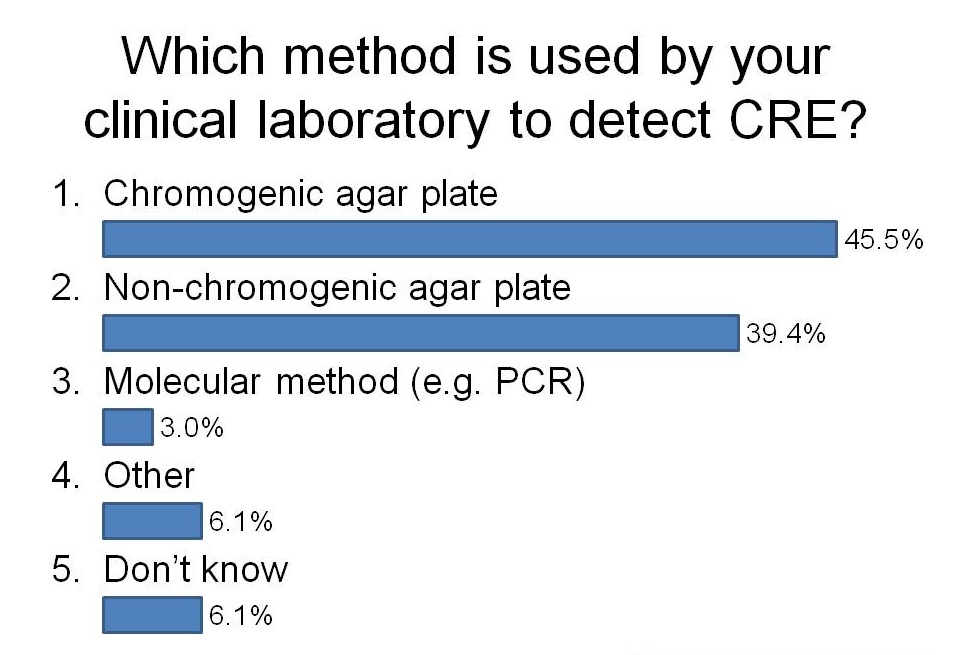
I had the opportunity to ask the audience how they were detecting CRE in their diagnostic clinical labs during a talk last week. It was an audience of around 50 laboratory and clinical folk, mainly from the UK but a few from continental Europe. And here’s what I found:

CRE diagnosis which method

I was a little surprised that more labs have switched to using chromogeneic agar plates than use non-chorogeneic agar plates. In the case of our lab in London, we are currently using non-chromogenic media for clinical samples, but in the process of evaluating chromogenic media. Although the purchase costs of chromogenic media are higher, they are more sensitive and substantially reduce the amount of time required to confirm a negative or positive culture, so I suspect they actually work out cheaper when you factor in labour costs.

I was not surprised that so few labs are using PCR. The costs are considerably higher but turnaround time is faster and they are more sensitive. There are now a number of PCRs on the market for the detect of CRE direct from rectal swabs (e.g. Checkpoints and Cepheid). We are currently in the process of evaluating the Checkpoints assay and after sharing our preliminary data, this was the feeling in the room about using PCR to detect CRE:

CRE diagnosis_PCR

I think I’ll leave it there for now…

Diagnosis of CRE: time to throw away those agar plates?

CRE are an emerging threat to healthcare systems worldwide. Most guidelines recommend screening and isolation of carriers. But relying on conventional agar-based culture presents a dual threat of poor sensitivity (depending on which method is used) and slow turnaround time, with a minimum overnight incubation before a presumptive positive result. PCR solves both of these problems – but at a cost. I gave a talk today at a BD seminar considering whether it’s time to switch to PCR diagnostics for the detection of CRE. You can download my slides here. (The title of the talk “Time to throw away those agar plates” was inspired by a talk by Dr Dan Diekema at a recent SHEA conference.)

There are a number of options for CRE screening, summarized in the flow chart below:

Flow chart: Overview of laboratory methods for the diagnosis of CRE. (To be precise, throughout the blog I really mean CPE most of the time, but I’m using CRE for consistency with other blogs…)CPE diagnosis

Continue reading

Journal Roundup: Ebola, antibiotic abuse, and the usual suspects

bacterial spores

The latest edition of Journal Roundup is now available on the Journal of Hospital Infection website, freely accessible here.

Some highlights:

Journal Roundup is changing! As a result of feedback received from six months of Journal Roundup, I’ve decided to change the format to write a little more detail on fewer articles. This gives me a good opportunity to accept submissions from others to include in the Roundup. So, Journal Roundup is seeking submissions! If you read an article that you think should be included in the Journal Roundup, please submit a short critique (100 to 300 words) of the article as a comment below to be considered for inclusion in a future edition of the Roundup. I won’t publish the comment on this blog, but your contribution will be acknowledged, of course!

Let’s get those submissions rolling in!

Image: Bacterial spores.

We need new antibiotics for Gram-negative, not Gram-positive bacteria

gram stain pos and neg

The threat from antibiotic resistance is more pink than purple. You probably need to be a microbiologist to get this: Gram-positive bacteria (such as MRSA and C. difficile) stain purple in the Gram stain, whereas Gram-negative bacteria (such as Klebsiella pneumoniae and Acinetobacter baumannii*) stain pink. All of the international concern surrounding antibiotic resistance from the WHO, CDC, PHE and others have focused our mind on one threat in particular: carbapenem-resistant Enterobacteriaceae (CRE). The Enterobacteriaceae family of bacteria are all Gram-negative, so we need to focus our drug discovery towards the Gram-negatives rather than the Gram-positives.

I blogged last week on the fanfare surrounding the discovery of Teixobactin. Whilst it looks promising, it’s still a long way from the pharmacy shelves, is most certainly not “resistance-proof” and, most importantly, only active against Gram-positive bacteria. I’ve received some useful comments in response to the blog pointing me in the direction of another novel antibiotic, Brilacidin.

Brilacidin is a novel antibiotic class that is in many ways more promising than Teixobactin, not least due to its activity against both Gram-positive and Gram-negative bacteria. Furthermore, it’s much closer to the pharmacy shelves, having undergone promising Phase 2b clinical trials (showing broadly comparable efficacy to daptomycin for the treatment of acute bacterial skin and skin structure infections).

Brilacidin is not without its problems though. Firstly, it is not active against A. baumannii. This is important, since multidrug-resistant – especially carbapenem-resistant – A. baumannii is a serious problem in ICUs around the world. Secondly, although the antibiotic is truly novel (working on the principle of ‘defensin-mimetics’), manufacturer claims that resistance is ‘unlikely’ are as fanciful as the “resistance-proof” claims associated with Teixobactin. Every class of antibiotics was novel once. And resistance has developed to them all!

There are some other emerging options for the antimicrobial therapy of multidrug-resistant Gram-negative bacteria. A number of beta-lactamase inhibitors combined with existing antibiotics are currently at various phases of the clinical trials process (for example, avibactam and MK-7655). Again though, although promising, beta-lactamase inhibitors have limitations, the most important being their specificity. For example, these inhibitors are effective against only some beta-lactamases (and have a blind spot for the metallo beta-lactamases such as NDM-1).

So, there is no silver bullet coming through the pipeline. And there will be no silver bullet. However clever we are in discovering or designing new antibiotics, some bacteria will always find a way to become resistant. It would be naive to think otherwise. Drug discovery is one part of our response to the rising threat of antibiotic resistance, but we ultimately need to focus on prevention over cure.

* Actually, A. baumannii is a bit “Gram-variable” so is somewhat pinky-purpley – but let’s not get too hung up on that. 

Image credit and caption: Marc Perkins. ‘Gram stain demonstration slide. A slide demonstrating the gram stain. On the slide are two species of bacteria, one of which is a gram positive coccus (Staphylococcus aureus, stained dark purple) and the other a gram-negative bacillus (Escherichia coli, stained pink). Seen at approximately 1,000x magnification.’