Isolation: the enemy of CRE

isolation enemy cre

Pat Cattini (Matron / Lead Specialist Nurse Infection Prevention and Control, Royal Brompton and Harefield NHS Foundation Trust) and I recently teamed up to present a webinar entitled: ‘Introduction to the identification and management of carbapenem-resistant Enterobacteriaceae (CRE)’. You can download our slides here, and here’s the recording:

The webinar covered the following ground:

  • Why the fuss?
  • What are CRE?
  • Who do we screen?
  • How do we screen?
  • What happens if someone is positive?
  • Key questions

CRE represent a combination of anitibiotic resistance, mortality and potential for rapid spread, so we need to be proactive in our approach to the detection and management of carriers. We simply can’t afford for CRE to become established in the same way that MRSA did, so now is the time of opportunity to develop the most effective prevention strategy. The recently published Public Health England Toolkit is useful, but it’s a set of tools to help construct a local policy, not a one-size-fits-all CRE policy. We hope that this webinar will assit you in developing your local CRE policies and plans.

Oh, and look out for the Premiere of ‘ISOLATION: THE ENEMY OF CRE’ (a Pat Cattini film)…

My close shave with viral haemorrhagic fever (VHF)

ebolaAs the outbreak of Ebola continues unabated in Sierra Leone and Liberia (1323 cases and 729 deaths as of July 27), I thought it would be an opportune moment to share a close shave that I had with the closely related Lassa viral haemorrhagic fever (VHF) virus in 2009.

A patient was transferred from Mali to a London hospital with a diagnosis of malaria. The case was initially thought to represent a low risk of VHF (to be fair, Lassa had never been reported in Mali, and the patient came with a diagnosis of malaria). This led to the potential exposure of 123 healthcare workers and visitors, and a busy week for the infection prevention and control team to follow each of these individuals. The useful risk assessment now available from Public Health England may have helped to reduce the number of people exposed.

The patient died in a negative pressure ICU room on the day of admission. At that time, there were no clear recommendations about how to decontaminate the room, so I was involved in developing a decontamination plan with the hospital. Due to the rarity of VHF in the UK, the plan took a week to be authorized by the Health and Safety Executive. This meant that by the time it came to decontaminating the room, the bags of blood-soaked clinical waste, spots of blood on the bed, and used consumables on the floor had been festering for a week. Not ideal.

Our decontamination plan included the use of hydrogen peroxide vapour (HPV) for terminal room disinfection due to the risk that VHF viruses can survive when protected by blood for several weeks on surfaces. This is borne out by some sampling during an outbreak that found intact RNA from the Ebola virus on blood contaminated fomites (although not on fomites that were not contaminated with blood). It’s reassuring that the Department of Health / Health and Safety Executive guidelines published a few years after this case also recommend the use of fumigation for terminal decontamination of hospital rooms.

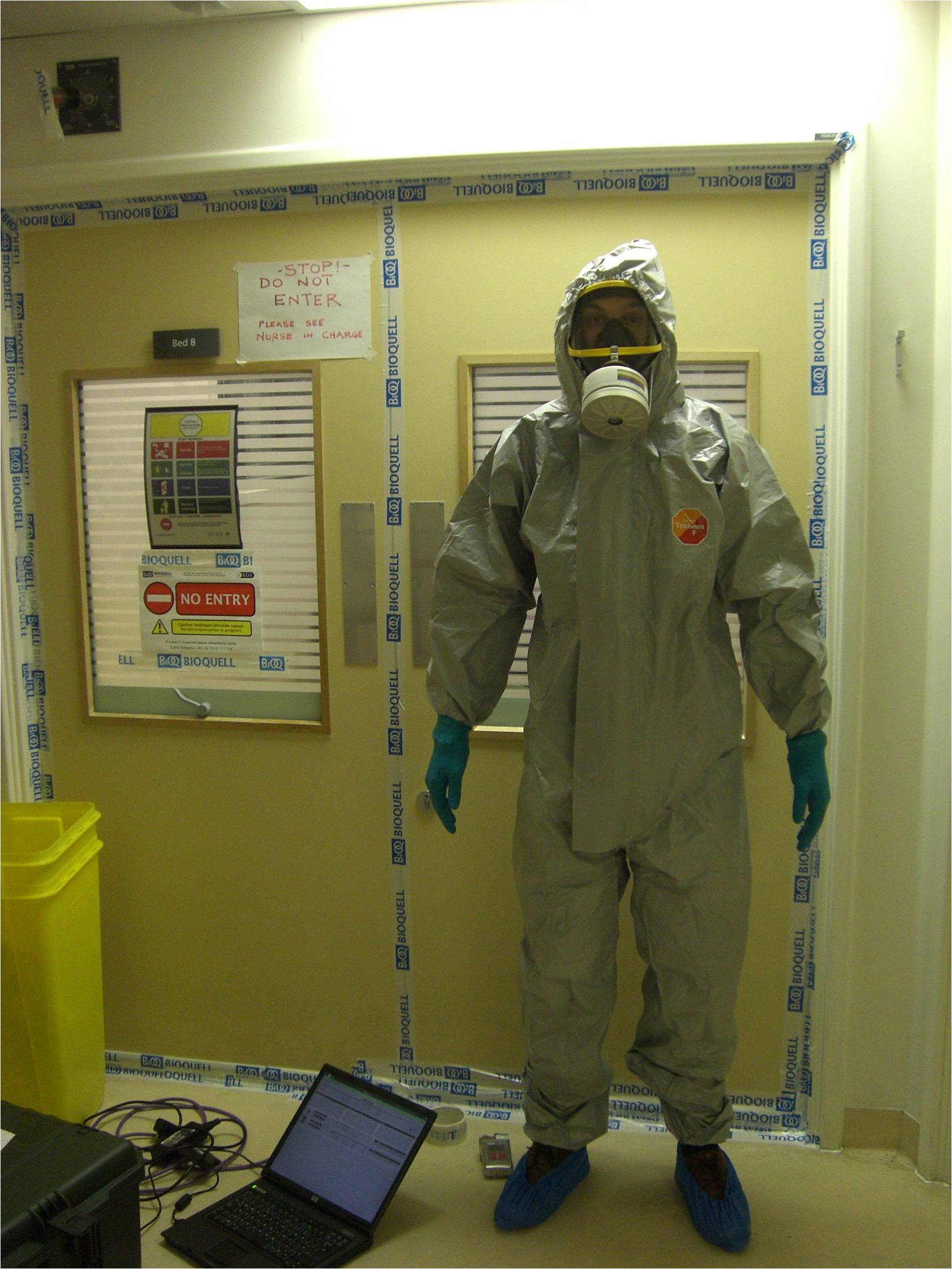
I ended up being tasked with setting up the HPV equipment that was used to decontaminate the room. We decided it would be better to clean the room after the decontamination to provide some protection to the cleaners. This meant that I was the first person to enter the room after the body of the patient had been removed. I will never forget donning my Tyvek suit, gloves and face-fitted FFP3 mask (see below!). It was exciting: I felt a lot like Dustin Hoffman in Outbreak (the movie that got me interested in medical microbiology in the first place). But it was also frightening. The most frightening part was collecting the bags of clinical waste and consumables from the floor, knowing that they were still likely harbouring live Lassa fever virus. To think that one slip could have infected me with a deadly virus for which there is no treatment…

Lassa PPE me

Figure: Me kitted out in PPE (and looking somewhat apprehensive)

There is legitimate concern that we may see cases of Ebola in the UK and USA in this globalized, interconnected world. If so, then we need to be prepared, and some have questioned our state of readiness. We are fortunate to have comprehensive guidelines from the Department of Health / Health and Safety Executive, including clear guidance on how to decontaminate a room following a case of VHF.

My close shave with VHF has given me a great deal of respect and, frankly, veneration for the brave healthcare workers who are risking their lives on the front line in bringing the current outbreak of Ebola under control.

Photo: Ebola courtesy of Phil Moyer and CDC/Cynthia Goldsmith.

Preventing HCAI: go long or go wide?

quarterbackThere seems to be a general movement away from targeted, pathogen-based precautions (principally screening and isolation) in the USA. This changing professional opinion was clear from the recent SHEA conference, where several leading experts gave what amounted to a collective justification for abandoning contact precautions for MRSA.

The update of the SHEA Compendium of Strategies to Prevent Healthcare-Associated Infections in Acute Care Hospitals is accompanied by a commentary from a group of leading US figures titled ‘Approaches for preventing HCAI: Go long or go wide’. In the commentary, the authors weigh the evidence and opinion for so-called ‘vertical’ (aka targeted) vs. ‘horizontal’ (aka universal) interventions (Table).

go wide or longTable: Go long or go wide? Examples of targeted and universal interventions (adapted from Wenzel & Edmond, via Septimus et al.).

The commentary outlines the potential drawbacks of targeted approaches (such as fewer visits from healthcare workers and feelings of isolation), but doesn’t spend a lot of time discussing the potential drawbacks of universal approaches. For example, “isolation fatigue”, where a procedure loses its impact if it has to be applied to every patient. And then there’s the possibility of resistance when performing universal decolonization. This is particularly worrysome when using antibiotics, but could also be a problem when using biocides such as chlorhexidine.

I’m not ready to abandon pathogen-based targeted interventions just yet. Conceptually, it just does not make sense. If you have a patient with MRSA and a respiratory virus, chances are they will become a ‘super-spreader’. Those who favour universal approaches do make some provision for exceptional cases that really should be identified and isolated via a ‘syndromic’ approach to isolation: crudely, only isolate patients when they’re oozing. However, this syndromic approach would likely miss our ‘super-spreading’ patient, which may well result in an MRSA outbreak – that we could all do without.

Furthermore, if you have a patient who is colonized with CRE, are you brave enough to take no special precautions, as would be the case for a ‘universal only’ approach? The success of this strategy would depend on a high level of compliance with standard precautions such as hand hygiene and environmental cleaning and disinfection. Whilst sound in theory, this just doesn’t happen in the trenches; your facility is above average if your hand hygiene compliance rate is the right side of 40%. Whilst still not 100%, hand hygiene compliance is higher when patients are placed in isolation, most likely because there’s a stronger psychological trigger to comply with hand hygiene.

It’s important to note that targeted and universal approaches are by no means mutually exclusive. For example, on our ICU in London, we have been using universal chlorhexidine decolonization for a decade combined with targeted screening and isolation, and have seen a dramatic reduction in the spread of MRSA.

So, should we go long or go wide in the prevention of HCAI? The answer is both. We should optimize case for all patients, which means careful standard precations with liberal application of chlorhexidine and tight restriction of antibiotics. But we should also identify those with communicable pathogens and segregate them from others. In this regard, we have the weight of history on our side.

Image: Jeff Weese.

How to write a conference abstract…and beyond!

ACIPC

The Australasian College for Infection Prevention and Control (ACIPC) asked me to give a webinar on writing a conference abstract for an infection prevention and control conference. I thought it would be useful to share the slides (which you can download here), and let you know how it went.

So why bother submitting an abstract to a conference? It’s all about the big speakers on the big stage, right? Wrong. Submitted abstracts delivered through oral and poster presentation is the life blood of the science underpinning our infection prevention and control practice. There’s a useful PLOS blog along these lines here.

It can be pretty daunting to prepare an abstract for a conference if you’ve not done it before, or had a bad experience in the past. So the idea of the webinar was to provide a step-by-step guide to producing a winning conference abstract.

There are a number of hurdles to overecome to get your abstract accepted. You need to tick the ethics box, be transparent with conflicts of interest, decide on appropriate authorship before getting down to the abstract itself. Follow the ‘house rules’ of the conference carefully to avoid your abstract being rejected simply because it’s in the wrong format.

The title of your abstract is especially important; it will be all that many people will read (particularly if it’s bad). I’ve included some illustrations of titles that I think are good, and some that are not so good. The ones in the ‘not so good’ category are by no means bad: these are accepted abstracts from a scientific conference. It’s just that if the authors thought again about a creative, engaging, informative title, I think they’d come up with something difference. (I should add here, that my abstract titles tend to default to really dull because I’m not brave enough to do anything more creative, so who am I to talk!)

When it comes to writing the abstract itself, the following ‘Dos and Don’ts’ should help:

dos and donts

Once the abstract is accepted, it will be time to produce the poster or prepare the slides. Both posters and slides to illustrate talks should be just that – a visual illustration. For me, the text of the abstract should suffice for the text of the poster and, to a lesser degree, the slides. Save the dense text for the paper that should follow.

Finally, if you have any queries about an abstract for a conference, get in touch with the conference organisers. Behind the impersonal abstract submission site will be living, breathing human beings who would love to support you in disseminating your findings for the good of the community.

Journal Roundup July 2014

longitude

The July Journal Roundup is now available at the Journal of Hospital Infection website.

Topics this month include:

  • The Longitude Prize.
  • Randomized controlled trials of two novel glycopeptide antibiotics.
  • Developments in antimicrobial therapy, including several new approaches to augmenting the activity of existing agents.
  • Using chemicals for the prevention and treatment of skin wounds.
  • Updates on antibiotic cycling (which does seem to work afterall).
  • Commentary on ‘Mass Gatherings Medicine’.
  • Further updates to the SHEA Compendium.
  • Consideration of ‘horizontal’ (universal) vs. ‘vertical’ (targeted) strategies.
  • A randomized controlled trial on the effectiveness of issuing mobile phone reminders for HIV appointments.
  • A video surveillance study reporting a truly shocking level of hand hygiene compliance among anesthesiologists: 2.9%!
  • Reviews on colistin, rapid nucleic acid based diagnostics, and the hithertofore unrecognised importance of free living amoebae in some healthcare-associated infection.
  • And finally…what makes Twitter light up with antibiotic chat more than anything else?

Enjoy, and let me know if you have any questions or comments.

Should every body have a silver lining (inside and out)?

silver lining

sense about science

sense about science have asked me to meet one of their ‘Ask for Evidence’* requests about ‘Silver Shield’.

‘Silver Shield’ comes in two forms. A gel for topical application on wounds and an oral suspension. It seems that these two products are different formulations of the same biocide. It is true that silver has long been known to have antimicrobial properties, which is, of course, dose dependent. There’s a big difference in whether you apply the silver-containing gel to a wound versus drinking a silver-containing oral suspension in the hope of preventing or treating an infection.

There is some evidence that topical application of silver can help to disinfect wounds, which improves their healing. A number of well-designed randomised controlled studies have shown that silver containing dressings can help to improve wound healing. However, there is less evidence for gels (such as Silver Shield), and most literature is restricted to burns.

The real problem with claims around these products relate to the oral suspension. The audio recording on the website includes detailed dosing information for the oral suspension to prevent and treat MRSA wounds. There is no evidence to my knowledge in the peer-reviewed literature that ingesting an oral suspension of silver confers any health benefit for the prevention or treatment of MRSA or any other microbial infections. The product claims to be ‘non-toxic’ but there is some evidence of toxicity through ingesting silver suspensions in animal models.

The patent includes some laboratory (in vitro) data showing that silver inactivates a range of microbes, which is already known from other studies. It also references a number of case series of patients who took an oral suspension and recovered from various conditions. Details on these patients are scant, and there is no mention of a placebo control group, which is necessary to determine whether improvements were really due to the treatment or explained wholly or in part by the natural disease progression or a placebo effect. Indeed, the ‘case report’ for HIV betrays a frightening lack of understanding: to claim that a 5 day course of oral silver suspension can ‘resolve’ HIV is utterly scandalous:

‘Retrovirus Infection (HIV). The method comprises the step of administering a silver composition, comprising 5 to 40 ppm silver one to five times a day orally area until there was a response. One patient exhibiting HIV (human immunodeficiency virus) was treated with about 5 ml (approximately one teaspoon) of a composition of the present invention two times per day. The patient’s symptoms resolved within five days.’

As we come towards the end of antibiotics, we need to open our eyes to the potential of non-antibiotic treatments, and silver-based wound gels and dressings are a promising candidate. However, more evidence is required before widespread adoption of Silver Shield gel. As for taking an oral suspension of silver to prevent and treat microbial infections: this is likely to cause more harm than good and toxicity studies are required before considering testing this product on humans, let alone buying it online for £19.95!

*Sense about science ‘Ask for Evidence’ campaign:

ask for evidence

Every day, we hear claims about what is good for our health, bad for the environment, how to improve education, cut crime and treat disease. Some are based on reliable evidence and scientific rigor. Many are not. These claims can’t be regulated; every time one is debunked another pops up – like a game of whack-a-mole. So how can we make companies, politicians, commentators and official bodies accountable for the claims they make? If they want us to vote for them, believe them, or buy their products, then we should ask for evidence. Read about our Ask for Evidence campaign.

Image: ‘Silver lining’ by Bruce Turner.
Summer 2014 Update

summer 2014

It’s been another busy quarter on the blog, with some updates from ECCMID and APIC, the inaugural ‘Journal Roundup’ plus a few key studies.

Please keep your responses coming – and let me know if you’d like to contribute a guest blog!

Photo: ‘Summer’ by Matteo Angelino

ESCMID MDR-GNR guidelines

ESCMID experts recently released comprehensive guidelines for the control of MDR-GNR. Working with a limited evidence base, the experts managed to compile a coherent set of guidelines with graded recommendations. Given the important differences in the epidemiology of the various species and resistance patterns of MDR-GNR, this is really a 6-for-the-price-of-one set of guidelines, with separate recommendations for: ESBL-producing Enterobacteriaceae, MDR K. pneumoniae, MDR A. baumannnii, MDR P. aeruginosa, Burkholderia cepacia and Stenotrophmonas maltophilia.

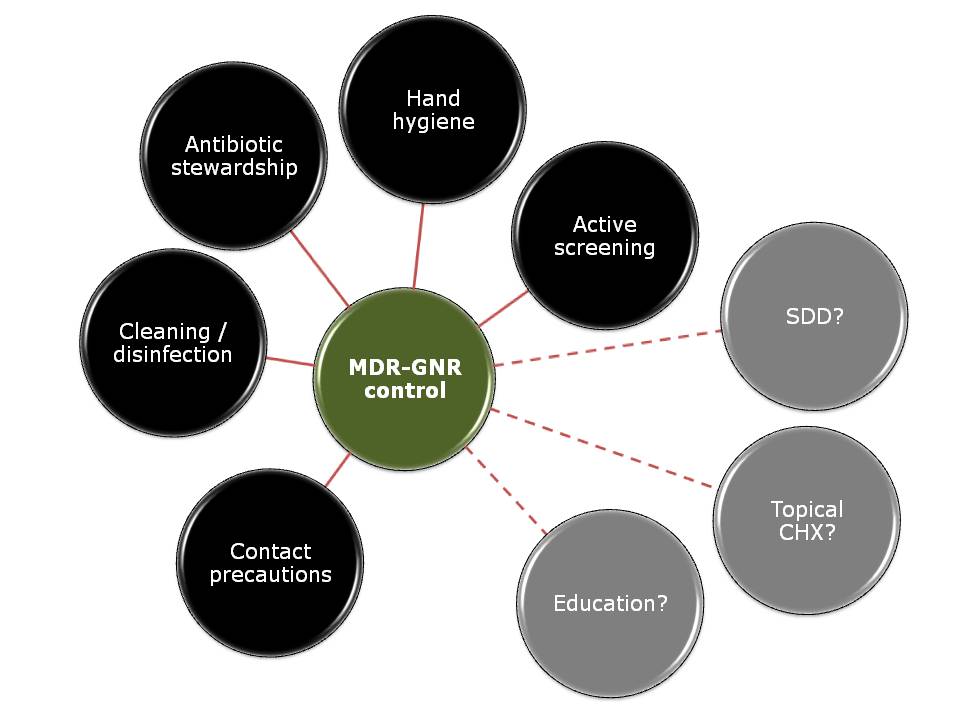
Five key interventions are identified: hand hygiene measures, active screening cultures, contact precautions, environmental cleaning, and antimicrobial stewardship. ‘Selective’ decontamination using antibiotics, topical ‘source control’ using chlorhexidine, and infrastructure / education are also reviewed. Which of these is most important? Most studies included multiple interventions simultaneously, so it’s difficult to tell and it will probably depend on species and setting.

MDR-GNR controlFigure: The cornerstones of MDR-GNR control (but we don’t have enough data to say which is most important, and which are redundant).

A few points for discussion:

  • We still don’t really know what works to control MDR-GNR. Reflecting on my recent blog on influenza transmission, where the relative importance of various transmission routes varies by context, this also seems likely for MDR-GNR. The relative importance of say, environment vs. hands, is likely to vary by setting for a given MDR-GNR species. This makes definitive guidelines difficult to write!
  • The guidelines begin with a useful review of the differing transmission routes for the various MDR-GNR species. This shows that person-to-person spread of Klebsiella species and some other Enterobacteriaceae (such as Enterobacter species and Serratia species) seems to be more important than for E. coli. The non-fermenters A. baumannii and P. aeruginosa have some fundamental differences with one another and with the Enterobacteriace in terms of transmission routes. If I had to rate the importance of patient-to-patient spread vs. other routes for the various MDR-GNR I would say A. baumannii > Klebsiella species > other Enterobacteriaceae > P. aeruginosa > E. coli. But don’t hold me to it!
  • It seems odd that all of the recommendations are ‘strong’ but the evidence is graded mainly as ‘moderate’, ‘low’ or ‘very low’. Perhaps more ‘conditional’ recommendations would be a better fit with the quality of the evidence?
  • The recommendations are stratified by organism-group and setting (endemic or outbreak), which is a workable approach. What you’d do in an outbreak does probably differ from what you’d do in an endemic setting.
  • There’s a useful recommendation for the identification of a new CRE case to prompt contact tracing and enhanced local surveillance, in line with PHE and CDC recommendations.
  • There’s a little fence sitting when it comes to a recommendation for active surveillance cultures in the endemic setting: ‘the implementation of ASC [active surveillance cultures] should be suggested only as an additional measure and not included in the basic measures to control the spread of MDR-GNB in the endemic setting.’ Still not clear whether this is a recommendation for or against ASC in the endemic setting!
  • I was surprised not to see a recommendation to use a disinfectant to help bring A. baumannii outbreaks under control. I appreciate that there is little evidence in endemic settings, but controlling the environmental reservoir does seem to be important in controlling A. baumannii outbreaks.
  • The remit of the guidelines is for adult patients, but what to do on neonatal units and in paediatrics?
  • The guidelines are restricted to hospitalized patients, but what about long-term acute care facilities (that are riddled with CRE in some parts of the world) and long-term care facilities (that have an unknown but probably sizable burden of resistance)?
  • The searches were restricted to MDR bacteria according to ECDC criteria, but what about all those literature on preventing the transmission of resistant (but not multiresistant) and sensitive GNR? If something works to control GNR, there’s no reason why it shouldn’t work to control MDR-GNR (except, perhaps, for antibiotic stewardship).
  • Finally, if all else fails (and only then), consider closing the ward!

In summary, these guidelines are very well written and will provide useful guidance for those on the front line try to deal with endemic and epidemic MDR-GNR. However, above all else, they highlight the need for high-quality studies telling us what works to control MDR-GNR.

Article citation: Tacconelli E, Cataldo MA, Dancer SJ et al. ESCMID guidelines for the management of the infection control measures to reduce transmission of multidrug-resistant Gram-negative bacteria in hospitalized patients. Clin Microbiol Infect 2014; 20 Suppl 1: 1-55.

Inaugural ‘Journal Roundup’ (June 2014)

JHI

I’ve been asked by the Editor of the Journal of Hospital Infection to begin writing a monthly column providing an overview of key updates in the infection prevention and control literature. I’m pleased to say that the first edition (June 2014) is now available on the Journal of Hospital Infection website, and I’m delighted that the Journal Roundup is open access.

I thought it would be useful to outline how I produced this roundup. I began by scanning the tables of contents of the following journals, pulling out articles of interest: AJIC, Ann Intern Med, BMJ, CID, ICHE, JAMA, JAMA Intern Med, JHI, JID, JIP, Lancet, Lancet ID, NEJM. This was easy for the “big five” (Lancet, BMJ, AIM, JAMA and NEJM) because only a handful of articles are directly relevant. It was more tricky for the specialist journals, since all articles are likely to be of interest. I’ve tried to avoid focusing solely on my own research interests, but these doubtless come through. One way to mitigate this in future is for others to provide a Journal Roundup now and then – or at least make some contribution. If you’re interested in this, please do let me know.

Highlights of this inaugural issue include a spike in MERS-CoV cases, coverage of the WHO report on antimicrobial resistance, more evidence that faecal microbiota transplantation works for curing recurrent CDI, the impact of nursing education on patient mortality, individualized antibiotic dosing, CA-MRSA in US Fire Stations, a successful community-based hand hygiene intervention, an outbreak of CRE in Ireland, updated SHEA guidelines for SSI and CDI, the identification of ‘optimum outlier’ (aka ‘positive deviant’) cleaners, a disturbing patient story, an update on the move towards ‘bare below the elbow’ in the US, an overview of the regulatory environment for healthcare apps, conference abstracts from APIC and ECCMID, and the use of Yelp (a customer review website) to identify cases that would otherwise have gone unreported during a foodborne outbreak.

Please feel free to share this with your colleagues, and let me know if you have any thoughts or comments.


What works to control antibiotic-resistant bacteria in the ICU? A two-for-the-price-of-one study

Not content with a single well-planned study to provide information on what works to control multidrug-resistant organisms (MDROs) in the ICU, the MOSAR study group published an interrupted time series and a cluster randomized trial of various interventions in the Lancet ID. This makes the study rather complex to read and follow, but there are a number of important findings.

Interrupted time series – ‘hygiene’ intervention (chlorhexidine and hand hygiene)

Following a 6-month pre-intervention period, a 6-month interrupted time series of a ‘hygiene’ intervention (universal chlorhexidine bathing combined with hand-hygiene improvement) was performed. The key outcomes were twofold: whether there was a change in trend during each phase, and whether there was a step-change between the phases. The hygiene intervention effected a trend change reduction in all MDROs combined and MRSA individually, but not in VRE or ESBLs (Table). However, there was no step-change compared with the baseline period.

Table: Summary of reduced acquisition of all MDROs combined, or MRSA, VRE and ESBLs individually.

Derde table

Cluster RCT – screening and isolation

In the 12-month cluster RCT of screening and isolation, the 13 ICUs in 8 European countries were randomized to either rapid screening (PCR for MRSA and VRE plus chromogenic media for ESBL-Enterobacteriaceae) or conventional screening (chromogenic media for MRSA and VRE only). When analysed together, the introduction of rapid or conventional screening was not associated with a trend or step-change reduction in the acquisition of MDROs (Table).  In fact, there was an increase in the trend of MRSA acquisition. When comparing rapid with conventional screening, rapid screening was associated with a step-change increase in all MDROs and ESBLs.

Discussion

  • The study suggests, prima facie, not to bother with screening and isolation. Indeed, the authors conclude: “In the context of a sustained high level of compliance to hand hygiene and chlorhexidine bathing, screening and isolation of carriers do not reduce acquisition rates of multidrug-resistant bacteria, whether or not screening is done with rapid testing or conventional testing”. However, the major limitation here is that many of the ICUs were already doing screening and isolation during the baseline and hygiene intervention phases! I checked the manuscript carefully (including the supplemental material) to determine exactly how many units were, but it is not disclosed. To make this conclusion, surely the cluster RCT should have been ‘no screening and isolation’ vs. ‘screening and isolation’.
  • The increasing trend of MRSA associated with screening and isolation by either method, and step-change increases in all MDROs and ESBLs associated with rapid screening are difficult to interpret. Is an increase in acquisition due to screening and isolation plausible? Can more rapid detection of carriers really increase transmission (the turnaround time was 24 hours for rapid screening, and 48 hours for chromogenic screening)? The rapid screening arm also included chromogenic screening for ESBLs, whereas the conventional screening arm did not, so perhaps this apparent increase in acquisition is due to improved case ascertainment somehow?
  • Looking at the supplemental material, a single hospital seemed to contribute the majority of MRSA, with an increasing trend in the baseline period, and a sharp decrease during the hygiene intervention. There’s a suspicion, therefore, that an outbreak in a single ICU influenced the whole study in terms of MRSA. Similarly, a single hospital had a sharp increase in the ESBL rate throughout the screening intervention period, which may explain, to a degree, the increasing trend of ESBL in the rapid screening arm.
  • There was an evaluation of length of stay throughout the study phases, with a significant decrease during the hygiene intervention (26%), a significant increase during the rapid screening intervention, and no significant change during the conventional screening intervention. It seems likely that improved sensitivity of rapid screening identified more colonized patients who are more difficult to step down, resulting in an overall increase in length of stay.
  • The carriage of qacA and qacB was compared in the baseline and hygiene intervention phase, finding no difference in carriage rate (around 10% for both). This does not match our experience in London, where carriage rates of qacA increased when we introduced universal chlorhexidine bathing. However, this was restricted to a single clone; the acquisition of genes associated with reduced susceptibility to chlorhexidine seems to be clone-specific.
  • ICUs varied from open plan to 100% single rooms. Whilst the average proportion of patients in single rooms (15-22%) exceeded the average requirement of patients requiring isolation (around 10%), there was no measure of unit-level variation of single room usage. Since the study was analysed by cluster, the lack of single rooms on some units could have been more important than would appear from looking at the overall average. Put another way, a 100% open plan unit would have been forced to isolate all carriers on the open bay, and vice versa for a 100% single room unit.
  • The impact of the various interventions was moderate, even though a ‘high’ MRDO rate was necessary for enrollment (MRSA bacteraemia rate >10%, VRE bacteraemia rate >5%, or ESBL bacteraemia rate >10%). Would the impact of screening and isolation be different on a unit with a lower rate of MDROs? It’s difficult to tell.
  • Some of the microbiology is quite interesting: 8% of MRSA were not MRSA and 49% of VRE were not VRE! Also, 29% of the ESBLs were resistant to carbapenems (although it’s not clear how many of these were carbapenemase producers).

In summary, this is an excellent and ambitious study. The lack of impact on ESBL transmission in particular is disappointing, and may lead towards more frequent endogenous transmission for this group. The results do indicate screening and isolation did little to control MDRO transmission in units with improved hand hygiene combined with universal chlorhexidine. However, we need a ‘no screening and isolation’ vs. ‘screening and isolation’ cluster RCT before we ditch screening and isolation.

Article citation: Derde LP, Cooper BS, Goossens H et al. Interventions to reduce colonisation and transmission of antimicrobial-resistant bacteria in intensive care units: an interrupted time series study and cluster randomised trial. Lancet Infect Dis 2014; 14: 31-39.