Journal of Hospital Infection Special Edition on the 2014 Healthcare Infection Society (HIS) Conference

HIS_Web_Banner_Jpeg

JHI have published a Special Edition featuring write-up from the 2014 HIS Conference (you can see my reflections from HIS here).

I’m all for special editions, and I think that JHI should do more of them. I know that compiling this Special Edition has been a considerable undertaking for the Journal, but well worth the effort: it’s a very useful read. Particular thanks to Dr Mark Walker who was the editor for this Special Edition, and to Dr Jenny Child who initiated it.

Over the top and into the trenches

moving IIAfter 12 years working for Bioquell (and part-time at Guy’s and St. Thomas’ / King’s College London since commencing my PhD in 2005), it’s time for me to move onto pastures new. Next week I’ll start working in a leadership role in Infection Prevention and Control at Imperial College NHS Trust in London. It’s a very exciting move for me and I can’t wait to get going. I thought that now would be a good time to reflect on the water under the bridge of the last decade or so (and I hope you’ll forgive my self-indulgence).

Over the last decade, the rate of MRSA and C. difficile infection (CDI) in the UK have fallen dramatically.1,2 At the peak of the MRSA epidemic in the early 2000s, there were more than 2000 MRSA bloodstream infections per quarter in England; now there are 10-fold less.2 It’s not certain how this has been achieved, but a combination of factors, including increased governmental focus, are likely responsible. Whilst MRSA is now rare in the UK this is not the case in other European countries and in many other parts of the world, where MRSA remains common.3

In recent years, a new and more troublesome bacterial threat has emerged: carbapenem-resistant Enterobacteriaceae (CRE).4 CRE present the “triple threat” of high levels of antibiotic resistance (including pan-drug resistant strains against which no antibiotics are left), severe clinical consequences (around half of patients with a CRE bloodstream infection will die), and the potential for rapid regional and national spread (illustrated by national outbreaks in Italy, Greece and Israel).4-6 CRE have been described as “nightmare bacteria” by the US CDC and have prompted unprecedented action from CDC, Public Health England (PHE) and other public health agencies, including a national Patient Safety Alert and a letter to all hospital Chief Executives in the UK to ensure that new CRE guidelines are implemented.7,8

Continue reading

CRE diagnosis: current status

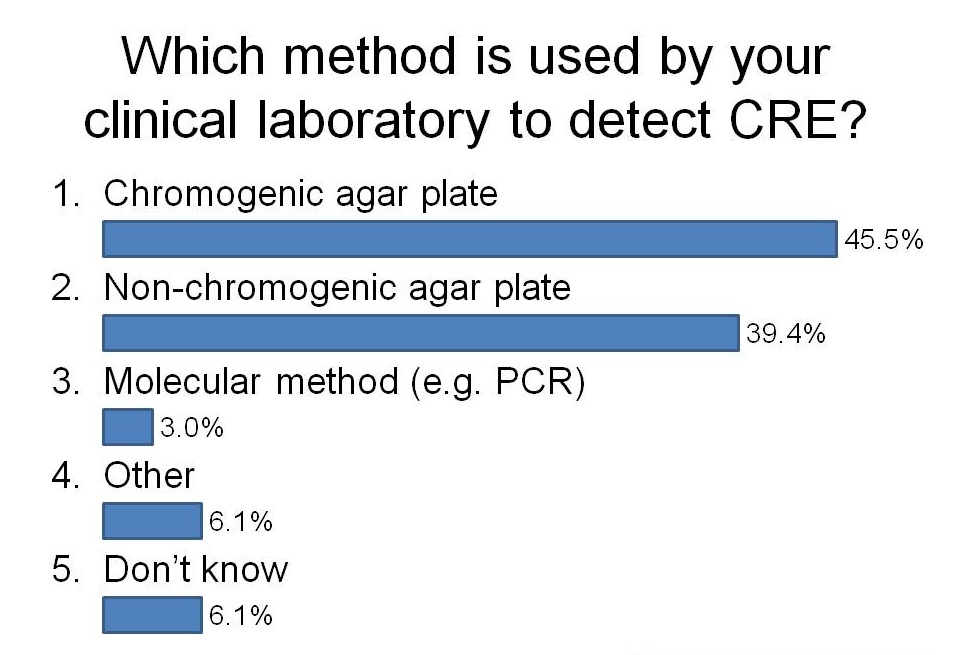
I had the opportunity to ask the audience how they were detecting CRE in their diagnostic clinical labs during a talk last week. It was an audience of around 50 laboratory and clinical folk, mainly from the UK but a few from continental Europe. And here’s what I found:

CRE diagnosis which method

I was a little surprised that more labs have switched to using chromogeneic agar plates than use non-chorogeneic agar plates. In the case of our lab in London, we are currently using non-chromogenic media for clinical samples, but in the process of evaluating chromogenic media. Although the purchase costs of chromogenic media are higher, they are more sensitive and substantially reduce the amount of time required to confirm a negative or positive culture, so I suspect they actually work out cheaper when you factor in labour costs.

I was not surprised that so few labs are using PCR. The costs are considerably higher but turnaround time is faster and they are more sensitive. There are now a number of PCRs on the market for the detect of CRE direct from rectal swabs (e.g. Checkpoints and Cepheid). We are currently in the process of evaluating the Checkpoints assay and after sharing our preliminary data, this was the feeling in the room about using PCR to detect CRE:

CRE diagnosis_PCR

I think I’ll leave it there for now…

Diagnosis of CRE: time to throw away those agar plates?

CRE are an emerging threat to healthcare systems worldwide. Most guidelines recommend screening and isolation of carriers. But relying on conventional agar-based culture presents a dual threat of poor sensitivity (depending on which method is used) and slow turnaround time, with a minimum overnight incubation before a presumptive positive result. PCR solves both of these problems – but at a cost. I gave a talk today at a BD seminar considering whether it’s time to switch to PCR diagnostics for the detection of CRE. You can download my slides here. (The title of the talk “Time to throw away those agar plates” was inspired by a talk by Dr Dan Diekema at a recent SHEA conference.)

There are a number of options for CRE screening, summarized in the flow chart below:

Flow chart: Overview of laboratory methods for the diagnosis of CRE. (To be precise, throughout the blog I really mean CPE most of the time, but I’m using CRE for consistency with other blogs…)CPE diagnosis

Continue reading

The English MRSA Miracle

If, in 2004, I’d told an MRSA expert that there would be around only 200 MRSA bloodstream infections (BSI) per quarter in England throughout 2014 they’d have laughed out loud. This is because, back in 2004, there were sometimes more than 100 MRSA BSI per month in some London hospitals (and around 2000 per quarter nationally), combined with a general perception that only around 30% of MRSA BSI are preventable. How wrong we were.

The reduction of MRSA BSI in England has been dramatic, with a reduction in the region of 90% achieved over a 5 year period. I was asked to speak on “The English MRSA Miracle” at a conference in Portugal today, so thought I’d share my thoughts. You can download my slides here.

It’s difficult to pin down exactly what is behind the ‘MRSA Miracle’ since quite a number of interventions occurred at more or less the same time (Figure 1):

Figure 1: National interventions aimed at reducing MRSA BSI.mrsa bacteraemia whats made the differecnce

Some have postulated that the national cleanyourhands campaign is responsible for the dramatic success. Indeed, there is a BMJ study that makes this case, showing that the national significant increase in the use of soap and water and alcohol gel correlated with the reduction in MRSA BSI. However, I contend that this can’t be the case because what has happened to the rate of MSSA and E. coli BSI over the same period? Nothing – no reduction whatsoever. If increases in hand hygiene compliance really do explain the reduction in MRSA BSI, then they should also reduce the rate of MSSA BSI (unless the increase in hand hygiene compliance only occurred after caring for MRSA patients, which seems unlikely).

There’s a more important epidemiological point here though. High-school tells us to change one variable at a time in science experiments. And yet in this case multiple variables were modified, so it’s not good science to try to pin the reduction to a single intervention, no matter how strong the correlation. (I should add that the authors of the BMJ study do qualify their findings to a degree: ‘National interventions for infection control undertaken in the context of a high profile political drive can reduce selected healthcare associated infections.’)

There has been much discussion about whether we should be investing in a universal or targeted approach to infection control. The failure of improved hand hygiene to make any impact on MSSA BSI suggests that targeted interventions are behind the reduction in MRSA. So what targeted interventions were implemented that may have contributed to the decline? MRSA reduction targets were introduced in 2004, a series of ‘high-impact interventions’ focused mainly on good line care in 2006 and revised national guidelines in 2006 (including targeted screening, isolation and decolonization) all contributed to a surge of interested infection control. Infection control teams doubled in size. Infection control training became part of mandatory induction programmes. And hospital chief executives began personally telephoning infection control to check “how many MRSA BSIs” they had left.

The ‘English MRSA Miracle’ has not been matched in most parts of Europe, except in France, which has had a rather more steady ‘MRSA Miracle’ of its own (Figure 2).

Figure 2: Rate of methicillin-resistance in invasive S. aureus infections, from EARS-Net.MRSA europe rates 

What is behind the failure of most European countries in controlling MRSA? The barriers are multifactorial, but include high levels of antibiotic use, a lack of single rooms for isolating patients, infection control staffing, and, of course, crippling national debt (Figure 3).

Figure 3: Barriers to infection prevention and control in Europe.barriers to IC Europe

If the English MRSA Miracle is to be replicated across Europe, it will take concerted national initiatives to raise the profile of infection control, combined with considerable investment, which is challenging in these times of austerity.

Journal Roundup: Ebola, antibiotic abuse, and the usual suspects

bacterial spores

The latest edition of Journal Roundup is now available on the Journal of Hospital Infection website, freely accessible here.

Some highlights:

Journal Roundup is changing! As a result of feedback received from six months of Journal Roundup, I’ve decided to change the format to write a little more detail on fewer articles. This gives me a good opportunity to accept submissions from others to include in the Roundup. So, Journal Roundup is seeking submissions! If you read an article that you think should be included in the Journal Roundup, please submit a short critique (100 to 300 words) of the article as a comment below to be considered for inclusion in a future edition of the Roundup. I won’t publish the comment on this blog, but your contribution will be acknowledged, of course!

Let’s get those submissions rolling in!

Image: Bacterial spores.

Twitter for healthcare professionals: useful or a waste of time?

twitter

An unusual review has just been published by Clinical Infectious Diseases by Debra Goff, Ravina Kullar and Jason Newland entitled Review of Twitter for Infectious Diseases Clinicians: Useful or a Waste of Time?”. As a keen reader of the journal, and a keen Twitter user, I found the article to be a fascinating read.

The authors make a strong argument that Twitter is a better fit with our “always on” culture than traditional forms of communication: and cite the fact that ‘UpToDate’ has pretty much replaced textbooks. However, I was interested to read that around 1.5% of all Twitter users are healthcare professionals (75,000 / 5,000,000). Does this mean that healthcare professionals are underrepresented on Twitter, since around 6% of the UK workforce work in the healthcare sector (1.4 m / 23 m)?

One interesting section addresses the accuracy of data on Twitter, which you’d expect to be somewhat flaky. However, an interesting analysis of tweets related to the H1H1 swine flu outbreak identified a surprising degree of accuracy. For example, 90% of the tweets contained a reference to source information where considered necessary, and <5% of tweets were classified as misinformation / speculation.

The article serves as a “how-to” guide, with a basic overview of what Twitter is and how it works. There’s also a useful list of people and organizations to follow to get you started (including ‘lil old me, I’m delighted to say)! The table of ‘Twitter Terminology’ is especially useful: this would have been a much-used resource for me if available when I started out on Twitter and didn’t know my retweet from my favorite!

From a personal viewpoint, I was pretty resistant to the idea of Twitter. How did I feel about putting myself ‘out there’ is such a public space? I have to admit though, my experience of Twitter for professional use has been unanimously positive:

  • It’s a very personalized newsfeed – I pick up on a lot of useful new data.
  • I’ve not had any ‘trolling’ whatsoever. Yes, some challenging, frank discussions. But nothing nasty.
  • I try hard to fit Twitter into my schedule and not let it take over my life. My general rule is that what goes out on Twitter is what I do anyway – so it’s pretty much time-neutral. In reality, it’s not quite time-neutral, but it’s pretty close.
  • It goes hand in hand with this blog. Sometimes 140 characters just won’t do – and that’s where this blog comes in!
  • I’ve made some really useful new contacts (not least Debbie Goff and Jason Newland, two of the review’s authors).
  • Live-tweeting conferences is a lot of fun; it has added a lot of value to my conference experience, and has served as notes for more comprehensive reports. (My conference experience has been enhanced further by Symplur Healthcare Hashtags analytics, which is also mentioned in the review.)

So, ‘Twitter for healthcare professionals: useful or a waste of time?’ It’s unrealistic to expect Twitter use to be completely time-neutral, but I do think that you can get close to that and add a new dimension to your worklife.

Image: Charis Tsevis.

What’s lurking in the NYC subway? “City-scale metagenomics” brings unprecedented resolution

pathomap

A remarkable study published last week in Cell Systems has described the ‘environmentome’ of the subway system in NYC. The study has attracted a fair bit of attention in the mainstream press, not least due to claims of Bubonic Plague and Anthrax lurking in the NYC subway system (more on this later)…

The authors took a ‘microbiomic’ approach to characterize the DNA found on surfaces, similar in concept to the Hospital Microbiome Project. Since the collection of microbes in and on our bodies outnumbers our own cells by 10:1, and accounts for up to a third of active molecules in the bloodstream, this sort of approach to microbiology is going to become more and more common.

The study is mind-blowing in many ways, with 1457 samples collected from subways, public parks and alongside a canal. The headline findings are:

  • DNA from pathogens (including Yesinia pestis and B. anthracis and some antibiotic resistant bacteria) were found on some surfaces.
  • Human DNA identified in subway stations mirrors the demographics of the local region.
  • The microbiome of surface in a station is far from stable: hourly sampling over a single day at Penn Station (a busy rail hub) identified considerable ebb and flow in predominant bacterial species.

I have a lingering concern that the techniques available for bioinformatic analysis have not yet caught up with our ability to sequence vast amounts of DNA. Put another way, the identification of bacteria in metagenomic samples is a surpassingly and rather unnervingly approximate science.

In order to identify bacteria in the sample, very many short reads of DNA are produced and then compared with databases. (This results in particular difficulty in distinguishing plasmid from genomic DNA, the subject of a recent post.) Almost half of the DNA identified in the study from New York did not match any known sequences. Furthermore, some of the species identified seem rather unlikely. For example, two of the most common Eukaryotic DNA species identified were the Mountain Pine Beetle and Mediterranean Fruit flies. Now, I’ve spent many-a-weekend in NYC from my time living in Connecticut, and I’ve never seen a Mountain Pine Beetle down there. So, this seems almost certain to be a mis-match with a closely related species due to imperfect databases. And yet when it comes to Y. pestis and B. anthracis, the authors seem more certain that the matches are correct, unlikely as they seem. (There is an acknowledgement in the discussion that these apparent “best hits” may be erroneous.)

Another key limitation is the degree of viability associated with the DNA identified. It could be that much of the DNA is a shadow of ancient contamination that is no longer viable. Whilst the authors did do a small amount of conventional sampling, and did grow some antibiotic resistant bacteria, there is no real sense of how much of the DNA identified is from viable microbes.

Quite a few years ago, I took some similar samples from buses and tube trains in London, and found no MRSA whatsoever and only a few sites grew S. aureus. It would be fascinating to see how a metagenomic analysis of these samples would look. Would there be a vastly different ‘environmentome’ in the London Underground compared with the NYC subway? Probably, but I suspect you wouldn’t find many Mountain Pine Beetles, Y. pestis or B. anthracis in either!

One of the best parts of the study is the accompanying website, which provides an interactive overview of the ‘environmentome’ of NYC: pathomap.org. Related to this, an interesting future application of these data is to derive a persons’ recent or ancient geographical location based on their current microbiome. Criminals beware – analysis of the ‘environmentome’ on the sole of your foot could invalidate your alibi!

The authors should be credited for describing the microbial ecology of the NYC subway in unprecedented detail – and this study will serve as a marker in the sand for future approaches to exploring where we fit into our inanimate environment.

‘Crapsules’ spell the end for recurrent Clostridium difficile infection

Faecal microbiota transplantation (FMT) has shown remarkable efficacy for treating recurrent C. difficile infection (CDI). In fact, the randomized controlled trial to evaluate the effectiveness of FMT for recurrent CDI versus treatment with vancomycin was terminated early because FMT was so obviously superior, with a cure rate of more than 90% (see Figure 1, below).

Figure 1: Faecal microbiota transplant for recurrent CDI. Patients with recurrent CDI randomised to FMT (n=16), vancomycin (n=12) or vancomycin + bowel lavage (n=13). Colour scheme chosen carefully.van nood_blog

FMT is crude in every sense. You take donor stool, put it in a blender, sieve it, and deliver it to the recipient’s gut. I had the pleasure of watching a colleague prepare a dose of FMT in our laboratory in London last week. It really is a simple preparation. The delivery of the FMT to the recipient’s gut isn’t so much tricky as it is unpleasant for the recipient, with a tube required for the procedure.

So, could you deliver FMT orally? The answer according to a recent JAMA study is yes. The team from Boston in the US developed specially formulated capsules (aka ‘crapsules’) designed to deliver the FMT to the correct part of the gut. Of the 20 patients with recurrent CDI given a short 2 day course of ‘crapsules’, 14 (70%) resolved. The 6 non-responders were given a second course and 4 of these resolved, resulting in an overall resoluation rate of 90% (18/20). The quality of life benefits are obvious, and spelled out in the reduction in number of daily bowel movements (Figure 2, below). Although this wasn’t an RCT, so the patients knew they were getting the FMT and there could have been a placebo effect, the similarity in the rate of resolution between this study and the van Nood study (Figure 1) is striking.

Figure 2: Median number of bowel movements for 20 patients suffering from recurrent CDI treated with ‘crapsules’.Youngster blog

Oral FMT via ‘crapsules’ takes away the unpleasantness of the delivery for the recipient (if they can get over the ‘gross’ factor). But it doesn’t solve the lingering safety concerns associated with the procedure. We simply don’t have the tools to screen donor stool for problems we don’t yet know about. The experience from delivering hepatitis C virus to haemophiliacs in the 1980s in contaminated blood products from donors is salutary, and close to my heart since one of my good friends is still suffering the consequences of this. But, this risk has to be balanced against the urgent need of patients becoming increasingly desperate with recurrent CDI. If I had recurrent CDI, I’d be joining the queue for FMT.

The real solution to this problem is synthetic FMT. Lots of people are working on this at the moment – check our some of the work by Trevor Lawley on this. I am pretty certain that a simple bacterial cocktail will not make an effective synthetic FMT. There’s huge microbial and non-microbial diversity in the gut contents which will need to be replicated somehow. Clearly, some of this will be redundant, but it will take quite some time to pick through the constituent parts to derive an effective synthetic FMT. But I’m certain it will happen, and probably over the next decade.

Until then, ‘crapsules’ offer an alternative, effective way to deliver FMT, which is remarkably effective for resolving recurrent CDI. But recurrent CDI is just the start. There’s a host of other conditions that could potentially benefit from FMT. It may even be that ‘crapsules’ become a ‘new statin’: “a crapsule a day keeps the bad bugs away”?

Article citationYoungster I, Russell GH, Pindar C, Ziv-Baran T, Sauk J, Hohmann EL. Oral, Capsulized, Frozen Fecal Microbiota Transplantation for Relapsing Clostridium difficile Infection. JAMA 2014; in press.

Does chlorhexidine bathing work for Gram-negative bacteria?

CHGThe idea of “source control” – using chlorhexidine to reduce the amount of bacteria on a patient’s skin – makes a lot of sense. There’s mounting evidence that chlorhexidine daily bathing works for Gram-positive pathogens, especially in the ICU.1 For example, one of the first thorough studies of chlorhexidine gluconate (CHG) daily bathing showed that the amount of VRE on the skin, in the environment and transmitted to others were all reduced by implementing CHG daily bathing.2 A number of more recent high-quality studies have provided evidence that CHG daily bathing in the ICU setting helps to prevent the transmission of Gram-positive bacteria (see Table below – although note that studies have not been universally positive for CHG).

Table: Studies evaluating the impact of chlorhexidine daily bathing (with or without other interventions) including data on Gram-negative bacteria.

Study Setting Design Intervention Results
Noto 2015 3 ICU Cluster RCT Daily CHG No significant reduction in HCAI (composite measure including CLABSI, CAUTI, VAP and CDI)
Derde 2014 4 ICU Time series analysis Daily CHG plus hand hygiene Reduction in all MDROs and MRSA (but not VRE or ESBLs)
Seyman 2014 5 ICU Before-after Weekly CHG ‘douche’ Reduction in BSI but not CLABSI; slight reduction in Gram-negative BSI (n too small for statistical analysis)
Hayden 2014 6 LTAC Before-after Bundle (including daily CHG) Acquisition of CRE fell from 4 to 2 per 100 patient weeks
Martínez-Reséndez 2014 7 ICU Before-after Daily CHG plus hand hygiene Reductions in all infections, and in A. baumannii VAP rate
Apisarnthanarak 2014 8 ICU Before-after Bundle (including daily CHG) Reductions in a. baumannii infection and colonization
Climo 2013 9 ICU Cluster RCT Daily CHG Reductions in MRSA / VRE acquisition and all BSI; BSI mainly CoNS (no significant reduction in Gram-negative BSI or CLABSI)
Milstone 2013 10 Paed ICU Cluster RCT Daily CHG BSI reduced; mainly CoNS (no significant reduction in Gram-negative BSI or CLABSI)
Munoz-Price 2010 11 LTAC Before-after Bundle (including daily CHG) CRE carriage prevalence fell from 21% to 0%
Evans 2010 12 ICU Before-after Daily CHG Rate of CLABSI reduced; A. baumannii colonisation reduced but not significantly
Popovich 2009 13 ICU Before-after Daily CHG Rate of CLABSI reduced; A. baumannii infection rate reduced but not significantly
Bleasdale 2007 14 ICU Cross-over Daily CHG Number of Gram-negative BSI in each arm too small for analysis
Gould 2007 15 ICU Before-after Daily CHG + mupirocin Number of Gram-negatives too small for analysis
Camus 2005 16 ICU RCT Daily CHG + mupirocin Number of Gram-negative acquisitions similar in intervention vs. control groups

The question of whether CHG is effective for the prevention and control of Gram-negative bacteria is rather more complicated. The main issue is that Gram-negative bacteria are less susceptible to CHG than Gram-positive bacteria.17 In theory, this shouldn’t be a problem because the amount of CHG applied to skin (10,000 mg/L) is much higher than the minimum inhibitory concentration (MIC) of most Gram-negative bacteria.17 However, it’s worth noting that the concentration of CHG measured on the skin of patients being treated with CHG in one study was considerably lower than the amount applied (15-312 mg/L before the daily bath and 78-1250 mg/L after the daily bath).18 Nonetheless, in this same study, CHG was found to be effective in reducing the skin burden of CRE on patients in a long-term acute care hospital (see Figure, below).18 So, should CHG bathing be applied to combat MDR-GNR?

Figure: Impact of chlorhexidine gluconate (CHG) daily bathing on skin colonization with KPC-producing K. pneumoniae in 64 long-term acute care patients (difference is statistically significant, p=0.01).Lin CHG

A number of studies have implemented CHG as part of a bundle of interventions to control various MDR-GNR. For example, a team from Thailand found that an intervention aimed at improving environmental hygiene combined with CHG brought an outbreak of A. baumannii under control.8 The National Institute of Health Clinical Center19 has included CHG bathing as a component of a successful CRE control bundle, and the same goes for long-term acute care hospitals.6,11 Meanwhile, a Dutch study found that implementing CHG bathing combined with improving hand hygiene failed to reduce the acquisition rate of ESBL Enterobacteriaceae.4 A Mexican study implemented CHG bathing combined with improved hand hygiene and reported a significant reduction in VAP due to A. baumannii.7 However, in all of these studies, it is not possible to tell whether it was the CHG or another element of the bundle that made the difference (or not, in the case of the Dutch study).

No study has been designed specifically to evaluate the impact of CHG daily bathing alone on the rate of Gram-negative bacteria infection or colonization, although rate of Gram-negative bacterial infection or colonization has been reported in several studies of CHG. A small number of high-quality studies that have evaluated CHG as a single intervention including randomization have failed to demonstrate a reduction on Gram-negative BSIs and CLABSIs (see the Climo9, Mlistone10 and Camus16 data from the Table above). Also, a non-randomised before-after study in a trauma ICU reported a non-significant reduction in Acinetobacter species colonization.12 Several other studies mention the rate of Gram-negative infection or colonization in passing, but the numbers are too small for meaningful statistical analysis (see Seyman,5 Popovich13, Bleasdale,14 and Gould15). Although these studies do not provide convincing evidence that CHG works for Gram-negative bacteria, it’s important to remember that they were not powered to evaluate the impact of CHG on Gram-negative bacteria.

One final point to consider is the potential for the development of CHG resistance. Units using CHG universally have reported an increase in the presence of bacteria with reduced CHG susceptibility.20-22 However, the actual degree of reduced susceptibility is moderate, meaning that the clinical importance of this reduced susceptibility is debatable. It is true to say, though, that the potential for meaningful reduced susceptibility is greater in Gram-negative bacteria than in Gram-positive bacteria due to their higher baseline MIC and manifold mechanisms of resistance to biocides and antibiotics.17

So, does CHG bathing work for Gram-negative bacteria? Based on current data, we simply don’t know.

References:

  1. Derde LP, Dautzenberg MJ, Bonten MJ. Chlorhexidine body washing to control antimicrobial-resistant bacteria in intensive care units: a systematic review. Intensive Care Med 2012; 38: 931-939.
  2. Vernon MO, Hayden MK, Trick WE et al. Chlorhexidine gluconate to cleanse patients in a medical intensive care unit: the effectiveness of source control to reduce the bioburden of vancomycin-resistant enterococci. Arch Intern Med 2006; 166: 306-312.
  3. Noto MJ, Domenico HJ, Byrne DW et al. Chlorhexidine Bathing and Health Care-Associated Infections: A Randomized Clinical Trial. JAMA 2015 in press.
  4. Derde LP, Cooper BS, Goossens H et al. Interventions to reduce colonisation and transmission of antimicrobial-resistant bacteria in intensive care units: an interrupted time series study and cluster randomised trial. Lancet Infect Dis 2014; 14: 31-39.
  5. Seyman D, Oztoprak N, Berk H, Kizilates F, Emek M. Weekly chlorhexidine douche: does it reduce healthcare-associated bloodstream infections? Scand J Infect Dis 2014; 46: 697-703.
  6. Hayden MK, Lin MY, Lolans K et al. Prevention of Colonization and Infection by Klebsiella pneumoniae Carbapenemase-Producing Enterobacteriaceae in Long Term Acute Care Hospitals. Clin Infect Dis 2014 in press.
  7. Martinez-Resendez MF, Garza-Gonzalez E, Mendoza-Olazaran S et al. Impact of daily chlorhexidine baths and hand hygiene compliance on nosocomial infection rates in critically ill patients. Am J Infect Control 2014; 42: 713-717.
  8. Apisarnthanarak A, Pinitchai U, Warachan B, Warren DK, Khawcharoenporn T, Hayden MK. Effectiveness of infection prevention measures featuring advanced source control and environmental cleaning to limit transmission of extremely-drug resistant Acinetobacter baumannii in a Thai intensive care unit: An analysis before and after extensive flooding. Am J Infect Control 2014; 42: 116-121.
  9. Climo MW, Yokoe DS, Warren DK et al. Effect of daily chlorhexidine bathing on hospital-acquired infection. N Engl J Med 2013; 368: 533-542.
  10. Milstone AM, Elward A, Song X et al. Daily chlorhexidine bathing to reduce bacteraemia in critically ill children: a multicentre, cluster-randomised, crossover trial. Lancet 2013; 381: 1099-1106.
  11. Munoz-Price LS, Hayden MK, Lolans K et al. Successful control of an outbreak of Klebsiella pneumoniae carbapenemase-producing K. pneumoniae at a long-term acute care hospital. Infect Control Hosp Epidemiol 2010; 31: 341-347.
  12. Evans HL, Dellit TH, Chan J, Nathens AB, Maier RV, Cuschieri J. Effect of chlorhexidine whole-body bathing on hospital-acquired infections among trauma patients. Arch Surg 2010; 145: 240-246.
  13. Popovich KJ, Hota B, Hayes R, Weinstein RA, Hayden MK. Effectiveness of routine patient cleansing with chlorhexidine gluconate for infection prevention in the medical intensive care unit. Infect Control Hosp Epidemiol 2009; 30: 959-963.
  14. Bleasdale SC, Trick WE, Gonzalez IM, Lyles RD, Hayden MK, Weinstein RA. Effectiveness of chlorhexidine bathing to reduce catheter-associated bloodstream infections in medical intensive care unit patients. Arch Intern Med 2007; 167: 2073-2079.
  15. Gould IM, MacKenzie FM, MacLennan G, Pacitti D, Watson EJ, Noble DW. Topical antimicrobials in combination with admission screening and barrier precautions to control endemic methicillin-resistant Staphylococcus aureus in an Intensive Care Unit. Int J Antimicrob Agents 2007; 29: 536-543.
  16. Camus C, Bellissant E, Sebille V et al. Prevention of acquired infections in intubated patients with the combination of two decontamination regimens. Crit Care Med 2005; 33: 307-314.
  17. Stickler DJ. Susceptibility of antibiotic-resistant Gram-negative bacteria to biocides: a perspective from the study of catheter biofilms. J Appl Microbiol 2002; 92 Suppl: 163S-170S.
  18. Lin MY, Lolans K, Blom DW et al. The effectiveness of routine daily chlorhexidine gluconate bathing in reducing Klebsiella pneumoniae carbapenemase-producing Enterobacteriaceae skin burden among long-term acute care hospital patients. Infect Control Hosp Epidemiol 2014; 35: 440-442.
  19. Palmore TN, Henderson DK. Managing Transmission of Carbapenem-Resistant Enterobacteriaceae in Healthcare Settings: A View From the Trenches. Clin Infect Dis 2013; 57: 1593-1599.
  20. Horner C, Mawer D, Wilcox M. Reduced susceptibility to chlorhexidine in staphylococci: is it increasing and does it matter? J Antimicrob Chemother 2012; 67: 2547-2559.
  21. Otter JA, Patel A, Cliff PR, Halligan EP, Tosas O, Edgeworth JD. Selection for qacA carriage in CC22 but not CC30 MRSA bloodstream infection isolates during a successful institutional infection control programme. J Antimicrob Chemother 2013; 68: 992-999.
  22. Suwantarat N, Carroll KC, Tekle T et al. High prevalence of reduced chlorhexidine susceptibility in organisms causing central line-associated bloodstream infections. Infect Control Hosp Epidemiol 2014; 35: 1183-1186.

Image: John Loo.