The annual Christmas BMJ is always good for a laugh. This year, one of the featured articles introduces the idea of using the tune of Frère Jacques to help memorise the WHO’s six-step hand hygiene technique.
And here’s the song in action:
The annual Christmas BMJ is always good for a laugh. This year, one of the featured articles introduces the idea of using the tune of Frère Jacques to help memorise the WHO’s six-step hand hygiene technique.
And here’s the song in action:
There’s a plethora of guidelines for MDR-GNR. But how do we choose between them? And how do we implement them effectively in our hospitals? I did a talk on this recently in London, here:
I’ve been meaning to blog on this editorial about ethnicity as a risk factor (or not!) for infection by Prof Leibovici in Clinical Microbiology and Infection for a while. The basic story is that “ethnicity” often falls out as associated with infection-related variables (e.g. colonisation or infection with resistant bacteria), but the editorial poses an important question: it is actually ethnicity, or something co-correlated with ethnicity (e.g. socio-economic status) that is the causal risk factor?
The 2019 edition of the ESPAUR report has recently been published, including data up to and including 2018. The report is an excellent read – here’s a few summary points.
Figure: Trends in BSIs (blue line) and AMR BSIs (green line).
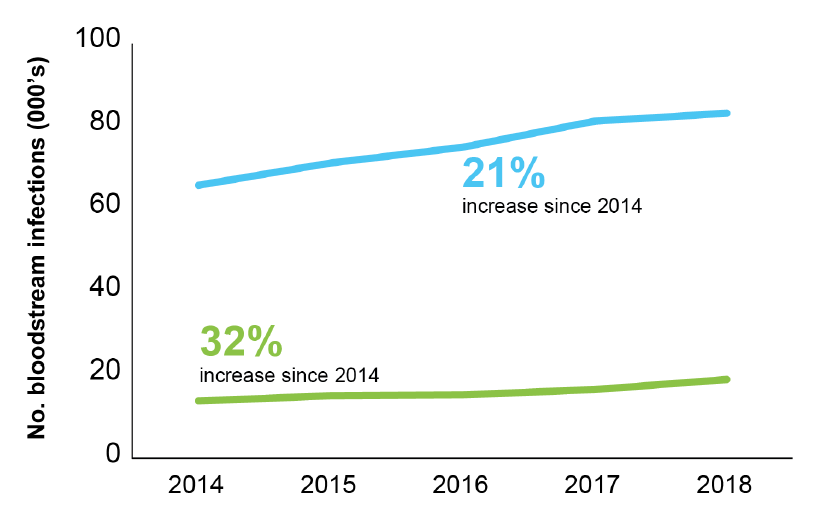
ESPAUR is a fantastic resource – it seems that this is the last ESPAUR report related to the UK AMR Strategy from 2013-2018, but I’m confident that ESPAUR will continue to report the successes and challenges of implementing the new five year action plan (from 2019-2024).
Since writing this 2015 review on gaps and controversies in the guidelines for the prevention and control of CPE (and other MDR-GNR) I’ve tried to keep it fairly up to date. So, here’s the latest iteration, including the 2015 CDC guidelines.
I blogged recently about the new ESCMID guidelines on resistant Gram-negative carriage and decolonisation, which supported a “once positive, always positive” approach to CPE carriers due to the lack of effective decolonisation options. A new study suggests that a large majority (75%) of patients who were once identified as CPE carriers no longer had CPE detectable when they were readmitted. This has implications for the management of CPE carriers in hospitals.
A comprehensive and impressive cluster randomised crossover study published in Lancet ID examines whether it makes sense to use single rooms (as compared with multi-bed bays) to apply contact precautions for patients known to be carrying ESBL-Enterobacteriaceae. I need to be careful what I say, because fellow bloggers Marc and Andreas are co-authors. However, the gist seems to be: don’t bother with single rooms for ESBL-E carriers – but many hospitals don’t have capacity to do that anyway, so this may not be a practice-changing finding in many parts of the world!
Those of you who have published a scientific paper or two will recognise the following process:
Format.
Submit.
Reject.
Reformat.
Submit.
Reject.
Reformat.
Submit.
Accept.
By the end of this process, not only have you lost the will to live (or ever reformat a scientific paper ever again), you’ve also wasted time = money. And chances are, the money has been entrusted to you to perform research, not reformat documents! A recently study counts the cost of this process, concluding that the average scientist spends 52 hours per person per year on formatting / reformatting scientific papers, with a cost of around $500 USD per manuscript or ~$2k per year.
I’ve spent the last couple of days up in Liverpool for Infection Prevention 2019. One of the highlights was a talk by Dr Paz Aranega-Bou on the issues around contamination of sinks and drains. Paz flagged a paper just published in JHI investigating the dispersal of CPE in a sink/drain test risk at PHE, showing the CPE can make its way from contaminated drains to sink and surrounding surfaces via splashback.
This blog is usually concerned with covering the latest developments – but this post features a paper published in 1962! Have you ever wondered what would happen if you didn’t do hand hygiene? Well, this remarkable, shocking, and absolutely unrepeatable study from the 1960s gives us the answer: the result would be transmission of pathogens that can cause HCAI.
 Reflections on Infection Prevention and Control