There’s surprisingly little literature published on the cost of HCAI outbreaks. In this context, a useful Dutch study in PLoS ONE counts the cost of 7 HCAI outbreaks.
Author: Jon Otter (@jonotter)
Review on AMR: final report

The final report from Jim O’Neill’s Review on AMR is published today. The report summarises the key findings of the reports published by The Review. The key interventions outlined in the report are:
- A global public awareness campaign
- Preventing the spread of infection
- Reducing unnecessary use of antibiotics, and controlling their environmental dissemination
- Improving surveillance of resistance and consumption
- Improving diagnostics
- Explore vaccines
- Improve remuneration for people working in ID (here here)
- Develop a global innovation fund for anti-infective drug development
- Incentivise anti-infective drug development
Not a great deal on infection prevention in the report – but this was covered in detail in a previous report. Some more excellent infographics, and an impressive Review. Well worth a read.
HIS Spring Meeting: ‘Contaminated surfaces: the missing link’

Thought I’d share some key points from the 2016 HIS Spring Meeting.
Outlining the problem(s)
Prof Gary French kicked off the meeting with a (sic) historical perspective, describing how the perceived importance of the environment in transmission has oscillated from important (in the 40s and 40s) to unimportant in the 70s and 80s to important again in the 2000s. Gary cited a report from the American Hospital Association Committee on Infections Within Hospitals from 1974 to prove the point: ‘The occurrence of nosocomial infection has not been related to levels of microbial contamination of air, surfaces and fomites … meaningful standards for permissible levels of such contamination do not exist.’ Gary covered compelling data that contaminated environmental surfaces make an important contribution to the transmission of Gram-positive bacteria and spores, highlighting that C. difficile in particular is a tricky customer, not helped by the fact that many ‘sporicides’ are not sporicidal!
Do we need new models of hand hygiene for anaesthetists?

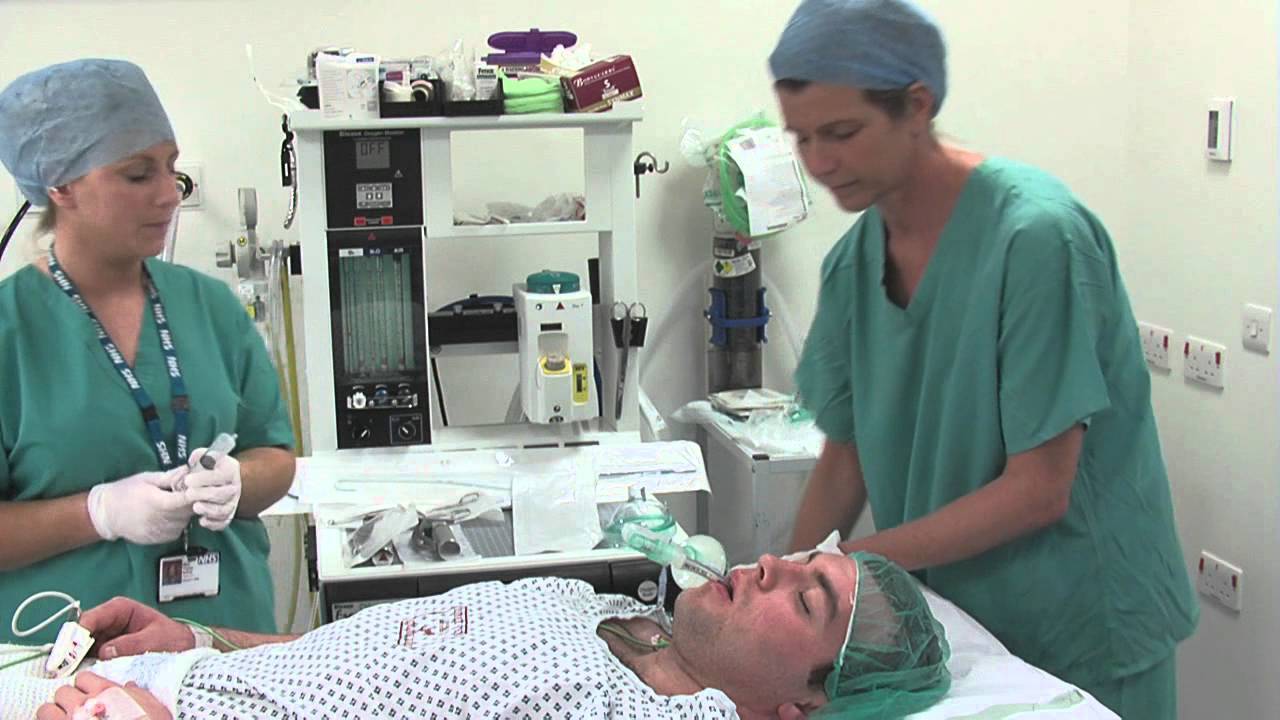
In honour of #safesurgicalhands day, I thought I would highlight a shocking fairly recent study of hand hygiene compliance among anaesthetists. The study identified a huge number of hand hygiene opportunities during the delivery of anaesthesia (149 per hour on average) – in fact, it would have consumed more than an hour of each anaesthetists time! Importantly, the observation was done via video camera, so is probably a better reflection of actual compliance. It is little surprise then that the hand hygiene compliance rate was so low (a dire 2.9%). So, before berating our anaesthetic colleagues, we may need to think of some new models of defining critical control points related to hand hygiene for this specialist group. And then berate them (with love and support) for failing to meet them!
Image credit: youtube.
Should we start admission screening for C. difficile carriage? A Kiernan vs. Otter pro-con debate!

Both Martin and Jon wanted to post a blog about the same article, so thought we’d put our hands together, so to speak, into a pro-con format! We hope you find it useful.
Are hand dryers safe for clinical settings?
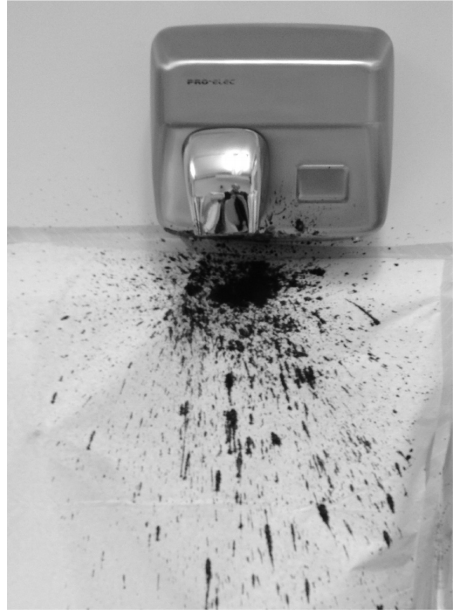
I edited a paper for Journal of Hospital Infection a few years ago on the potential risk of warm air dryers and especially jet air dryers compared with paper towels in spreading microbial contamination via the air. The paper showed that hands dipped in a concentrated bacterial suspension resulted in fairly widespread bacterial contamination of the air; jet air dryers were the worst culprit, followed by warm air dryers, with paper towels resulting in markedly less contamination. They also did some cool paint splatter experiments to visualize potential contamination routes (see image above, from the paper).
Reflections from ECCMID: the pink, the blue, and the new

I’ve recently returned from an enjoyable few days in Amsterdam for ECCMID. I’ve not been to a conference of this scale for a few years; there was a lot of good stuff to choose from so I’ve tried to stick to key updates for the purposes of this reflection!
Social media survey for healthcare professionls: the results
I gave a presentation at ECCMID today on social media use by healthcare professionals (you can download my slides here). Since there isn’t a great deal of data around social media use by healthcare professionals, I thought I’d generate some! I put out this survey a few weeks ago. I was delighted that 749 healthcare professionals took the survey; thanks to everybody who took part.
English HCAI and AMR data at your Fingertips
PHE have just launched an interactive database for HCAI and AMR data from England using their ‘Fingertips’ platform. The HCAI data in the module has been available for years, but was buried in pretty dense Excel spreadsheets so tricky to visualise. The Fingertips platform makes data extraction and visualisation so easy even I can do it (example below).
Diluting the efficacy of hydrogen peroxide room decontamination?

A somewhat perplexing new study has just been published in the Journal of Hospital Infection comparing the effectiveness of two hydrogen peroxide based automated room decontamination systems: a low-concentration (5%) hydrogen peroxide system (Deprox) and a high-concentration (30%) hydrogen peroxide system (Bioquell).
The study evaluated the impact of the two systems each run in 10 single rooms containing seeded metal discs placed in five locations, with a 6-log load of MRSA, K. pneumoniae, and C. difficile spores. The MRSA and K. pneumoniae were either low soiling (0.03% BSA) or heavy soiling (10% BSA), and the C. difficile spores was either low soiling (0.03% BSA) or in body fluid. In addition, surface samples were taken from 22 surfaces in each room before and after decon using contact plates. The bottom line is that both systems achieved a >5-log reduction on all of the discs (including those with heavy soiling), and there were no real differences in the levels of surface contamination remaining. All this understandably moved the authors to conclude that ‘The starting concentration and mode of delivery of hydrogen peroxide may not improve the efficacy of decontamination in practice.’
 Reflections on Infection Prevention and Control