This visual abstract has appeared to summarise the findings of our article about tweeting and infection-related conferences (previous post about the article here):
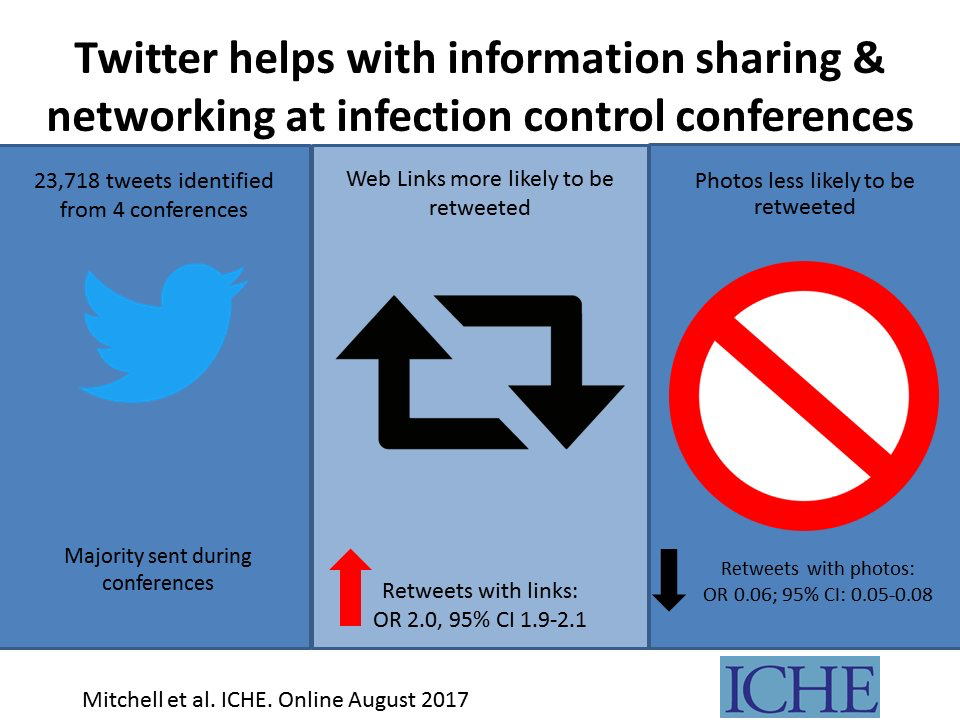
This visual abstract has appeared to summarise the findings of our article about tweeting and infection-related conferences (previous post about the article here):
Earlier this year, CMI published our article on the cost of a CPE outbreak in London, which cost 1.1m (Euros) over 10 months. EID have recently published a similar article, reporting a 0.6m (Euro) outbreak of CPE in the Netherlands.
In this weeks’ PhD journal club Darren Troeman discussed the paper “Effect of a multifaceted educational intervention for anti-infectious measures on sepsis mortality: a cluster randomized trial”. The plan was to improve compliance with guidelines, thereby reducing time before start of antimicrobial therapy (AT) which should reduce 28-day mortality. The intervention was compared to conventional medical education. Disappointingly, the trial provided more lessons for trialists than for healthcare providers. Continue reading

If I’m still around in 2027 (which I hope to be by the way), you have my advance express permission to throw this post back in my direction. I thought an interesting way to summarise the key themes from IP2017 would be to think about how the IPC landscape will look 10 years from now.
Our careers (at least partly) depend on our publications. The more, the better and to suit our needs we have a journal for any kind of publication. Sometimes, you read something and you may think “Hey, I have seen that before”. If the new study than confirms a previous finding, we apparently have a reproducible fact, which increases the likelihood that it is indeed true. Here is an example. Or not? Continue reading
I am heading home from an outstanding Infection Prevention 2017. There was a fair bit of discussion about hospital-associated pneumonia (HAP). HAP does not get the attention it deserves and there is more that we can and should be doing to prevent it. Although, we need to keep an eye out for unintended consequences in tackling HAP.
It’s World Sepsis Day 2017! In support of this, I’ve pulled together a few resources that I have found helpful. Starting with a very general overview of sepsis, which I quite like (apart from ‘the bloodstream carrying death around the body’, which is a metonomical step too far for me)!
Two months ago I provided an update on the ESBL-predict study that Tim Deelen from our group coordinates. In short: Every hospital in the world can participate, through a user-friendly electronic CRF (in a secured environment), in the validation of 2 scoring systems to predict that sepsis is caused by ESBL-producing bacteria. Only relevant for those of us that are not yet ready to start meropenem/amikacine for every patient that starts with antibiotics! This tool may help, …. if reliable. We passed the 3,000 episodes! Here is a short update and info for those that want to join. Continue reading
The old dogma to “always complete your antibiotic course” has been challenged recently, see BMJ and previous blogs. Is it safe to tell patients to stop whenever they feel better? Purely by coincidence this paper appeared, and was discussed in our PhD’s Journal Club. The paper’s title was Individualizing duration of antibiotic therapy in community-acquired pneumonia (CAP), and the students were surprised by the final result, reports Valentijn Schweitzer. Continue reading

I heard an interesting piece of Radio 4 recently paralleling cybersecurity and the control of infectious diseases, which I thought I’d share.
 Reflections on Infection Prevention and Control