Balancing risk and resource for CPE screening

Klebsiella_pneumoniae_01

The PHE Toolkit recommends pre-emptive isolation for patients who meet one of the risk-factor triggers for CPE screening. Furthermore, the pre-emptive isolation recommended in the Toolkit should be continued until three negative screens are obtained, each separated by 48 hours. In what is best described as a data-based thought experiment, colleagues from Imperial tested the impact of various CPE screening strategies on the burden of contact precautions generated.

Continue reading

Appraising the options for detecting carbapenemase-producing organisms

CPE agar

Carbapenemase-producing organisms (including CPE) present important clinical challenges: the “triple threat” of high levels of antibiotic resistance, virulence, and potential for rapid spread (locally, regionally, nationally, and globally)! However, these organisms somewhat ironically also present challenges to detection in the clinical laboratory. You’d expect that since these organisms are so important clinically they’d be dead easy to detect in the clinical lab – but this isn’t the case.

A comprehensive review published in Clinical Microbiology Reviews provides an overview of the diagnostic approaches to detect carbapenemase producers in the clinical lab. Figures 6 and 7 of the review provide a useful overview of the two broad approaches you could take: culturing organisms on agar plates, or using nucleic acid amplification techniques (NAAT – most commonly PCR) directly from a rectal swab.

Continue reading

CRE -> CPE

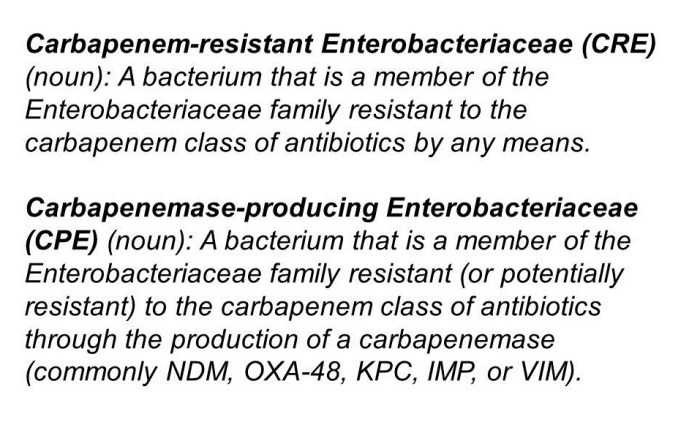
CRE CPE 2

I have thought a lot (probably too much) about the best way to describe the issue of carbapenem resistance in Enterobacteriaceae. I decided ages ago that CRE (a la the CDC) is the way to go as a generic term to describe the problem. But the more I think about it, the more I am coming around to the idea that CPE (a la PHE) is better. And here’s why:

  • The real issue from a clinical and infection control viewpoint is CPE. Enterobacteriaceae that are resistant to carbapenems by means other than an acquired carbapenemase (i.e. CRE that are not carbapenemase producers) are important, but they don’t seem to have the same capacity to spread as carbapenemase producers.
  • It’s a really confusing situation in terms of terminology. From the “end user” staff member on the front line and patient, all that really counts is whether it is a CPE or not. It’s really rather confusing to tell a patient that the have a “CRE that is also a carbapenemase producer” – easier just to say “you have a CPE”. (I accept that you will also need to tell a patient if they have a CRE that is not a carbapenemase producer – but I think this way around is easier.)
  • CPE is already en vogue in the UK (mainly due to the PHE Toolkit) so using any other term risks confusion at the time of patient transfer. (Clearly, this point is reversed if you are working in the US!)

I still think that “CRO/CPO” is not the way to go, given the gulf in epidemiology between the Enterobacteriaceae and the non-fermenters (although, sometimes, begrudgingly, you have to go there). What I mean by this is that you will sometimes detect a carbapenemase gene from a PCR but don’t yet know whether it is from a non-fermenter or Enterobacteriaceae species. In this circumstance, this has to go down as a ‘CPO’.

So, there you have it, a personal U-turn. CRE -> CPE. But I wonder whether CDC and PHE and the international community will ever agree a common term…
Reconsidering the burden of CRE screening


swabs

Shortly after the PHE Toolkit was published, I blogged some crude sums to size the burden of CRE admission screening a la Toolkit. I’m pleased to report that colleagues at Imperial have done a much better job of this, published in a letter in the Journal of Infection. The study provides some evidence that the recommendation in the PHE CRE Toolkit to perform pre-emptive isolation of suspected carriers whilst obtaining three negative screens is simply not feasible. The team then compare an alternate strategy – of applying the Tookit triggers to admissions to high risk specialties only (intensive care, nephrology, cardiothoracic surgery, neurosurgery and oncology).

Continue reading

We need to work together to reduce CRE and other pathogens

Some fascinating modelling from the CDC Vital Signs programme suggests that a co-ordinated, multi-facilitiy approach will be much more effective than each hospital doing its own prevention interventions.

The team first estimated the burden of key infections in the US: CRE, multi-resistant  P. aeruginosa, invasive MRSA and CDI combined were responsible for 310,000 infections in 2011, which would increase 10% to 340,000 over 5 years. However, with an ‘aggressive’ national intervention, this could be reduced to below 200,000 by 2019. It would be a huge undertaking to implement and co-ordinate a national campaign in the US, where there is so much heterogeneity in the way that hospitals are structured and funded. But if anybody can do it, the CDC can!

Continue reading

Is CRE lurking in nursing homes?

Nursing home CRE

They say that things come in threes, so following hot on the heels of blogs about MRSA and other MDROs in nursing homes, I was struck by a recent outbreak report of CRE associated with nursing homes the Netherlands.

Following the admission of a patient from a Greek ICU, a nosocomial transmission of CRE (ST258 KPC K. pneumoniae) occurred. By the way, this occurred despite the hospital recognising the risk of CRE at the time of admission from the Greek ICU, perform an admission screening and implementing pre-emptive contact precautions. Then the index patient was transferred to a nursing home, where subsequent transmission occurred to four other patients.

Continue reading

CRE winging its way around the world

aeroplane

CRE are known to be adept at hitchhiking around the world, hence the focus on cross-border transmission in Europe. A startling example of this comes in a report from Poland result from the terrorist shootings in Tunisia. Two Polish nationals seriously injured in the shootings were repatriated following a 10-day stay in a hospital in Tunis, Tunisia. A grand total of four CREs were identified from the two patients!

Three of these were identified at the time of admission, so almost certainly originated in Tunisia. The fourth CRE was identified 10 days after repatriation to Poland. The authors suggest that the most likely explanation for this is poor sensitivity of admission screening. I venture, however, that it’s more likely due to in-hospital transmission in Poland, since the two patients were treated by the same staff.

Nonetheless, the most troublesome finding here is that at least three separate CREs were imported into Poland by just two patients. Can anybody find me a paper on the prevalence and epidemiology of CRE in Tunisia? No? Thought not. The implication here is that CRE is already far more established than feared in Tunisia and many other parts of the world!

Image: Aeroplane.

CRE – too weak to spread!?

superbug

(Photo: thinkprogress.org)

In the May issue of ICHE, Weber et al. published their findings of a study looking at the environmental contamination of rooms occupied  by patients colonized or infected with CRE. In addition to their observations they actively inoculated test surfaces with 102 CRE (which I find rather low). They found that the contamination in the patients’ room was infrequent (8.4%) and at low levels (5.1 CFU/120cm2). With the single exception of K. pneumoniae on formica, alle CRE had a less than 15% survival at 24 hours and a 0% survival after 72 hours.

Should we just conclude that the chance of CRE transmission from the environment is very low?

I believe that this conclusion would be too early and probably wrong. The survival of micro-organisms in the environment is clearly strain dependent and while the authors used clinical isolates they did not mention if they included a strain that has proven its ability to spread (eg. outbreak isolates). In general multi-resistant bacteria may loose some of their fitness – including the ability to survive in the environment – but survival studies like those of Kramer et al. show survival of multiple weeks for E. coli and Klebsiella spp.

Continue reading

What drives carbapenem resistance? Carbapenem use, stupid!

An outstanding study from colleagues at Imperial shows that if you use a bucket-load of meropenem (a carbapenem antibiotic) one year, you see an uptick in carbapenem-resistant Enterobacteriaceae (CRE) the next. The figure below plots meropenem use in the previous year with the incidence rate of OXA-48 producing K. pneumoniae CRE.

mero usage correlation

Figure: The use of meropenem in the previous year plotted against the incidence rate of OXA-48 producing K. pneumoniae

Continue reading

CRE: coming to a hospital near you

carbapenemase

I thought for quite some time about whether the title to this post ought to be a statement or a question. I decided on a statement: pretty much wherever you are in the world, I am certain that CRE is now one (hospital) degree of separation from you.

I gave this talk yesterday at the imaginatively named “Darling Bugs of May” IPS conference, and you can download my slides here. I’ve given similar talks before, but the whole thing took on greater significance now I have had some first hand experience of making decisions around the management of CRE patients.

Continue reading