What can outbreaks of Salmonella from the 1950s tell us about CRE?

I recently came across a fascinating review article published in 1963 mainly about outbreaks of Salmonellosis during the 1950s. The review focuses on epidemics that were traced to contaminated surfaces, including ingested, contact and inhaled transmission routes. A number of interesting epidemics stand out:

  • An outbreak linked to contaminated neonatal respirators.
  • An outbreak linked to a contaminated chopping board (see Figure). In this outbreak, one of the investigators apparently contracted Salmonellosis after touching the chopping board during sampling and then having a cigarette before washing his hands.
  • An outbreak (of microbial endotoxin syndrome) linked to a contaminated mouthpiece of SCUBA equipment. Here, the outbreak occurred in naval diving academy and the pattern of lessons and cases was so regular, that the epidemiologist could predict precisely when to visit to see the next case.

chopping board 2

Figure: A chopping board at risk of persistent microbial contamination due to surface damage. 

Although most outbreaks covered in the review relate to ancient catering-related outbreaks of Salmonella, there may be some useful learning for hospital epidemiology today, specifically CRE. It’s rare although not unheard of to find Salmonella carrying a carbapeneamase (i.e. Salmonella CRE). However, Salmonella is a member of the Enterobacteriaceae, so the involvement of contaminated surfaces during outbreaks of Salmonella suggests that contaminated surfaces may also be important during outbreaks of CRE.

It’s interesting that even back in the 1960s contaminated surfaces were recognized as potentially important in epidemics, whereas by the 1980s, the role of contaminated surfaces in endemic transmission was considered negligible. It’s difficult to know whether experts of the 1960s (perhaps there are some reading this?) would have considered contaminated surfaces important in both epidemic and endemic transmission? I suspect so, and we just lost sight of that in the 1980s and 90s.

Article citation: Sanborn WR. The relation of surface contamination to the transmission of disease. Am J Public Health Nations Health 1963;53:1278-1283.

Image: Ben Hosking.

A postcard from Latin America; carnivals, tango and carbapenem resistance

postcard panama

Recently, I spent some time in Latin America, first in the “Tango” country, Argentina, attending the International Federation of Infection Control (IFIC) 2013 conference and then in Panama giving a talk at a symposium. Talking to doctors and other healthcare workers from across Latin America during these two events, it was clear that multidrug resistance, especially carbapenemase and ESBL production in Enterobacteriaceae and other Gram-negative bacteria, are major problems in the region.

This prompted me to review the status of carbapenem resistance among the major nosocomial Gram-negatives in Latin America and ESBL production in E. coli and Klebsiella. Unlike the US and Europe, data on antimicrobial resistance from Latin American countries is limited. Some Latin American countries, such as Argentina, Chile and Colombia, do possess a nationwide surveillance program for monitoring antimicrobial resistance. However, the data are rarely in the public domain. Other countries such as Brazil and Mexico don’t yet have such monitoring programs. This makes it difficult to estimate the accurate prevalence and burden of diseases caused by antimicrobial-resistant bacteria in this part of the world.

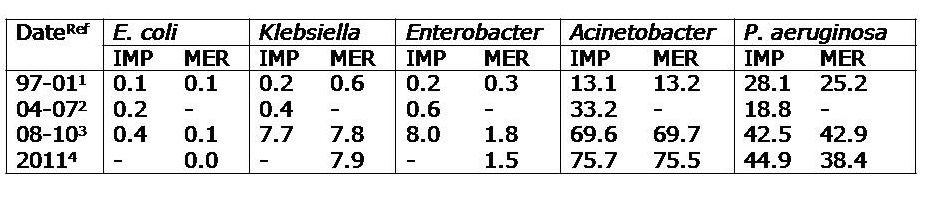
Thankfully, some data are flittering through from several national and international reports, including the SENTRY antimicrobial surveillance program (Table). SENTRY has been monitoring the predominant pathogens and antimicrobial resistance patterns of nosocomial and community-acquired infections via a broad network of sentinel hospitals since 1997 using validated, reference-quality identification and susceptibility testing methods performed in a central laboratory. Data from the SENTRY reports identify the five most frequently isolated Gram-negatives in Latin America as the Enterobacteriaceae (E. coli, Klebsiella and Enterobacter), P. aeruginosa and Acinetobacter.3

Table. Percentage of carbapenem resistance among the main nosocomial Gram-negatives in Latin America.CRE latinIMP; imipenem, MER; meropenem
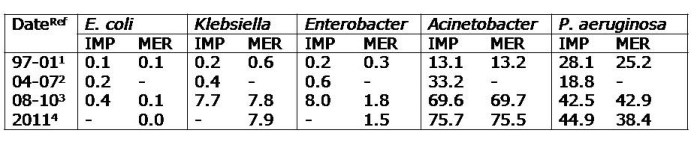
Resistance of these organisms to carbapenems has been increasing over the years, especially among Klebsiella, P. aeruginosa and Acinetobacter. The 1997-2001 SENTRY program reported on the antimicrobial resistance of 8,297 isolates of the 5 above organisms for 7 Latin American countries (Brazil, Argentina, Chile, Colombia, Mexico, Uruguay and Venezuela).1 The data found carbapenems to be effective against Enterobacteriaceae (<1% resistance level). Resistance among Acinetobacter and P. aeruginosa was around 13% and 26% respectively. In 2001, carbapenem resistance among the Enterobacteriaceae remained <1%, while resistance for Acinetobacter and P. aeruginosa rose to around 17% and 36% respectively.

The Tigecycline Evaluation and Surveillance Trial (TEST)2 reported  the antimicrobial resistance of bacteria from 33 centres in Latin America (Argentina, Brazil, Chile, Colombia, Guatemala, Honduras, Jamaica, Mexico, Panama, Puerto Rico and Venezuela) between 2004 and 2007, finding that imipenem-resistance among Enterobacteriaceae remained stable at <1%. However, resistance of Acinetobacter to imipenem increased to 33.2%.

The 2008-2010 SENTRY report from 10 Latin American medical centres located in Argentina, Brazil, Chile and Mexico, found a marked increase in imipenem and meropenem resistance among Klebsiella (7.7% and 7.8% respectively) and Enterobacter (8% and 1.8% respectively).3 KPC-2 was prevalent in Klebsiella but OXA-163, IMP and VIM were also detected. There was an important increase in KPC-2 producing K. pneumonia noted in Argentina and Brazil. Colistin resistance was highest among Klebsiella and Enterobacter with resistance rates of 3.1% and 17.6%, respectively. Nearly 70% of Acinetobacter were resistant to carbapenems and 1.2% were resistant to colistin. There was a marked increase in resistance in this organism particularly in Argentina and Brazil. OXA-23 and OXA-24were the most frequent OXA-carbapenemase genes detected. In P. aeruginosa, 42% of the isolates were resistant to carbapenems and 0.3% were resistant to colistin.

A recent article reported the antimicrobial resistance among 3,040 Gram negatives collected in 2011 from 11 countries in Latin America (Argentina, Brazil, Chile, Colombia, Costa Rica, Ecuador, Guatemala, Mexico, Panama, Peru and Venezuela).4 With the exception of Mexico (1.1%), all other countries had high rates of Carbapenem-Resistant Enterobacteriaceae (CRE) (10-20%). Panama, Colombia and Brazil had particularly high rates of 20%, 18.2% and 17.3% respectively. Resistance in Enterobacter was 2.9% with the highest rates in Colombia and Venezuela (10-12.5%). KPC-2 was identified in Brazil, Ecuador and Venezuela, KPC-3 in Colombia and Panama while NDM-1 was also found in Colombia.

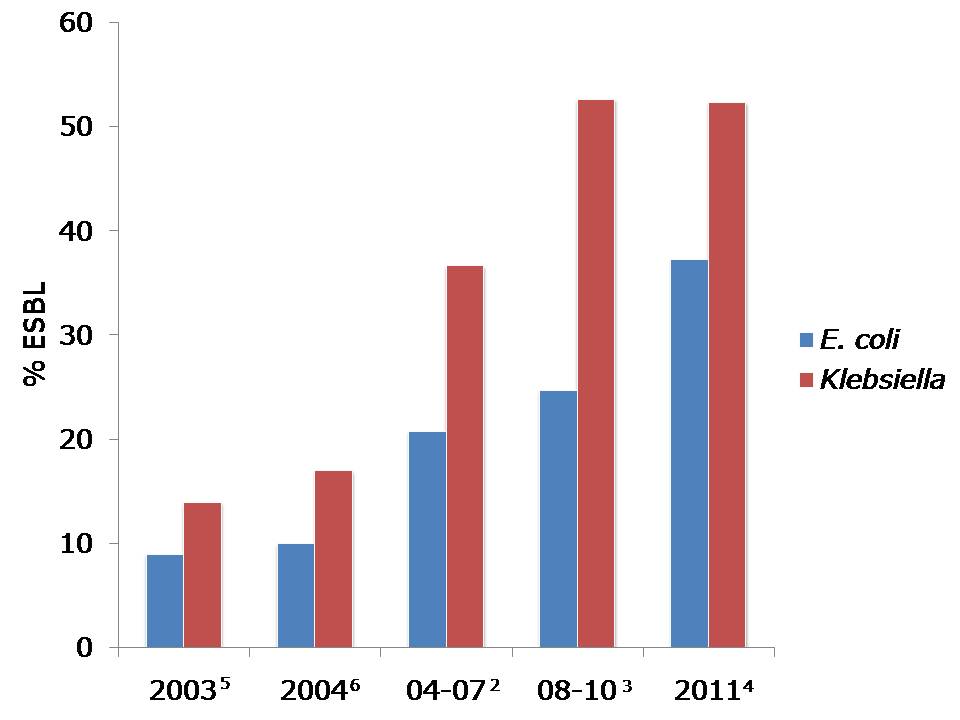
ESBL production by E. coli and Klebsiella isolated from Latin America is a well-recognized problem. The prevalence of ESBL-producers in Latin America has progressively increased over the years (Figure). The rates of these isolates in the region are now in excess of 50% in some regions.4 Peru, Guatemala and Chile have the highest ESBL-producing Klebsiella rates (70%, 69% and 59% respectively), while Mexico, Guatemala and Peru have the highest rates of ESBL-producing E. coli (71%, 59% and 54% respectively).

Latin americaFigure. Inexorable rise in rate of of ESBL-producing E. coli and Klebsiella in Latin America. 

It is clear that increasing antimicrobial resistance among Gram-negatives is a major problem in Latin America. The spread of carbapenem resistance is particularly troubling with increase prevalence of KPC and NDM carriage. Steps to reduce the transmission of these pathogens in Latin America require strategies at the institutional, community, national and international levels. For a start, it is important that true the prevalence rate of antimicrobial resistance among Gram-negatives in Latin America is determined at national levels with robust surveillance systems. Effective antibiotic stewardship and the control of inappropriate antibiotic use are important to slow the proliferation of resistant strains and should be targeted at both hospital and community levels. Strict infection control measures and targeted screening and isolation of patients with problematic strains should also help to slow the spread of resistant Gram-negatives in Latin America.

References

  1. Sader HS, Jones RN, Gales AC et al. SENTRY antimicrobial surveillance program report: Latin American and Brazilian results for 1997 through 200. Braz J Infect Dis 2004;8:25-79.
  2. Rossi F, García P, Ronzon B et al. Rates of antimicrobial resistance in Latin America (2004-2007) and in vitro activity of the glycylcycline tigecycline and of other antibiotics. Braz J Infect Dis 2008;12:405-15.
  3. Gales AC, Castanheira M, Jones RN, Sader HS. Antimicrobial resistance among Gram-negative bacilli isolated from Latin America: results from SENTRY Antimicrobial Surveillance Program (Latin America, 2008-2010). Diagn Microbiol Infect Dis 2012;73:354-60.
  4. Jones RN, Guzman-Blanco M, Gales AC et al. Susceptibility rates in Latin American nations: report from a regional resistance surveillance program (2011). Braz J Infect Dis 2013 Oct 10.
  5. Paterson DL, Rossi F, Baquero F et al. In vitro susceptibilities of aerobic and facultative Gram-negative bacilli isolated from patients with intra-abdominal infections worldwide: the 2003 Study for Monitoring Antimicrobial Resistance Trends (SMART). J Antimicrob Chemother 2005;55:965-73.
  6. Rossi F, Baquero F, Hsueh PR et al. In vitro susceptibilities of aerobic and facultatively anaerobic Gram-negative bacilli isolated from patients with intra-abdominal infections worldwide: 2004 results from SMART (Study for Monitoring Antimicrobial Resistance Trends). J Antimicrob Chemother 2006;58:205-10.


Key themes from ID Week 2013

idweek

Having somewhat dipped in towards the end of ID Week 2013 due to the overlapping Infection Prevention 2013 Conference in London, I can’t begin to provide a comprehensive overview of such a large event. Instead, I’ve tried to summarize new data on two important areas: the epidemiology and control of multidrug-resistant Gram-negative rods (MDR-GNR) and the role of the environment in transmission. You can access all of the abstracts free online here. Also, the poster abstracts that I cite below are either individually hyperlinked or can be downloaded here.

MDR-GNR

Dr Kavita Trivedi (California Department of Public Health) gave an overview of CRE in the USA, which has now been reported in virtually every state. Whilst surveillance sites, methods and definitions are problematic, CDC are coordinating some useful emerging data. For example, an NNIS prevalence survey indicates an increase in CRKP from 1% in 2001 to 10% in 2011. Also, the Multi-Site Resistant Gram-Negative Bacilli Surveillance Initiative (MuGSI) is beginning to yield some data. Early results from four states indicate that CRE is 10x less common than MRSA in the population, predominantly from urine cultures (85%) from patients with co-morbitities (93%) with a low mortality rate (4%). The CDC CRE toolkit provides a practical overview of recommended interventions. Finally, the challenges outlined by Dr Trivedi included: long-term care; variable prevalence; unknown epidemiological associations of different strains and genes; and colonization duration.

Oral presentations

A featured oral abstract by Bamburg et al. described an outbreak of NDM-producing K. pneumoniae affecting eight patients. The complex transmission map was dissected using whole genome sequencing, reminiscent of the NIH experience.

There was a useful oral session on ‘Identifying and Overcoming Challenges in Preventing Transmission of MDRO GNR’:

  • 1207, Haverkate. A Dutch group found that Klebsiella carrying OXA-48 can appear susceptible in vitro, risking ‘silent transmission’ of both the gene and the organism. The mean duration of colonization was almost one year and modeling indicated that readmission of CRE colonized patients needs to be carefully accounted for.
  • 1208, Mody. A cluster RCT in nursing home residents with urinary catheters or feeding tubes found that enhanced and preemptive isolation; ASC; and education led to a significant reduction in MDROs and CAUTI.
  • 1209, Hayden. A bundled intervention (ASC and isolation; daily CHG bathing; education; and adherence monitoring) significantly reduced CR Klebsiella in three of four LTACs included in the study. The prevalence of CR Klebsiella was remarkably high: 45% of patients at baseline. Environmental contamination was not identified, so no enhanced cleaning and disinfection was implemented, which is different to the experience of NIH.
  • 1210, Lewis. Varying the definition of ‘MDR’ made a profound impact on the proportion of patients requiring contact isolation, from 8-30%. Subsequent discussion with the authors indicated that the proposed MDR definitions developed by ECDC and CDC to be too sensitive for bacteria with less intrinsic resistance, such as E. coli. Perhaps a separate definition for the Enterobacteriaceae and non-fermenters is the way forward here?
  • 1211, Apisarnthanarak. The implementation of chlorhexidine bathing plus a switch to bleach for environmental disinfection brought an outbreak of A. bauamannii in Thailand under control. But which worked?
  • 1212, Barnes. A mathematical model indicated that hand hygiene is twice as important as environmental hygiene for interrupting A. baumannii, MRSA and VRE transmission. Whilst an awful lot of assumptions are required in this model, I can believe this 2:1 ratio in light of the following: “healthcare personnel are like small children: they touch everything and don’t always wash their hands” (Curtis Donskey) and “healthcare personnel hands are like very mobile shared surfaces” (Eric Lofgren).

Posters

  • 740, Jamal. CRE rate: 3% of 2000 Kuwaiti clinical isolate; 15.9% of CRE NDM-1 producers.
  • 746, Koper. A match made in hell between hypervirulent K2 Klebsiella and KPC; in vitro plasmid transfer demonstrated.
  • 1578, Madigan. No CRE detected in 69 international patients at Mayo Clinic; 22% carried ESBLs.
  • 1582, Johns. 50% of 66 MDR A. baumannii cases in Ohio in 2012 presented in first two days of admission, mostly admitted from extended care facilities, illustrating the ‘revolving door’ between acute and other healthcare facilities.
  • 1586, Carrilho. 26% of 157 Brazilian CRE polymyxin-resistant, though polymyxin resistance was not associated with increased mortality.
  • 1603, Drees. Remarkably, a survey from the SHEA Research Network indicates that 6% of hospitals do NOT isolate patients with CRE.
  • 1609. Decker. A study of CRE colonization patterns indicates median colonization of 216 days (range 134-376). One patient was colonized for >500.
  • 1611, Odom. CRE cultured from 12 (4.4%) of surfaces, predominantly sink drains.
  • 1612, Fitzpatrick. Selective broth enrichment added 10% sensitivity for detecting CRE. Is the resulting diagnostic delay worth the wait?
  • 1615, Lin. Chlorhexidine gluconate (CHG) daily bathing significantly reduces the number of body sites growing CRE, but several sites remain colonized.
  • 1618, Cheng. CRE identified in 1.2% of 6533 rectal screens and faecal specimens in Hong Kong, which is lower than I would expect.

Reflections from MDR-GNR research

  • We now have some intervention studies, but many include bundled interventions. We need more resolution on what works.
  • The duration of colonization with CRE seems to be long, probably around 1 year on average. Is this enough for a “once positive, always positive” approach?
  • Prevalence of CRE is variable around the USA, and in other parts of the world.
  • There is poor resolution between the epidemiology of Enterobacteriaceae and non-fermenters.
  • Most would agree that contaminated surface play an important role in the transmission of MDR non-fermenters such as A. baumannii. But is CRE an environmental issue? Some groups have found contamination and implemented enhanced disinfection, others have not.
  • Should chlorhexidine decolonization be part of the intervention for MDR-GNR?
  • Different research groups use different terminology and the meaning is sometimes obscured. International consensus is required.

Role of the environment in transmission

Dr Curtis Donskey (Cleveland) gave an excellent overview of ‘Environmental Controls for the Prevention of C. difficile Transmission’. Dr Donskey is one of the most active researchers anywhere in the world, focusing much of his attention on the role of the environment. Having established the importance of contaminated surfaces in the transmission of C. difficile, Dr Donskey explored emerging themes in addressing surfaces contaminated with spores covering conventional and automated terminal cleaning, and the impact of improving daily disinfection. The current challenges outlined included where to clean, how to validate “no-touch” automated room disinfection systems (NTD) to disentangle product claims from real-world performance, how best to engage environmental services and how to make disinfection easier in order to facilitate compliance.

Posters

  • 347, Livorsi. Patients with a higher nasal burden of MRSA are more likely to carry MRSA at other sites and contaminate their environment.
  • 348, Sitzlar. Useful stratification of MRSA/VRE room contamination rate by patient C. difficile status. Rooms of patients on precautions for CDI 3x more likely to be contaminated.
  • 1393, Deshpande. One hospital found more C. difficile contamination in the rooms of patients who were not on precautions for CDI than in rooms of patients on precautions for CDI!
  • 1394, Kundrapu. Suggests that the result would be better if those tasked with monitoring cleaning performance got their hands dirty and cleaned.
  • 1541, Sunkesula. Reduction in VRE in new unit; attributable to no shared rooms and bathrooms in the new unit?
  • 1685, Rose. A couple of carbapenem-resistant bacteria on public surfaces outside New York hospitals; I bet you it’d be higher in New Delhi!
  • 1685, Havill. Extended survival of CRE on dry surfaces; will surprise some.
  • 1690, Kirk. Almost no MRSA cultured from medication cabinets in isolation rooms. Direct plated swab lacks sensitivity?
  • 1691, Suwantarat. Quantitative assessment of HCP contact with equipment and fomites helps to define high touch (risk?) items; medication chart highest frequency of contact (1 per patient hour) yet possibly also the least cleaned item.
  • 1692, Hirsh. ipads (and other personal electronic devices) can become contaminated with pathogens; contact precautions should include an explicit instructions not to touch these items. (This was implemented at NIH during recent CRE outbreak there).
  • 1695, Williams. Pathogens identified on the clothing of HCP at the BEGINNING of their shift! (Reminds me of Hayden article where VRE commonly found on the hands of HCP BEFORE they entered patient rooms.)
  • 1697, Vassallo. Universal standard precautions didn’t stop impressive trend reductions. Time to abandon contact precautions?
  • 1698, Mann. Cleaning survey response rate of 100% (unprecedented). EVS staff have something to say, if only we’d listen.
  • 1700, Gerba. What’s for lunch in the hospital cafeteria? MRSA, enteric bacteria and spores, apparently.
  • 1701, Wiemken. Wipes are quicker and easier than bucket methods. Why wouldn’t you? (Perhaps only due to lack of wetting reducing efficacy.)
  • 1705, Boyce. The informal ‘standard’ for ‘clean’ is <2.5 cfu/cm2. This equates to 65 cfu/contact plate, which is almost 1/3 of the way to uncountable. Is this an acceptable standard for ‘clean’?
  • 1706, Power. Contaminated neonatal incubator? An hour of UVC should do the trick.
  • 1707, Horn. HPV for terminal room disinfection associated with significant reduction in CDI. Study design controlled for hand hygiene compliance, but time series analysis may have been more appropriate.
  • 1708, Anderson. Is variation in UVC cycle time for room disinfection explained entirely by variation in room size?
  • 1709, Uslan. Assessment of various Cu surfaces; I was unaware that you could apply Cu as a spray though have concerns over durability.

Other highlights

  • Decolonization has been a hot topic since several high-profile articles have been published recently. It’s a shame that universal chlorhexidine was conflated with universal mupirocin in the Huang study; the two should be considered separately in my view. The potential for resistance to mupirocin is extremely high, whereas the risk for ‘resistance’ or continued reduced susceptibility to chlorhexidine is lower. However, an interesting finding from poster 1615 was that the measured CHG skin concentration (20-1200 mg/L) was MUCH lower than the applied CHG concentration (10,000 mg/L). This brings the subtly reduced susceptibility to CHG reported in MRSA into play. Both Dr Aaron Milsone (Hopkins) and Prof Mary-Claire Roghmann (University of Maryland) highlighted the importance of the need to ‘tend the human microbiome’ and to consider the ‘host-microbiome-pathogen’ interaction rather than the ‘host-pathogen’ interaction, remembering that decolonization can cause considerable collateral damage to the host microbiome.  
  • Dr Denise Cardo (CDC) delivered the SHEA Lectureship on HAI Science and Policy. CDC are streets ahead of any other government health agency in leading HAI science through the development of common, simple goals; accountability; transparency; efficiency and strategy. HAI science alone is not sufficient to influence policy; this requires congressional briefings, senate hearings and the use of the scientific and lay press. The recently published CDC threat report outlines how the (somewhat bleak) future may look. Most poignantly, Dr Cardo could not attend the conference and delivered her lecture remotely due to the government shutdown, which signals leaner times ahead for CDC.  
  • BUGG. Dr Anthony Harris (University of Maryland) presented the results of the ‘Benefits of Universal Glove and Gown’ (BUGG) study. This RCT with impressive compliance to screening, gloving and gowning showed a significant 40% reduction in MRSA but no significant reduction in VRE. The a priori primary outcome (a composite measure of MRSA and VRE acquisition) was non-significant. I’m generally not a fan of universal approaches, since compliance in the real world is likely to tail off when the spotlight of a large study fades. Indeed, poster 1696 showing a ‘dismal’ 20% compliance rate with gowning in the field sheds a shadow on the BUGG study.   
  • Dr Brad Spellberg (UCLA) gave a wake-up call on the future of antibiotics and resistance. Reflecting on the three things guaranteed in life (death, taxes and resistance), Dr Spellberg outlined the unfair fight between humans and bacteria: we’re outnumbered to begin with, and multiply much more slowly! Dr Spellberg’s recent papers in CID and NEJM outline the radical approach required to curb and reverse antibiotic resistance including embracing technology, rekindling R&D, preserving effective agents and exploring novel therapies. Dr Spellberg gave a fascinating insight from the 1960s revealing that it’s not the first time the antibiotic pipeline has dried. We need to learn from history and rekindle R&D before the pipeline dries completely. More importantly though, exploring non-antibiotic therapies, or novel applications of existing agents, has a more realistic chance of brightening the future of antimicrobial therapy.   

CRE outbreak control: a view from the trenches

Drs Tara Palmore and David Henderson have written an engaging ‘view from the trenches’ in CID reflecting on their efforts to control an ongoing outbreak of CRE at the NIH Clinical Center, beginning in 2011.

The review outlines their interventions, including:

  • aggressive active surveillance (including regular house-wide surveys);
  • rapid identification and characterization of resistant organisms and resistance mechanisms (a mixture of conventional culture-based microbiology, mass-spec and mass spec);
  • whole-genome sequencing of outbreak isolates (which allowed the identified of counterintuitive transmission patterns);
  • enhanced contact precautions for all infected or colonized patients (patients only to leave room for medical reasons, visitors to wear gloves and gowns, staff not to touch personal electronic devices, preferable use of single-use equipment and enhanced terminal disinfection);
  • geographic and personnel cohorting;
  • daily chlorhexidine gluconate baths;
  • dedicating equipment for cohorted patients and aggressive decontamination of equipment that had to be reused on uncohorted patients;
  • monitoring adherence to infection control precautions, including unwavering attention to adherence to appropriate hand hygiene procedures (included the use of observing ‘enforcers’ to make sure staff complied with the basics);
  • enhanced environmental decontamination (including double bleach wipe daily disinfection, hydrogen peroxide vapor for terminal disinfection and careful management of drains);
  • engagement of all stakeholders involved in care of at-risk patients;
  • and detailed, frequent communication with hospital staff about issues relating to the outbreak.

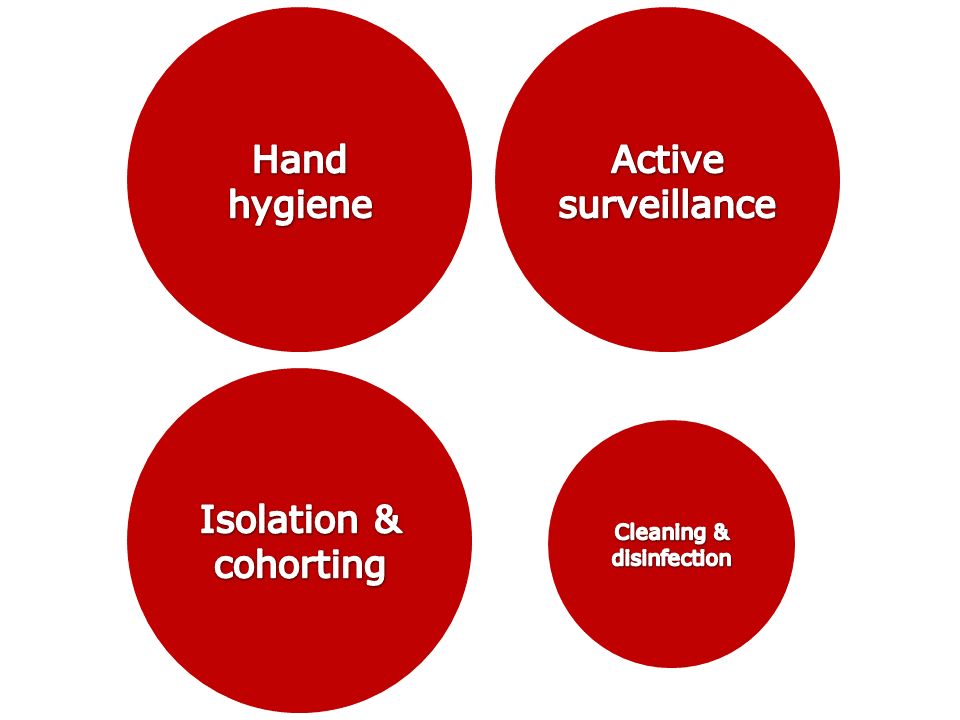
The authors discuss the problem of determining which of these interventions worked, since they were implemented more or less simultaneously; the so-called “kitchen sink” approach (Figure). A recent systematic review performed by ECDC identified this problem in virtually all studies evaluating control interventions for CRE.

NIH CRE control measuresFigure. Perceived relative importance of outbreak control interventions at NIH.

There’s an interesting section on the ‘unintended consequences’ of publishing in report, including the inevitable scaremongering in some parts of the lay-press. It wasn’t all bad though; this is an unusually detailed article based on the original NIH outbreak report in the Washingtonian.

Some reflections from me:

  • This all started with the transfer of a colonized patient from New York. Recognizing and containing colonized patients that are transferred from other hospitals is going one of the most important fronts in the battle against CRE. Worth noting that ECDC are recommending a rectal screen of all cross-border transfers of hospital patients in Europe.
  • Mortality was especially high in the NIH outbreak (albeit in patients with serious underlying illness), illustrating the clinical ‘teeth’ that this issue bares.
  • The outbreak reignited from an unidentified reservoir after apparently being brought under control; we have a limited understanding of the challenging epidemiology of these organisms.
  • It’s sad, though not surprising, that the high hand hygiene compliance achieved during the outbreak could not be sustained following the outbreak.
  • As you would expect, relying on clinical cultures only is looking at the tip of the iceberg. Active surveillance is a must.
  • One unique aspect of their enhanced contact precautions was an instruction for staff to avoid touching personal electronic items. This makes a lot of sense, and should be considered for inclusion in regular contact precautions.
  • There are some telling insights on the practical challenges of cohorting staff, not least the fact that there were not enough physicians to feasibly cohort!
  • The initial isolation measures failed, and NIH (commendably) went to extraordinary lengths to bring the outbreak under control. ‘Aggressive’ is used to describe several aspect of their strategy, which seems apt. Israel is another success story of extraordinary CRE control measures. Greece and Italy are examples of where extraordinary measures have not been undertaken and CRE have quickly become endemic.

Article citation: Palmore TN, Henderson DK. Managing Transmission of Carbapenem-Resistant Enterobacteriaceae in Healthcare Settings: A View From the Trenches. Clin Infect Dis 2013 in press.

Prevalence survey illustrates the difference between CRE and CPE

I recently posted an article on the difference between CPE and CRE, which is neatly illustrated by a prevalence survey from Alder Hey Children’s Hospital in Liverpool. In case you didn’t read my CPE/CRE blog (shame on you), here’s a reminder of the difference between the two:

Carbapenem-resistant Enterobacteriaceae (CRE) – Enterobacteriaceae that are resistant to carbapenems by any mechanism, including the production of an acquired carbapenemase or the production of an ESBL or AmpC combined with porin loss.

Carbapenemase-producing Enterobacteriaceae (CPE) – Enterobacteriaceae that are resistant to carbapenems by means of an acquired carbapenemase.

At Alder Hey, a large children’s hospital in Liverpool, a prevalence survey was performed between September 2011 and August 2012. All clinical and screening specimens were included; rectal screens were collected on admission and weekly from all patients in the ICU and HDU. 24 patients with CRE were identified, five (21%) from clinical specimens and 19 (79%) from rectal screens. The prevalence of CRE in rectal screens was 4.5% (19/421). Four of the 19 patients identified by screening specimens only went on to develop an infection, so 9 (38%) of patients ended up with a CRE cultured from a clinical specimen.

The majority (71%) of the 24 isolates were resistant to carbapenems by AmpC or ESBL combined with impermeability; seven (29%) were CPE, 4 with NDM and three with KPC (Figure). Typing indicated that the 3/4 NDM producing Klebsiella pneumoniae isolates were clonal, and they were clustered in space and time, which may indicate a small outbreak.

CRE alder hey Figure. Composition of CRE at Alder Hey Children’s Hospital. 

Carbapenem-resistance due to the production of an ESBL or AmpC combined with porin loss may lead to treatment failure, but it is often unstable and may impose a fitness cost, meaning that these strains rarely spread. Hence, carbapenem resistance conferred by an acquired carbapenemases is the key problem. This study helps to define the prevalence of CRE (and, more importantly CPE) in the population. We are not given a denominator for the clinical specimens, so the prevalence of CRE amongst clinical specimens cannot be calculated. However, the fact that around 5% of patients admitted to ICU / HDU were carrying CRE is a concern, although the prevalence of CPE on the rectal screens was lower at 1.7% (7/421).

Currently, the prevalence and epidemiology of CRE and CPE is poorly defined in the UK so this useful prevalence survey from Alder Hey is welcome. However, we urgently need more research from other hospitals to scale the CRE problem.

Article citation: Drew et al. Emergence of carbapenem-resistant Enterobacteriaceae in a UK paediatric hospital. J Hosp Infect 2013;84:300-304.

Do you know your CRO from your CPO from your CRE from your CPE?

Carbapenems are a class of beta-lactam antibiotic with a broad spectrum of activity against Gram-positive and Gram-negative bacteria. Whilst carbapenems are used for the treatment of Gram-positive infections, the emergence of Gram-negative bacteria with resistance to the carbapenem antibiotics is a health issue that has prompted unusually dramatic health warnings from the US CDC, Public Health England (PHE) and the European CDC (ECDC). However, the various acronyms employed to describe the subtleties of the problem are a minefield for the uninitiated:

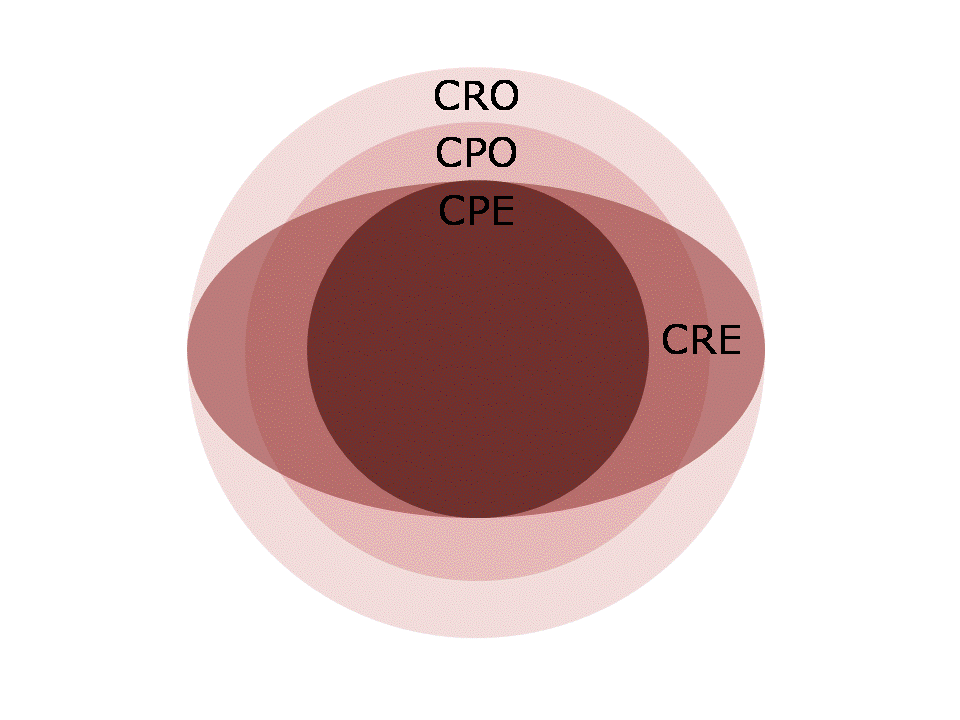
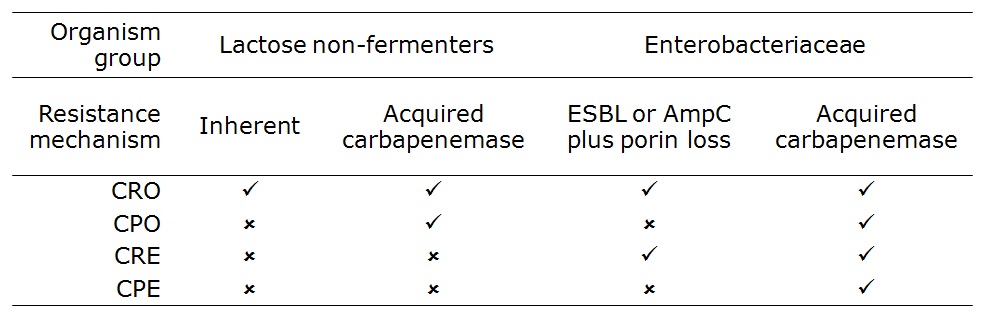
Carbapenem-resistant organism (CRO) – Gram-negative bacteria* including the Enterobacteriaceae (such as Klebsiella pneumoniae and Escherichia coli) and non-fermenters (such as Acinetobacter baumannii, Pseudomonas aeroginosa and Stenotrophomonas maltophilia) that are resistant to carbapenems by any mechanism. The non-fermenters can be inherently resistant to carbapenems, or they can acquire carbapenemases (typically KPC, VIM, NDM and OXA-48 types). Enterobacteriaceae do not have inherent resistance but may be resistant to carbapenems through the production of an acquired carbapenemase or the production of an ESBL or AmpC combined with porin loss.

Carbapenemase-producing organism (CPO) – Enterobacteriaceae and non-fermeters that are resistant to carbapenems by means of an acquired carbapenemase.

Carbapenem-resistant Enterobacteriaceae (CRE) – Enterobacteriaceae that are resistant to carbapenems by any mechanism, including the production of an acquired carbapenemase or the production of an ESBL or AmpC combined with porin loss.

Carbapenemase-producing Enterobacteriaceae (CPE) – Enterobacteriaceae that are resistant to carbapenems by means of an acquired carbapenemase.

The image below tries to graphically represent the relative size of these groups (not to scale!), and the table provides a summary of their distinguishing features:

CRE etc

CRE table

“O” or “E”

The US CDC and European CDC seem to favour ‘CRE’ as a generic term for this problem, whereas the PHE in the UK seems to favour ‘CRO’. Clearly, each term has a defined meaning and context will determine which is technically correct. But which is most useful as a generic term?

The epidemiology of the non-fermenters and the Enterobacteriaceae is different, with the non-fermenters tending only to cause problems in very sick patients, usually in critical care settings. Meanwhile, the Enterobacteriaceae are more able to cause infections in a wider range of patients both inside and outside the hospital. Hence, the emergence of carbapenem resistance is more concerning in the Enterobacteriaceae, as demonstrated by rapid national and international spread of KPC-producing K. pneumoniae.

“R” or “P”

Amongst the Enterobacteriaceae, whilst carbapenem-resistance due to the production of an ESBL or AmpC combined with porin loss may lead to treatment failure, it is often unstable and may impose a fitness cost, meaning that these strains rarely spread. Hence, carbapenem resistance conferred by an acquired carbapenemases is the key problem.

So, for me, CPE would be the most suitable generic term for this emerging problem. However, since the US CDC and the ECDC seem to have gone with CRE, and the vast majority of CRE will be CPE, let’s go with CRE shall we?


[* Whilst Gram-positive bacteria that are resistant to carbapenems (such as MRSA) could be described as ‘CROs’, these terms are reserved to describe Gram-negative bacteria.]

Dissecting the CRE epidemic in Italy

Italy flagCarbapenem-resistant Enterobacteriaceae (CRE) present unique challenges to infection prevention and control. Firstly, unlike MRSA and C. difficile, CRE can be caused by multiple genetic determinants (typically KPC, VIM, NDM and OXA-48 types) in multiple species. The combination of resistance determinants and species may have distinct characteristics with transmission and control implications. Further, there is a larger pool of resistance determinants for horizontal transfer. Secondly, CRE colonize the gastrointestinal tract, so deconlonization therapy is likely to be limited to suppressing the amount of CRE in the gut; elimination of the carrier state, which has been a mainstay of prevention and control interventions for MRSA, seems unlikely. Thirdly, pan-drug resistant CRE has already been reported and the pipeline for new agents is virtually empty, meaning that effective therapeutic options will be increasingly limited.

Data from EARS-Net suggests that the prevalence of CRE among bloodstream infections is low in most parts of Europe, with a gradual year-on-year increase. In Greece though, rates are exceptionally high, with the proportion of K. pneumoniae invasive isolates resistant to carbapenems increasing from 27.8% in 2005 to 68.2% in 2011. Also, rates in Cyprus are on the rise with 0% reported in 2006 up to to 15.7% in 2011. In the UK, rates of carbapenem resistance amongst K. pneumoniae have remained consistently <1% for the same period. Disturbingly, there has been a dramatic increase in the prevalence of carbapenem-resistant K. pneumoniae in the last few years in Italy, from 1% in 2009 to 15% in 2010 to 27% in 2011.

CRE Europe [Chart: Changes in proportion of carbapenem resistance in K. pneumoniae invasive isolates. Data from EARS-Net.]

A recent Eurosurveillance article reports a national survey of carbapenem resistance in Italy. 25 laboratories across the country participated and analyzed all consecutive, non-duplicate Enterobacteriaceae clinical isolates for six weeks in mid 2011. A total of 7,154 isolates were collected from inpatients and 6,595 isolates from outpatients. The highlight findings are:

  • 3.5% of inpatient isolates and 0.3% of outpatient isolates carbapenem resistant.
  • Carbapenem-resistant K. pneumoniae (CR-KP) the most problematic CRE, with 11.9% of K. pneumoniae isolates CR.
  • Substantial geographical variation in resistance rate, ranging from 0 to 33% for CR-KP.
  • KPC accounted for 90% of CRE enzymes; one CR-KPC clone predominated (CC-258).
  • Resistance to other agents was common amongst KPC-producing K. pneumoniae; 22% were resistant/non-susceptible to colistin, 21% to tigecycline and 16% to gentamicin; 1.5% were non-susceptible to all three.

This study raises several challenging questions. What do you do with a CR-KP isolate causing an infection that is also resistant to colistin, gentamicin and tigecycline? This seems to be true pan-resistance, with supportive care the only option.

Why is KP the outstanding CRE, specifically the CC-258 clone? What does it have that the other CRE lack? K. pneumoniae seems to survive better on surfaces that other Enterobacteriaceae, and has been associated with more hospital outbreaks than other Enterobacteriaceae historically. However, further research is required to answer this question.

Can the worrying trend of CRE in Italy be reversed? An aggressive, national intervention was successful in Israel, and there are some local success stories in Italy. However, brining the situation under control in Italy will require an aggressive, national programme that must be implemented immediately. Otherwise, CR-KP will quickly become endemic and probably impossible to bring under control.

The authors should be complimented for performing a timely study, but I do wonder whether the situation is considerably worse now, 12 months later, given the shape of the national epi curve.

Citation: Giani T, Pini B, Arena F, Conte V, Bracco S, Migliavacca R, the AMCLI-CRE Survey Participants, Pantosti A, Pagani L, Luzzaro F, Rossolini GM. Epidemic diffusion of KPC carbapenemase-producing Klebsiella pneumoniae in Italy: results of the first countrywide survey, 15 May to 30 June 2011. Euro Surveill 2013;18(22):pii=20489.

Image permission: Original image obtained from http://www.freestock.ca.

Carbapenem-Resistant Enterobacteriaceae (CRE) in US hospitals

Enterobacteriaceae are a family of bacteria that commonly cause infections in health-care settings as well as in the community. The family includes more than 70 genera but Escherichia coli, Klebsiella species, and Enterobacter species are the most common in healthcare settings. Until recently, carbapenems have been the treatment of choice for serious infections due to these organisms. However, resistance to these agents has emerged in the Enterobacteriaceae family by various mechanisms and is now a major concern worldwide as infections caused by carbapenem-resistant Enterobacteriaceae (CRE) are difficult to treat and are associated with significant morbidity and mortality.

mmwr

A recent CDC MMWR report used three different surveillance systems to describe the extent of CRE spread among acute-care hospitals in the US as well as the proportion of clinical isolates resistant to carbapenems. They found that while CRE are relatively uncommon, they have spread throughout the US and their rates have increased during the past decade. During the first 6 months of 2012, 4.6% of the 3,918 US acute-care hospitals performing surveillance for either CAUTIs or CLABSIs reported at least once CRE to the National Healthcare Safety Network (NHSN). CRE were more often reported from long-term acute-care hospitals (17.8%) and the percentage of hospitals reporting CRE was highest in the Northeast of the US and among larger and teaching hospitals. Data from NHSN and the Nosocomial Infection Surveillance system (NNIS) showed that the rate of carbapenem resistance among Enterobacteriaceae increased from 1.2% in 2001 to 4.2% in 2011, most of this increase was among Klebsiella species (from 1.6% to 10.4%).

Data from population based surveillance suggest that most (96%) clinical CRE isolates came from cultures collected outside of the hospital from patient with substantial health-care exposure, particularly recent hospitalization (72%). Although nearly all patients with CRE were currently or recently treated in a healthcare setting, these organisms have the potential to spread into the community among healthy individuals.

A combination of infection control strategies applied on national level are needed to control the rise of carbapenem resistance among the Enterobacteriaceae and the spread of CRE. These include active case detection, contact precautions for colonized or infected patients and patient, and staff cohorting as well as strict antibiotic stewardship in all settings. Particular attention should be given to long-term acute-care hospitals which have historically had less developed infection prevention programs. Such coordinated infection prevention and control programs implemented on a national level have been shown to be effective for controlling the rise of CRE, for instance the containment of KPC-producing strains which emerged in 2006 in Israel.

Article citation

Centers for Disease Control and Prevention (CDC): Vital Signs: Carbapenem-Resistant Enterobacteriaceae. MMWR. 2013;62:165-170.

No need to worry about environmental contamination with Enterobacteriaceae…or is there?

It was once thought that only bacterial endospores would survive on dry hospital surfaces for extended periods (measured in days and weeks rather than hours). Microbiological data indicates that a range of vegetative bacteria can survive on dry surfaces for extended periods. Whilst differing testing methods and conditions make comparison of survival times between studies difficult, it is clear that non-fermenting Gram-negative bacteria (such as Acinetobacter baumannii and Pseudomonas aeruginosa) survive considerably longer than the Enterobacteriaceae (such as Klebsiella pneumoniae and Escherichia coli).  However, the Enterobacteriaceae can survive for more than a month on dry surfaces. Indeed, a 2009 laboratory study highlighted substantial strain variation in the survival of K. pneumoniae, with the survival of three strains ranging from a 6-log reduction inside 3 weeks to a 1-log reduction over six weeks.

Several recent studies have evaluated environmental contamination with ESBL-producing Enterobacteriaceae. One French study evaluated surface contamination on five standardized sites surrounding patients infected or colonized with ESBL-producing Klebsiella spp. (n=48) or ESBL-producing E. coli (n=46). Environmental contamination was significantly more likely in the rooms of Klebsiella spp. patients (31% of 48 rooms positive; 6% of 240 sites positive) vs. E. coli patients (4% of 46 rooms positive; 1% of 230 sites sites). Multiple regression identified carriage of ESBL-producing K. pneuomiae as the only independent predictor of ESBL environmental contamination (adjusted odds ratio=10.38, 95% confidence interval = 1.24-228.58). Surprisingly, only 52% of the ESBL-producing isolates were identical to the patients in the room, suggesting survival of ESBL-producing bacteria from prior occupants or importation into the room. Another French study with a similar design identified comparable rates of contamination, and also found that contamination was significantly more likely with K. pneumoniae than with E. coli.

environmental sampling

Environmental contamination with C. difficile spores, VRE and non-fermenting Gram-negative bacteria is now a well-established route of transmission. Whilst the same cannot be said for the Enterobacteriaceae, these studies combined with an Israeli article recently featured on this Micro Blog, show that environmental contamination with Enterobacteriaceae may be more important than previously thought. These findings are particularly important in light of the recent global spread of carbapenemase-producing K. pneumoniae.

Article citations:

Guet-Revillet H, Le Monnier A, Breton N et al. Environmental contamination with extended-spectrum beta-lactamases: is there any difference between Escherichia coli and Klebsiella spp? Am J Infect Control 2012; 40: 845-848.

Gbaguidi-Haore H, Talon D, Hocquet D, Bertrand X. Hospital environmental contamination with Enterobacteriaceae producing extended-spectrum β-lactamase. Am J Infect Cont 2013; Jan 18 [Epub ahead of print].

Where the wild things are

Carbapenem-resistant Enterobacteriaceae (CRE) are a major threat to public health worldwide and Israel is among the countries with the highest rates of these pathogens. A concerted campaign has done a good job of bringing the national outbreak under control, but problems persist1. An Israeli hospital investigated the extent of environmental contamination with CRE in the vicinity of 34 CRE-carriers using two different sampling methods; contact plates and swabs (with or without enrichment). Pilot sampling was performed to identify the five sites that were most likely to be contaminated (pillow, crotch and leg area on the bed, personal bedside table and infusion pump). To investigate the effect of cleaning on the recovery of CRE, the five sites were sampled at two different times; 4 and 24 hr after rooms were cleaned and patient cloths and sheets were changed.

12-PDR-A290-278

The study detected CRE in the surrounding environment of most (88%) of the patients sampled, showing that a high proportion of carriers shed these pathogens into their environment which can then be transmitted. Recovery was highest in the carrier’s immediate environment with the patient bed being the most contaminated. Not surprisingly, recovery of CRE from the environment was reduced when sampling was done 4 hr after cleaning compared to 24 hr after cleaning (21% of sites contaminated vs 27%). However these results also highlight the speed by which the patient environment is re-contaminated with CRE after cleaning. The study also showed that the choice of the detection method is also important and reported that contact plates were more efficient at recovering CRE than swabs even with enrichment broth.

The high rate of recovery of CRE from the environment in this study is surprising. Hence, hospitals with CRE-carriers should expect the environment in the vicinity of these patients to be contaminated. Regular and thorough cleaning of the patient environment and equipment should be an integral part of the hospital’s infection control strategy to reduce the spread of these pathogens.

Article citation:

Lerner A, Adler A, Abu-Hanna Jet al.Environmental contaminationby carbapenem-resistantenterobacteriaceae. J Clin Microbiol 2013;51:177-81.

References

1.       Schwaber MJ, Lev B, Israeli Aet al. Containment of a country-wide outbreak of carbapenem-resistant Klebsiella pneumoniae in Israeli hospitals via a nationally implemented intervention. Clin Infect Dis 2011; 52: 848-855.