This week I attend the general assembly of COMBACTE, this year in Athens. COMBACTE stands for COMBatting AntibiotiC resistance in Europe (www.combacte.com) and is part of the New Drugs for Bad Bugs (ND4BB) program of the Innovative Medicines Initiative. Our local host is professor George Daikos, who opened the meeting with an overview of the epidemiology of antibiotic resistance in his country. Continue reading
Conferences
Reflections from Infection Prevention 2017: Where will IPC be in 2027?

If I’m still around in 2027 (which I hope to be by the way), you have my advance express permission to throw this post back in my direction. I thought an interesting way to summarise the key themes from IP2017 would be to think about how the IPC landscape will look 10 years from now.
Reflections from FIS/HIS 2016: Cauliflower, Clostridium, cash, and Candida

A very enjoyable few days in Edinburgh this week for the Federation of Infection Societies / Healthcare Infections Society (FIS/HIS) meeting. Some reflections follow…
Reflections from Infection Prevention 2016

As is now becoming traditional, I thought I’d share a few reflections from the recent IPS conference in Harrogate. Fantastic to see the submitted abstract published, full and free, in a Journal of Infection Prevention supplement.
The first International Conference on Clinical Metagenomics (ICCMg)

Guest blogger Dr Etienne Ruppé (bio below) writes about a new conference in the emerging field of ‘Clinical Metagenomics’. I suspect we are all beginning to dip our toes into this challenging new arena, so I am sure this conference will be useful… Continue reading
HIS Spring Meeting: ‘Contaminated surfaces: the missing link’

Thought I’d share some key points from the 2016 HIS Spring Meeting.
Outlining the problem(s)
Prof Gary French kicked off the meeting with a (sic) historical perspective, describing how the perceived importance of the environment in transmission has oscillated from important (in the 40s and 40s) to unimportant in the 70s and 80s to important again in the 2000s. Gary cited a report from the American Hospital Association Committee on Infections Within Hospitals from 1974 to prove the point: ‘The occurrence of nosocomial infection has not been related to levels of microbial contamination of air, surfaces and fomites … meaningful standards for permissible levels of such contamination do not exist.’ Gary covered compelling data that contaminated environmental surfaces make an important contribution to the transmission of Gram-positive bacteria and spores, highlighting that C. difficile in particular is a tricky customer, not helped by the fact that many ‘sporicides’ are not sporicidal!
Reflections from ECCMID: the pink, the blue, and the new
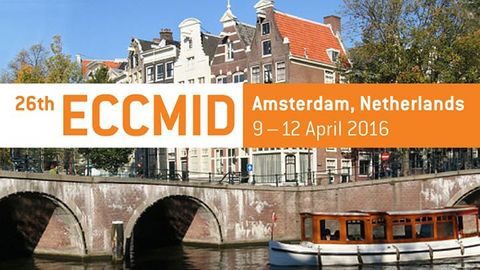
I’ve recently returned from an enjoyable few days in Amsterdam for ECCMID. I’ve not been to a conference of this scale for a few years; there was a lot of good stuff to choose from so I’ve tried to stick to key updates for the purposes of this reflection!
Social media survey for healthcare professionls: the results
I gave a presentation at ECCMID today on social media use by healthcare professionals (you can download my slides here). Since there isn’t a great deal of data around social media use by healthcare professionals, I thought I’d generate some! I put out this survey a few weeks ago. I was delighted that 749 healthcare professionals took the survey; thanks to everybody who took part.
Survey of social media use by healthcare professionals

I have been asked by ECCMID to do a talk on ‘Selling your colleagues and society: how to use social media.’ While there is some good data on social media use by scientists, I was struggling to find specific data on social media use by healthcare professionals. So I thought I’d generate some (and in doing so, generate the power of social media!). So, I have put together a short, simple survey that I hope you will have time to complete here.
Reflections from IFIC 2016

I enjoyed my first IFIC experience over the past few days in Vienna, and thought I’d share some reflections.
I found the pro-con debate between Dr Michaal Borg and Prof Gary French on whether we need more evidence to improve infection prevention and control useful. (Clearly, my vote was for Prof French, my PhD supervisor and all-around acadmic mentor.) Prof French gave a good case for an evidence-based medicine approach to IPC, bemoaning poor-quality evidence to support IPC interventions and an over-reliance on ritual and tradition. Although decent IPC study designs are tricky (and tricker than for an antibiotic trials), they are possible, as illustrated by the small number of cluster RCTs we have at our disposal. Dr Borg argued convincingly that, even if cluster RCTs support on intervention, they would likely be performed in high-resource, academic teaching hospitals, which are a different plant to the average hospital so may well not be applicable. Furthermore, clinicans are pretty poor at following guidelines even if they are evidence-based because culture eats policy for breakfast! Michael questioned whether the ‘English MRSA Miracle’ was founded in evidence-based medicine, or a pragmatic multi-faceted intervention. On balance, the room sided with Michael, agreeing that we have enough evidence to make a big different (but all agreed that better quality evidence wouldn’t hurt)!
 Reflections on Infection Prevention and Control