COVID-19 and a lack of PPEs

Schermafbeelding 2020-03-20 om 15.27.13.png

By Andreas Voss, Jan Kluytmans and Alexander Friedrich

As the surge of COVID-19 cases is hitting some of the Dutch hospitals hard, healthcare, in the areas being overwhelmed with cases, experience a shortage of PPEs and especially masks. In other Dutch regions with no or only a few cases, colleagues still believe that life is normal and PPEs can be ordered with a click on the computer. They look with awe at what colleagues in the midst of battling COVID-19 and shortages are facing. In addition, all healthcare-settings that do not usually use a lot of PPE’s (e.g. nursing homes and GPs), will be heavily understocked.

Still, infection control advice seems to be based on standard, safety-maximized procedures, thereby wasting valuable resources. As a consequence, HCWs in the Netherlands are still following these recommendations, by using FFP masks routinely, in low risk situations, while they should be saved for the high-risk procedures.

We believe that it is time to rethink our protocols, based on the fact that we still assume that COVID-19, in general, is based on droplet and contact transmission.

  1. Restricted and risk-based use of FFP masks
  2. Use of surgical masks for normal care of COVID patients
  3. Efficient and extended use of FFP masks and other PPEs
  4. Re-use of FFP masks

Continue reading

COVID-19: hello social distancing

The UK government yesterday announced a far-reaching package of social distancing measures to suppress the spread of COVID-19. These are based on some Imperial College London modelling work, published here. The model predicts that the UK approach to mitigate the impact of the UK epidemic would indeed reduce the overall number of people affected and those who die, but would still leave hundreds of thousands dead in an overwhelmed healthcare system. In contrast, a more intensive suppression approach would be effective in reversing the epidemic trend and keep the number of new cases to a low level – in the short term, at least.

Continue reading

Considering the role of environmental contamination in the spread of COVID-19

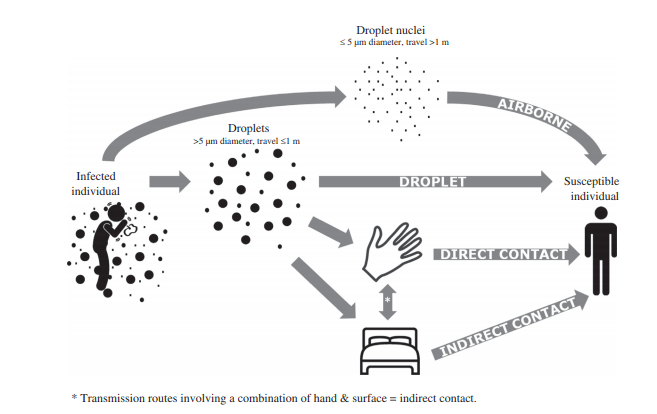
We know that respiratory viruses can be spread through droplets, occasionally aerosols, and contact routes (see Figure 1). But what is the relative importance of these transmission routes for the SARS-CoV-2 virus, which causes COVID-19? A new pre-print paper published yesterday provides evidence that the stability of the SARS-CoV-2 coronavirus is broadly comparable to the ‘original’ SARS coronavirus (SARS-CoV-1) on dry surfaces and in aerosols. This paper supports an important role for dry surface contamination and aerosols in the spread of SARS-CoV-2, and suggests that improved environmental persistence isn’t the key to the relative success of SARS-CoV-2 over SARS-CoV-1.

Figure 1: Transmission routes of respiratory viruses (from this review article).

covid transmission routes

Continue reading

Update on COVID-19: part 15, keep a distance

In my country we stopped shaking hands, because of SARS CoV-2, and in a large region people are asked to work at home. Is that justifiable, in light of the evolving pandemic? The answer is YES, according to two publications that appeared yesterday. Continue reading

Update on COVID-19: part 14, the changing picture

Where the world is gradually (or instantaneously) facing the COVID-19 reality, China claims victory. Yet, it ain’t over till it’s over, and many fear a rebound once daily life has returned to its normal practices and contact patterns. In the meantime our Chinese colleagues keep on producing very impressive epidemiological studies. Such as this one, published today. Continue reading

Developing antimicrobial “smart surfaces” to tackle HCAI and AMR

I participated in a launch event by the Institute of Molecular Science and Engineering (IMSE) at Imperial College London yesterday for a new white paper on developing “smart surfaces” to tackle HCAI and AMR.

Continue reading

Using machine learning to super-charge anti-infective drug discovery: the case of Halicin

30212411048_2a1d7200e2_b

Yes, it’s true. There is more to HCAI & AMR (and this blog) than COVID-19! To prove it, I’m posting on something different today – the use of AI to streamline the anti-infective drug discovery process. Scientists at MIT have used machine learning (aka “deep learning”) to improve the drug discovery process, by predicting antimicrobial activity in molecules that are different from known antibiotics. This process has yielded Halicin, a promising candidate molecule for a broad-spectrum antimicrobial agent – which is, of course, a long way from clinical trials!

Continue reading

COVID-19 Preparedness Survey

After discussions on IPC measures for COVID-19, some members of ISAC’s IPC working group decided to created a survey. The group would very much appreciate your participation:

https://www.surveymonkey.com/r/COVID-19_IPC

Thanks for your help

COVID-19 and my idea on masks

Next to the idea that we see many contraptions (you can’t even call them masks) we see many people with all kind of masks, in and outside our healthcare settings. Certainly after my last flight to a WHO meeting on COVID-19, I had the feeling that it is time to write about masks.

On my way to Geneva, the gentleman to my left (yes, thanks to a canceled flight, I was in the hated middle seat) was calm, sleepy and wearing a mask. The fellow on my right, clearly had the sniffles, came from somewhere far away and was spreading his respiratory secretions in all directions, including mine. I so wanted to pull of the mask from calm-sleepy-guy, to place it on the next-seat-germ-blower.

How easy could basic prevention be? Wouldn’t it be fantastic if people would adhere to simple principles of how to cough and sneeze in public: turn away from others, use a tissue or elbow, followed by hand hygiene? Why don’t the people on buses, trains and airplanes don’t know this? If in addition, anyone who is sick gets a surgical mask while in public, we might have a way of preventing (or at least delaying) the spread of respiratory viruses. Instead, masks are worn by the healthy, leaving the sick (and soon-to-be hospital patients) without the needed protection.

Talking about masks in healthcare; Nearly every country I know off, went for maximum safety, recommending FFP2 masks (similar to N95). I would have suggested to use FFP1 for the majority of cases, and FFP2 only during high-risk procedures. But how can I, if everyone else seems to go “full safety”. Another reason, why I believe that my idea wouldn’t have been too bad, is the high probability that soon we will have a shortage of FFP2 and will have to tell our HCWs that FFP1 and surgical masks are “equally save”. Yes, I can see how they believe me and willingly expose themselves to the increasing number of patients with less than previously needed PPE! I believe that we have valid reasons to consider evidence over maximum safety, and that while we didn’t even start to talk about discomfort and physical effects associated with prolonged use of FFP2. Continue reading

Coronavirunoia

I guess it was inevitable really – the Coronavirus paranoia (or Coronavirunoia) is setting in!

I called my local GP today to get an appointment for my son…

Continue reading