Is superoxidised water destined to be an environmental superhero?

OLYMPUS DIGITAL CAMERA

Anything that with claims that are too good to be true usually is. But the data coming out about superoxidised water does seem very impressive. The latest research study, coming from the Cleveland VA, evaluated an electrochemically activated saline solution, also known as ‘superoxidized water’. Surprisingly, the novel disinfectant performed comparably to 10% bleach in vitro. VRE, MRSA and C. difficile spores were dried onto surfaces and exposed to 10% bleach or superoxidised water (Sterilox). The superoxidised water matched the bleach log for log (both achieving a 5-6 log reduction with no organic load and a 3-4 log reduction with organic load present). This was true even for the C. difficile spores. The team also evaluating the efficacy of spraying superoxidised water on wall-mounted equipment, finding that 12% of 66 cultures grew C. difficile before treatment, compared with none of the matched sites after treatment.

Superoxidised water lacks some of the drawbacks associated with 10% bleach, principally compatibility with electronic equipment as demonstrated in this study. This agent should be prioritized for further evaluation.

Article citation: Fertelli D, Cadnum JL, Nerandzic MM, Sitzlar B, Kundrapu S, Donskey CJ. Effectiveness of an electrochemically activated saline solution for disinfection of hospital equipment. Infect Control Hosp Epidemiol 2013;34:543-544.

An environmental odyssey

Research from the Cleveland VA published in the ICHE special edition tells a fascinating story of sequential interventions to reduce environmental contamination with C. difficile. The research includes pretty much the whole battery of environmental interventions at our disposal: education of housekeepers, the introduction of a specially trained “A” team, ATP bioluminescence, fluorescent markers and UVC for “no-touch” disinfection. About the only thing missing is copper surfaces!

Before we get to the interventions, let’s just reflect on the fact that somewhere between 60-70% of rooms were contaminated with C. difficile after terminal disinfection in the baseline period. It’s little wonder that admission to a room previously occupied by a patient with C. difficile increased the chances of developing C. difficile infection! Related to this, there’s some interesting thoughts at the beginning of the discussion about whether there could be a “safe” level of C. difficile contamination. I discussed this in a previous blog post here.

The introduction of fluorescent marking with feedback did not eliminate the C. difficile environmental contamination, with 50-60% of cultures remaining contaminated. Similarly, the introduction of a UVC “no-touch” room disinfection system for terminal disinfection did not solve the problem, with 30-40% of cultures remaining contaminated. Only when daily disinfection was performed by a dedicated team and terminal disinfection was performed by EVS supervisors and/or the infection control team was the problem finally solved and C. difficile could no longer be cultured from surfaces. It’s disappointing that the intervention that worked in eliminating C. difficile room contamination comprised improvements in both daily and terminal cleaning, so it’s not possible to determine which was most important. It seems likely that a combination of the two did the trick.

environmental-odyssey2

Figure: sequential interventions to tackle environmental contamination with C. difficile.

The study used robust microbiology methods to sample the environment, comprising swabs plated directly onto selective agar, and gauze pads from the same surfaces cultured through broth enrichment. The % positive sites from the enriched gauzes was approximately double the swabs inoculated directly onto agar, demonstrating the value of broth enrichment for environmental sampling.

Another important study finding was that the effectiveness of room cleaning prior to UVC room disinfection was sub-optimal, indicating that the housekeepers were placing too much faith in the automated system, which is designed only to disinfect and not to clean.

So what does this odyssey mean? Firstly that a combination of interventions can be useful, and secondly, the extraordinary lengths required to eliminate C. difficile spores from the environment.

Article citation:

Sitzlar B, Deshpande A, Fertelli D, Kundrapu S, Sethi AK, Donskey CJ. An Environmental Disinfection Odyssey: Evaluation of Sequential Interventions to Improve Disinfection of Clostridium difficile Isolation Rooms. Infect Control Hosp Epidemiol 2013;34:459-465.

How the implementation of hydrogen peroxide vapour (HPV) could save you money

On a recent trip to the US, I asked five or six hospitals what their policy was for dealing with packaged medical supplies (syringes, dressings etc) from the rooms of patients on precautions for MDROs. The response was startling: every hospital had a different policy. The policies ranged from 100% disposal of supplies for every discharge through a “toss heavy toss light” approach depending on the perceived risk of the patient to 0% disposal. I scoured international guidelines and, save a few organism-specific guidance documents, there is no direction on this issue in the guidelines.

What actually happens is another issue. Hospitals with a 100% disposal policy knew that staff often could not bring themselves to throw away perfectly good, sometimes fairly valuable items (IV sets and the like) for the small risk that the packaging may be contaminated. Some threw their supplies into “third world bins” to send to underprivileged hospitals, which is great, unless they happen to be contaminated with an MDRO that would survive the journey! Conversely, hospitals with a 0% disposal policy know that sometimes staff threw out the supplies if the patients had a high perceived risk of shedding. As for the “toss heavy toss light” hospitals: who knows what actually happens.

So, is there a real risk associated with contamination of the packaging of these items? A recent study by Johns Hopkins published in the recent ICHE special issue sampled a selection of supplies to quantify the risk, counted the cost of their current policy and found a potential solution in the use of hydrogen peroxide vapour (HPV) for the disinfection of the supplies. The study found that the packaging of 7-9% of supply items was contaminated with MDROs, and that hydrogen peroxide vapor (HPV) was effective for the disinfection of the supply packaging. The cost of supplies discarded from six ICUs amounted to almost $400,000, not including the costs associated with waste disposal. Hence, the practice of disinfecting the packaging of supplies using HPV would generate substantial cost savings.

Can the introduction of 6 copper items into ICU rooms really reduce the rate of HAI by >50%?

The recent article by Salgado et al.in the ICHE special edition is the long-awaited copper study: a multi-centre evaluation of the clinical impact of introducing 6 copper alloy high-touch sites into the rooms of patients on three ICUs. I’ve been looking forward to getting my hands on this study for some time!

copper bed

Patients (n=614 following exclusions) were randomized to intervention ‘copper’ rooms and control ‘non-copper’ rooms in three USA ICUs over an 11 month period. The only difference between the rooms was the presence of six items made of copper alloy, comprising bedrails, overbed tables, IV poles and visitor chair arms in all rooms and the nurse call button, computer mouse, computer palm rest and rim of a touch-screen monitor in other rooms.

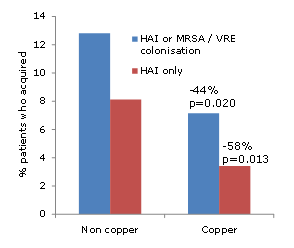
Patients admitted to copper rooms were significantly less likely to acquire healthcare-associated infection (HAI) or colonization with MRSA / VRE (Figure).

evidence of copper for hai

Figure: difference in acquisition rate between patients admitted to ‘copper’ or ‘non-copper’ rooms

The authors also make an interesting association between the degree of contamination in patient rooms and the risk of acquisition. However, since sampling was performed weekly regardless of a patient’s infection or colonization status, it is not possible to determine whether this association is causal or simply due to the fact that infected / colonized patients are likely to shed more bacteria into the hospital environment.

The study team should be commended for the careful design and attention to detail in the execution of the study. For example, they performed a daily census of the items in the study to determine exactly who was exposed to copper surfaces, and for how long. This indicated that only half of the patients in ‘copper’ rooms were exposed to all six copper items for the duration of their stay, and 13% of patients in the ‘non-copper’ arm were exposed to some copper items during their stay. It’s important to note that the analysis was performed on an ‘intention to treat’ population, i.e. all patients randomized to the two groups, regardless of which items they were actually exposed to. It would have been interesting to see a sub-analysis on the ‘per protocol’ population (i.e. those patients admitted to ‘copper’ rooms and exposed to all six copper items vs. those patients admitted to ‘non-copper’ rooms and exposed to no copper items). Also, I’m not sure why they chose to analysis % acquisition rather than a comparison of rates between the groups. And then there’s the salary support and grant funding to some authors (not directly related to this study) from the Copper Development Association. Notwithstanding these limitations, it does seem that the introduction of copper high-touch surfaces does reduce the transmission of hospital pathogens.

The scale of the difference is incredible. And I mean just that. It lacks credibility. Many will dismiss the study simply because of the scale of the difference between the groups. So, can the introduction of 6 copper items into ICU rooms really reduce the rate of HAI by >50%?

The degree to which contaminated surfaces contribute to the transmission of pathogens is up for debate. I was asked to give a talk at APIC 2012 on the role of the environment. Prior to the talk, I asked the expert faculty a question: ‘What is your estimation of the % of allC. difficile transmission in hospitals that is mediated, directly or indirectly, by contamination of the inanimate environment?’ The answers ranged from 25-75%, reflecting the uncertainty on this issue.

A recently published study by Johns Hopkins provides some illuminating findings (albeit indirectly). Extrapolating unadjusted acquisition rates from all study cohorts indicates that if rooms had been disinfected using hydrogen peroxide vapour (HPV) after every discharge, the overall rate of acquisition of MDROs would have been halved. Whilst it’s not feasible to disinfect all rooms using HPV at patient discharge, this does add some weight to the scale of the reduction identified in this copper study.

It seems that the introduction of a handful of copper alloy high-touch sites had a profound impact on HAI rates. On reflection, I do believe it possible that the scale of reduction in study is “real”. However, questions remain over the practicality and durability of the widespread adoption of copper alloy surfaces in healthcare.

Article citation:

Salgado et al. Copper surfaces reduce the rate of healthcare-acquired infections in the intensive care unit. Infect Control Hosp Epidemiol 2013;34:479-486.


How long does it take to clean a hospital room properly?

Long hours don’t necessarily correlate with productive output. A lifetime’s practice does not necessarily make a champion tennis player. An old boss once told me that “practice doesn’t make perfect; perfect practice makes perfect”. I think there’s something in this that goes some way to explaining the findings of a recent study examining the time taken to clean a hospital room and the thoroughness of cleaning.

You would expect that longer cleaning times would result in more thorough room cleaning. However, the authors used a fluorescent marker to evaluate the thoroughness of cleaning and found no correlation between the length of time cleaning a room and the thoroughness of cleaning.

man_mop

Since this was an assessment of “terminal cleaning” (when the patient was discharged) you would hope that the rates of cleaning for the items in the room would be high. However, the marker was removed from less than half marked sites, and only 5% of monitors were cleaned in the 40 rooms assessed. Disappointingly, there was no correlation between completion of a room a cleaning checklist and removal of the markers.

So, the efficacy of cleaning remains low, even at patient discharge, so it is not surprising that admission to a room previously occupied by a patient with certain multidrug-resistant organisms increases the risk of acquisition!

Article citation: Rupp et al. The time spent cleaning a hospital room does not correlate with the thoroughness of cleaning. Infect Control Hosp Epidemiol 2013;34:100-102.

Improved terminal disinfection using hydrogen peroxide vapour (HPV) or bleach to control C. diff

A prospective before-after study at the 900 bed St. John’s Mercy Medical Center evaluated the impact of an HPV intervention focused on the terminal disinfection of rooms used by patients with multidrug-resistant organisms and C. difficile. HPV was introduced on a priority scale accounting for the target pathogen and the risk associated with the unit. Due to local prevalence, most of the rooms decontaminated using HPV were vacated by patients with C. difficile infection (CDI). Hence, the authors evaluated the impact of introducing HPV on the rates of CDI.
The rate of CDI was static prior to the introduction of HPV, with no significant change in rate from 2007 to 2008 (Figure). Hence, this study was performed in a truly endemic setting in contrast to a previous study of a similar design by Boyce et al., which was performed in a “hyper-endemic” setting. When HPV was introduced in 2009 (along with enhanced conventional methods comprising quadruple bleach disinfection for rooms that could not be disinfected using HPV), the rate of CDI fell by 37% from 0.9 to 0.5 cases per 1000 patient days (p<0.0001) (see chart below).
Chart showing the rate of C. difficile infection before and after the implementation of HPV or quadruple bleach disinfection for the terminal decontamination of patient rooms.
Micro Blog Jan 2013
Recent data have shown that patients admitted to rooms previously occupied by a patient with C. difficile are at an increased risk of developing C. difficile infection. Thus, it seems logical that improving the efficacy of terminal disinfection would result in reduced rates of CDI. Furthermore, the scale of reduction in CDI incidence was remarkably similar to the study by Boyce et al. (37% vs. 39%), though in this previous study, the 39% hospital wide reduction was not statistically significant.
The major criticism of the study is that HPV and quadruple bleach disinfection were implemented more or less simultaneously so it’s not possible to attribute the reduction to HPV alone. This is complicated by the fact that quadruple bleach disinfection was implemented for all C. difficile rooms in mid-2008, 6 months prior to the introduction of HPV. So, it is possible in theory to do a sub-analysis of corresponding months during the period when quadruple bleach disinfection alone compared with HPV plus quadruple bleach disinfection was in operation. However, this sub-analysis was not performed. A previous study by the same group showed that quadruple bleach disinfection was necessary to eliminate A. baumannii and MRSA from surfaces, and that HPV was microbiologically superior to quadruple bleach disinfection. Thus, since HPV has time and efficiency savings compared with quadruple bleach disinfection, it is cost effective to use HPV in this setting.
The authors undertook a careful evaluation of hand hygiene and glove / gowning compliance, showing that these were not significantly different comparing the pre-intervention and intervention periods. They also evaluated the use of key antimicrobial agents and found that there were small but statistically significant changes in antimicrobial usage, which may have confounded the association with improved disinfection. However, levofloxacin use (one of the high risk CDI drugs) increased significantly in 2009 and there was still a significant reduction in CDI.
The paper includes some useful data on feasibility and safely aspects of implementing HPV, and the ‘priority scale’ (Appendix) for deciding which rooms were disinfected using HPV is rational and will help other hospitals decide on a similar priority scale.
Several other points of interest are reported. For example, the significant reduction in CDI was achieved whilst adhering to US C. difficile control guidelines, which recommend the use of gloves and alcohol based hand products (rather than hand washing with soap and water) for treating patients with CDI in endemic settings. They also held patients who had CDI in contact precautions for the duration of their stay, not just until symptoms resolved.
This study shows that more effective removal of C. difficile spores from the rooms of patients when they are discharged through enhanced conventional methods combined with the implementation of HPV reduces the hospital-wide incidence of CDI. The authors conclude: ‘implementation of an enhanced hospital-wide terminal cleaning program revolving around HPV decontamination of targeted hospital rooms was practical, safe, and associated with a significant reduction in the endemic rate of CDI at our hospital.’
Article citation: Manian FA, Griesnauer S, Bryant A. Implementation of hospital-wide enhanced terminal cleaning of targeted patient rooms and its impact on endemic Clostridium difficile infection rates. Am J Infect Control in press.

Hydrogen peroxide at war with catalase

Methicillin-resistant_Staphylococcus_aureus_b2340183_1

A study published by the UK Health Protection Agency highlights the fact that MRSA dried on surfaces appears to be less susceptible to hydrogen peroxide vapour (HPV) than bacterial endospores in the form of commercially produced biological indicators. This is a surprise because bacterial endospores are generally considered to be close to the top of the tree in terms of resistance to disinfection and sterilization. The answer lies in the enzyme catalase. Catalase breaks down hydrogen peroxide and is produced by MRSA but not by the metabolically inert spores. A previous study also showed that catalase-producing bacteria were less susceptible to HPV than bacteria that did not produce catalase and metabolically inert spores.

Bacterial endospore biological indicators (BIs) are typically used to monitor the efficacy of HPV systems. Does the finding that MRSA and probably other catalase-producing bacteria are less susceptible to HPV, “cell for spore”, than bacterial endospores challenge the use of BIs to monitor decontamination using HPV? In vitro susceptibility is important, but the resistance of a ‘system’ to HPV will be determined by a number of factors including the relative susceptibility of the organisms, suspending medium, substrate and inoculum. Thus, you’ll never get a “one-size-fits-all” monitoring system for HPV. BIs provide a stringent, repeatable, consistent and safe method to monitor the efficacy of HPV. Whilst they may not be top of the tree in terms of efficacy, BIs provide a useful yard-stick for monitoring efficacy.

Article citation: Pottage T, Macken S, Walker JT, Bennett AM. Meticillin-resistant Staphylococcus aureus is more resistant to vaporized hydrogen peroxide than commercial Geobacillus stearothermophilus biological indicators. J Hosp Infect 2012; 80:41-5.

Mitigating the increased risk from the prior room occupant through HPV room disinfection

The role of surface contamination is increasingly recognised in the transmission of certain nosocomial pathogens1. The most compelling evidence comes from the finding that admission to a room previously occupied by a patient infected or colonised with some multidrug-resistant organisms (MDROs) increases the risk of acquiring that MDRO for the subsequent room occupant by a factor of two or more1-3. Conventional cleaning and disinfection does not reliably remove all environmental MDROs4,5. Hence, it seems that inadequate terminal disinfection of hospital rooms explains the association with the increased risk of acquisition from the prior room occupant. It follows, then, that improvements in terminal disinfection should reduce the levels of residual contamination and the transmission of pathogens through this route. A recent study from Johns Hopkins Hospital tested this hypothesis through the introduction of hydrogen peroxide vapour (HPV) terminal disinfection of selected patient rooms6.

A 30-month prospective cohort intervention study was performed on 6 high-risk units (5 ICUs). HPV was implemented on 3 of the units following a 12-month pre-intervention phase. Clinical impact was assessed by a cohort study. Each patient admitted to any study unit during both phases was included in one of three cohorts:

  • ‘MDRO-standard’ Patients admitted to a room where the prior room occupant had an MDRO and the room was disinfected using standard methods.
  • ‘MDRO-HPV’Patients admitted to a room where the prior room occupant had an MDRO and the room was decontaminated using HPV
  • ‘No MDRO-standard’ Patients admitted to a room where the prior room occupant was not known to have an MDRO and the room was disinfected using standard methods.

The key finding was that patients admitted to rooms decontaminated using HPV were 64% less likely to acquire any MDRO (incidence rate ratio [IRR] of the MDRO-HPV vs. MDRO-standard cohorts = 0.36, confidence interval CI=0.19-0.70, p<0.001) (see chart below).


Chart showing the MRDO acquisition rate in the three patient cohorts.

MRDO acquisition rates

‘MDRO-standard’ = Patients admitted to a room where the prior room occupant had an MDRO and the room was disinfected using standard methods. ‘MDRO-HPV’ = Patients admitted to a room where the prior room occupant had an MDRO and the room was decontaminated using HPV.

‘No MDRO-standard’ = Patients admitted to a room where the prior room occupant was not known to have an MDRO and the room was disinfected using standard methods.


The difference between cohorts was adjusted for patient level variables such as length of stay, morbidities and other variables that could explain the difference. This means that the difference between cohorts is attributable to HPV alone. When broken down into individual MDROs, the largest reduction was shown for VRE (a 75% reduction, p<0.0001). HPV provided a protective effect for the other MDROs assessed (C. difficile, MRSA and MDR-Gram-negative rods), but differences for these individual pathogens were not statistically significant.

Surprisingly, even when the prior room occupant was not known to have an MDRO, HPV reduced the risk of acquisition by 51% (comparing the MDRO-HPV with the No MDRO-standard cohort). You’d expect the acquisition rate in the ‘MDRO-HPV’ cohort to match the ‘No MDRO-standard cohort’. In fact, it is lower. This is likely due to survival of contamination from previous occupants, unrecognised colonisation or introduction by healthcare workers.

Environmental impact was assessed by sampling each patient room on all units monthly for the last 3 months of the pre-intervention phase and the first 6 months of the intervention phase. Swabs were collected from all patient rooms, occupied or unoccupied, regardless of patient status. The overall percentage of rooms contaminated with one or more MDRO was reduced significantly when HPV was in operation. Further, rooms contaminated with multiple MDROs, occasions when the MDRO from room differed from the room occupant’s known MDRO and MDROs cultured from empty rooms were less likely when HPV was in operation.These changes are due to improved terminal disinfection using HPV.

Whilst this study is one of the few to evaluate patient outcomes in addition to environmental impact of a no-touch automated room disinfection system7. it does have several limitations, some of which are highlight in an accompanying editorial8. Firstly, the rooms or units were not randomized to an intervention arm, which could have introduced bias. Secondly, whilst the conventional disinfection methods were optimized prior to the introduction of HPV, more could have been done to improve the efficacy of conventional methods which may have over-estimated the impact of HPV. Thirdly, the low prevalence of acquisition (especially for MDROs besides VRE) made detecting changes in incidence difficult. Fourthly, whilst the infection rates in the three cohorts did not change significantly with study phase and the clinical impact on an individual patient level was impressive, overall unit level changes in rates of infection were not reported.

The study has important implications for the proportion of transmission that is likely to involve contaminated surfaces. Extrapolating unadjusted data from the study indicates that 16.7% of the acquisitions that occurred during the study were attributable directly to the prior room occupant. This figure most likely underestimates the total contribution of contaminated surface to nosocomial transmission because contaminated surfaces are likely to be involved indirectly in transmission during the stay of affected patients1.

In summary, HPV disinfection significantly reduced the risk of patients acquiring MDROs from previous room occupants in high-risk settings. Furthermore, HPV also provides a protective effect even when the prior room occupant was not known to be infected or colonised with an MDRO. These clinical findings are supported by environmental data showing that HPV disinfection improves the efficacy of terminal disinfection, thus reducing environmental contamination. Whilst the study is not without its limitations, it takes the question of how to tackle hospital environmental contamination forward a pace or two.

Article citation: Passaretti CL, Otter JA, Reich NG et al. An evaluation of environmental decontamination with hydrogen peroxide vapor for reducing the risk of patient acquisition of multidrug-resistant organisms. Clin Infect Dis 2013; 56: 27-35.

References:

1.  Otter JA, Yezli S, French GL. The role played by contaminated surfaces in the transmission of nosocomial pathogens. Infect Control Hosp Epidemiol 2011; 32: 687-699.

2.  Drees M, Snydman D, Schmid Cet al. Prior environmental contamination increases the risk of acquisition of vancomycin-resistant enterococci. Clin Infect Dis 2008; 46: 678-685.

3.  Huang SS, Datta R, Platt R. Risk of acquiring antibiotic-resistant bacteria from prior room occupants.Arch Intern Med 2006; 166: 1945-1951.

4.  Manian FA, Griesenauer S, Senkel Det al. Isolation of Acinetobacter baumannii complex and methicillin-resistant Staphylococcus aureus from hospital rooms following terminal cleaning and disinfection: can we do better? Infect Control Hosp Epidemiol 2011; 32: 667-672.

5.  French GL, Otter JA, Shannon KP, Adams NM, Watling D, Parks MJ. Tackling contamination of the hospital environment by methicillin-resistant Staphylococcus aureus (MRSA): a comparison between conventional terminal cleaning and hydrogen peroxide vapour decontamination. J Hosp Infect 2004; 57: 31-37.

6.  Passaretti CL, Otter JA, Reich NGet al. An evaluation of environmental decontamination with hydrogen peroxide vapor for reducing the risk of patient acquisition of multidrug-resistant organisms. Clin Infect Dis2013; 56: 27-35.

7.  Otter JA, Yezli S, Perl TM, Barbut F, French GL. Is there a role for “no-touch” automated room disinfection systems in infection prevention and control? Submitted. J Hosp Infect 2013; 83: 1-13.

8.  McDonald LC, Arduino M. Climbing the evidentiary hierarchy for environmental infection control. Clin Infect Dis 2013; 56: 36-9.

Hydrogen peroxide vapour vs. aerosol

q-10vsasp4

There has been an awful lot of discussion out in the field about various hydrogen peroxide systems used for “no-touch” automated room disinfection. Comparison of different systems through assessment of individual studies is tricky because different methods are used to assess the effectiveness of the products. Thus, the only way to get an accurate comparison of different technologies is through head-to-head comparisons.

A recently published study compared a hydrogen peroixde vapour (HPV) system (Bioquell) with an aerosolised hydrogen peroxide (aHP) system (ASP Glosair). The independent study was performed by researchers at St. Georges’ Hospital Testing was performed in a 50m3 room with a 13m3 anteroom, representing a single occupancy room with bathroom. For both systems it was found that rooms must be sealed to prevent leakage and room re-entry must be led by a hand held sensor to ensure safety. HPV generally achieved a 6-log reduction of spore BIs and in-house prepared test discs inoculated with MRSA, Clostridium difficile and Acineotbacter baumannii, whereas aHP generally achieved a 4-log reduction or less. The aHP system had reduced efficacy against the catalase-positive A. baumannii with a <2-log reductions in the majority of room locations. HPV was able to penetrate soiling more effectively than aHP and uneven distribution of the active agent within the enclosure was evident for aHP but not for HPV.

It is difficult to produce a laboratory challenge that is truly representative of field conditions, but the authors did a thorough job and used several different ways to measure the efficacy of the products, concluding that ‘the HPV system was safer to operate, slightly faster and achieved a greater level of biological inactivation than the aHP system.’

Article citation: Fu TY, Gent P, Kumar V. Efficacy, efficiency and safety aspects of hydrogen peroixde vapour and aerosolized hydrogen peroixde room disinfection systems. J Hosp Infect 2012; 80: 199-205.