Making IPC live for frontline healthcare workers – part 2

I’ve written this post in preparation for next Wednesday’s IPS Journal Club in partnership with the Infection Prevention Society (register here). (Please note, it will be a little earlier in the day than most previous Journal Clubs, so don’t miss it, and yes I stole this paragraph from Jon). 

The paper that I have chosen for the Journal Club is this one  in the Journal of Infection Prevention, exploring infection prevention behaviour in midwifery staff. 

Kerry, Jon and I had an interesting discussion last week about which ‘live’ we use for this journal club. I think I am an advocate for both and will remain rooted to the fence! Why? We are bringing the journal club to you live and also we want everyone to live Infection Prevention and Control! 

Why did I choose this article? 

  • This is a qualitative study which I am reading more and more of as I try to understand and unpick the human behaviour and perception elements of IPC. In my opinion understanding these better can help support optimal delivery of IPC and patient care 
  • The research was conducted amongst midwives which I was interested to read more about given the high demands on midwifery services and some of the negative press midwifery services have faced in recent years 
  • I am big fan of ‘thematic analysis’ which was framework used for the analysis of the different themes arising from the semi structured interviews with midwives 

Design and methods 

  • To aim was to understand midwives’ experiences of the barriers and facilitators when adhering to infection prevention and control guidelines
  • Semi-structured interviews were conducted with 10 midwives working at a University Hospital in Ireland,  to form a qualitative descriptive study
  • A range of experience levels among participants were sort, including registration with the national nursing and midwifery board and at least 1 year of experience
  • Interviews were audio recorded, transcribed verbatim, and analysed utilising Braun and Clarke’s thematic analysis framework

Key findings 

  • Two themes were identified from the data analysis; (1) the seesaw for equilibrium; and (2) back to basics: learning on your feet.

Seesaw for equilibrium

  • Participants identified the need to find a balance between the demands and uncertainty of everyday practice and the desire to practice safely
  • Participants expressed a difficulty in balancing the ability to adhere to IPC guidelines when performing night duty or working long days as well as the physical demands of the participants’ work
  • Dealing with the effect of one’s workload and balancing workloads contributed to behaviours deviating from the IPC guidelines in the clinical practice setting.

Back to basics: Learning on your feet

  • Participants expressed frustration in having to deal with other disciplines who appeared to adopt a culture of ‘blame the midwife’ when matters relating to IPC were not put in place
  • At an environmental level, the ‘old’ and ‘not fit for purpose’ building infrastructure, physical layout and facilities of wards affected the participant’s ability to adhere to IPC guidelines
  • Some participants felt there was an overuse of posters (such as poster promoting hand washing), and the behavioural prompter was lost 
  • Participants experienced a ‘reactive rather than proactive’ approach from hospital management when there was an IPC issue

Strengths and limitations

  • The number of participants was 10 and only represents a handful of views 
  • All the participants were from the same hospital so it would be interesting to extend this out to others to see if the findings are generalizable 

Points for discussion 

  • There are clearly challenges in the delivery of safe maternity care whilst trying to maintain IPC guidelines and factors such as work patterns, environment, and resource availability impact guideline adherence
  • Do we need to reconsider visual overload? Do we have too many visual cues which confuse the messaging? How can we make our messaging more concise? 
  • Strategies like the buddy system, huddle, ISBAR, and behaviour-focused education, along with management support, are crucial.
  • There was a narrow focus on certain aspects of standard IPC precautions during the COVID-19 pandemic which led to neglect of other IPC elements. Do we need to revisit IPC guidelines post COVID? 
  • How do we strike a balance between delivering IPC safe care whilst dealing with the challenges of a busy, emotionally charged and often stressful working environment?

What does this mean for IPC? 

  • Fear, anxiety, professional integrity, and protection were key motivators for guideline adherence. How can we tackle these perceptions to make IPC guidelines less scary and more deliverable? 
  • Rapid guideline changes around COVID led to confusion and frustration so do we need to rethink IPC guidance post COVID? Could a refresh help?
Assessing the prevalence of MRSA and VRSA in Ethiopia

I’ve written this post in preparation for this week’s Journal Club in partnership with the Healthcare Infection Society themed around their MRSA article collection: “‘MRSA The Enduring Foe”. Having spent a lot of time working on MRSA as part of my PhD and it regularly cropping up as an organism of concern in IPC I was interested to read about the author’s experience, particularly in a less economically developed country. 

Why I chose this article:

  • I agree with Jon from his blog last week that MRSA isn’t the foe that it once was, but it is still highly relevant and topical, especially from a global health perspective.
  • It’s less frequent to encounter vancomycin-resistant Staphylococcus aureus (VRSA) so I was interested in prevalence of VRSA.
  • I was interested to read about the prevalence of MRSA and VRSA in wound infections in a less economically developed country. 
  • MRSA has been reported at very high prevalence levels in Africa previously so I was interested if this study was comparable.

Design and methods:

  • The study was undertaken at Nekemte Specialized Hospital in Western Ethiopia. 
  • Over a six month period swabs were taken from patients presenting with wound infections and 384 wound swabs (from 384 patients) were taken. 
  • Wound swabs were plated onto chromogenic agar and antibiotic susceptibility to vancomycin and cefoxitin was assessed using disc diffusion.

Key findings:

  • The majority of wounds (63%) were deep wounds and 30.7% of study subjects had wound infections on their legs, followed by 20.6% on their feet and 16% on their hands. 
  • S. aureus was isolated from 28.4% of wounds.
  • 6.4% of S. aureus isolates were sensitive to all antibiotics tested. 
  • The prevalence of MRSA and VRSA among the isolates was 40.4% and 7.3% respectively.
  • From a total of 44 MRSA isolates, 72.7% of them showed multidrug resistance.
  • MRSA resistance against other antibiotics was also shown in the present for ciprofloxacin (45.5%), cotrimoxazole (40.9%), gentamicin (36.4%), chloramphenicol (34%), clindamycin (25%), erythromycin (15.9%), and vancomycin (9.1%).
  • Age, sex, educational level, and marital status were not predictors for the prevalence of MRSA.
  • The depth of the wound, history of wound infection, and history of antibiotic use in the last 6 months was significantly associated with the prevalence of MRSA. 

Points for discussion:

  • The prevalence of S. aureus wound infection is consistent when compared to similar geographical regions but lower than the pooled national prevalence estimate. The rates of S. aureus wound infection reported in this study seem to be quite comparable with UK data.
  • The high prevalence of multidrug resistance in the MRSA isolates is concerning! 
  • What is the correct method to detect VRSA? Disc diffusion is not recommended by CDC.  
  • What are the treatment options given the resistance to multiple antibiotics observed in the MRSA isolates?  
  • What are the best options for decolonisation of S. aureus prior to surgery given the incidence of study participants who developed wound infections following surgery. 
  • Some of the prevalence rates of MRSA referenced in this study were truly staggering! 86% of all S.aureus isolate were MRSA in this study from Nigeria! 
  • The prevalence of VRSA (7.3%)  was significantly higher than other studies.  
  • What do these results mean in the context of the antimicrobial resistance (AMR) pandemic? 

What this means for IPC

  • Depth of the wound, the patient’s setting, previous wound infections, and antibiotic treatment in the previous six months were significantly associated with MRSA wound infection so should be considered as risk factors.
  • Prevention is better than cure, given the limited treatment options when resistance to multiple antibiotics is reported. 

Finally, I hope you can join us for Journal Club Wednesday (register here).

Using whole genome sequencing to investigate a Burkholderia ICU outbreak

I’ve written this post in preparation for Wednesday’s Journal Club (register here) in collaboration with IPC Partners

Burkholderia are fascinating genus of bacteria which I had the pleasure of doing some post doctoral work on. The ability of the species to innately resist antibiotics and preservatives, as well as prolonged persistence in the environment means the organisms can cause challenges for healthcare organisations and infection prevention and control. I have seen an increasing number of publications in recent years linking outbreaks to contaminated medical devices and even disinfectants (good systematic review here). Therefore this paper published in The Journal of Hospital Infection investigating a Burkholderia cenocepacia outbreak using whole genome sequencing (WGS) grabbed my interest. I have also been interested in the role of WGS in detection and prevention of outbreaks (see a previous IPC Partners by Dr Alex Sundermann) and the potential benefits.  

Design and methods 

  • The outbreak took place in an intensive care unit in Vietnam between May and August 2023 affecting 19 patients 
  • Environmental sampling of high touch surfaces, fluid samples and medical devices was performed 
  • WGS was performed on all available B. cenocepacia complex (Bcc) isolates using Illumina Hiseq platform. In total WGS was performed on 20 clinical isolates and 3 environmental isolates (from used syringes)
  • Prior to investigating with WGS it had been suspected that positive clinical Bcc samples were the result of blood culture contaminants

Key findings

  • Environmental sampling identified 3 B. cenocepacia isolates from separate syringes using to deliver IV fluids 
  • No growth of microorganisms was detected in samples of skin antiseptics, hand sanitizers and ultrasound gel (surprising to me!)
  • WGS confirmed that all B. cenocepacia isolates from clinical and environmental samples belonged to the same sequence type 
  • The isolates carried an array of acquired antimicrobial resistance genes predicted to confer resistance to carbapenems, sulfonamide, and tetracycline
  • The source of the outbreak was not identified but limitations in the preparation and administration of IV fluids were identified 

What this means for IPC

  • WGS can successfully be used to aid hospital outbreak investigation which is particularly relevant for complex bacteria such as Burkholderia, in which traditional detection and typing methods often have low sensitivity
  • WGS can be implemented successfully in low and medium income countries such as Vietnam but requires strong collaboration between IPC, clinical microbiologists and molecular biologists 
  • WGS allowed species identification which is important in this context, as the Bcc complex comprises of more than 22 different species, exhibiting differing epidemiological and pathologic features, and varying susceptibility to antibiotics both in vitro and in vivo. Misidentification may lead to inappropriate antimicrobial therapy. 
  • The study highlights the importance of following aseptic practices and procedures in handling and administration of intravenous medications to avoid bacterial contamination and prevent infection

IPS Journal Club: A real time intervention to increase CHG bathing and reduce CLABSIs

I’ve written this post in preparation for Wednesday’s IPS Journal Club (register here) in collaboration with IPC Partners

The paper that I have chosen for the Journal Club is this one in the Journal of Infection Prevention, describing a real time intervention to increase chlorhexidine (CHG) bathing to reduce central line-associated blood stream infections (CLABSIs).

Why I choose this paper?

  • CHG bathing has shown promise in reducing various infections (such as CLABSIs) therefore evidence demonstrating the effect on infections is welcome
  • A recent estimate of the cost of CLABSIs is extremely high – $48,108 for every case according to the Agency for Healthcare Research and Quality
  • I was really interested in the use of a ‘real time intervention’ given the challenges which are faced around effective implementation of interventions

Design and methods

  • The study was a quality improvement project (QIP) which aimed to increase the rate of daily CHG bathing adherence for patients
  • The QIP was conducted at a 166-bed acute care community hospital in the US over 4 months
  • A Fishbone Diagram and an Impact Effort Matrix were used to identify barriers. Barriers identified included difficulty in identifying CHG documentation, as well difficulties in identifying patients that are due for CHG bathing
  • This led to the development of a ‘Time Since Bathing Column’ to make identification of missing CHG bathing opportunities more apparent within the Electronic Health Record (EHR). This allowed the hospital IPC team to provide real-time feedback when CHG bathing was overdue for a specific patient
  • A consistent message and message platform within the EHR allowed standardisation of the message content and the method of delivery
  • A sustainability plan was introduced using tools and dashboards to create individual plans focusing on ownership and empowerment of frontline staff to ensure frontline bathing  

Key findings

  • Prior to the intervention CHG bathing rate adherence was 94.9% (already very impressive) with a CLABI rate of 1.89
  • Following the implementation of the real intervention a 0.42% increase in CHG bathing adherence was detected (which was not significantly significant)
  • When including weekend CHG adherence rates in the analysis, a 2.8% increase in CHG adherence was detected (97.6%), which was statistically significant (the QIP identified that CHG bathing adherence was low on weekends)
  • No CLABSIs were identified in the 3-month study period, and 12-month CLABSI rolling rate decreased from 1.78 to 1.07 (however the sample size was too small to perform statistical analysis)

Strengths and limitations

  • CHG adherence was already extremely high, so challenges in a detecting a significant change however the QIP identified reduced CHG adherence over weekend periods
  • Although CLABSIs rate decreased the sample size was too small to identify any statistical significance  

What does this mean for IPC?

  • Cross functional working with informatic and digital teams can improve CHG adherence and potentially reduce CLABSI rates
  • Real time interventions can identify falls in CHG adherence at times where staffing levels are low, such as weekends
  • Real time feedback accompanied by multidisciplinary team engagement with clinicians were important success factors
  • Outreach and reminders effectively improved CHG bathing adherence by emphasizing the importance of consistent communication and follow-up

Water-free patient care: a narrative review of the literature

In preparation for today’s Journal Club in partnership with the Healthcare Infection Society around water hygiene (details and registration here), I’ve reviewed this article in the Journal of Hospital Infection.

Why I choose this article?

Waterborne healthcare associated infections (and the prevention of), have always been an area of interest for me. Papers and evidence identifying the significance of the risk (particularly in the intensive care setting), and the challenges posed by outlets other than sinks and showers, such as toilets (read related blog here) have increased significantly.

This has resulted in novel ways of reducing the risks posed by waterborne infections being explored, including the concept of water-free or water light patient care. With that in mind I was really interested to read this article by Teresa Inkster  and colleagues. What better way than a narrative review from some of the world’s leading authorities on water, to examine if there really is a benefit to implementing water-free care?

Using a defined search criterion, the narrative review identified seven papers, the majority of which focused on implementing water-free care in the intensive care unit (ICU) setting. 

Key findings

  • Water-free care was largely instigated in response to outbreaks by Gram-negative bacteria (GNB)
  • 2 of the papers reported outbreaks of multidrug resistant Pseudomonas aeruginosa. In both papers removal or limiting use of sinks and implementing water-free alternatives resulted in the termination of outbreaks.
  • 2 papers reported outbreaks in neonatal intensive care. One the studies conducted in Australia, showed that complete removal of sinks (apart for one sink for hand washing at entry and exit points) result in decreased colonisation of neonates with GNB and the unit reporting no outbreaks (traceable to water systems) for over 10 years!
  • 2 quasi experimental studies both conducted in ICU settings reported benefits when implementing water-free care. One of the studies showed an overall decrease in GNB colonisation rates. The other study showed a reduction in the incidence of MDR GNB infection, with the greatest impact observed on reducing new cases of Klebsiella pneumoniae.

Limitations of the study

The studies identified in the narrative review are weakly powered. Further research should focus on higher powered studies which focus on water-free care as the sole intervention. We can also aspire to a randomised controlled trial to hopefully provide unequivocal evidence. There are also questions to be answered on the methodology we use to sample a sink (something Jon Otter and I wrote about recently). Where and how do we sample? Can we employ whole genome sequencing more effectively?

What strategies should be adopted by healthcare providers?

Terminating outbreaks and reducing colonisation of GNB are clear benefits when implementing water-free care. The authors helpfully set out challenges which need to be addressed before healthcare providers can consider the implementation of water-free strategies. These challenges include:

  • ‘Water-free’ being a confusing term which can be a barrier in itself
  • Risk from water and wastewater systems are not appropriately risk assessed in terms of risk to vulnerable patients
  • Surveillance methods often lack sensitivity
  • Standard IPC precautions are designed to be ‘catch all’ so lack effectiveness in preventing water and wastewater transmission events

Requirement for change

The article highlights the looming global antimicrobial resistance (AMR) crisis and considers the current strategy of infection control, antimicrobial stewardship and development of new antibiotics, being largely ‘oblivious’ to the built environment. The authors make an excellent point that through improved design, installation and commission/maintenance the built environment provides an excellent opportunity to tackle the AMR crisis head on. The authors go on to emphasise how the UK New Hospital Programme  (NHP) provides an opportunity to develop solutions to implement optimal water-free care. I couldn’t agree more!

As part of the requirement for change the authors also highlight why the move to water-free care has been relatively slow. These factors include lack of awareness and recognition of risks, low sensitivity of surveillance, concerns of risk to patient safety when removing clinical hand wash basins and an increase in skin related conditions (associated with increased alcohol-based sanitisers). 

What this means for IPC?

Clearly the evidence surrounding the reduction in risk and transmission of healthcare associated infections when adopting water-free care is gathering traction. There is work to do to overcome the challenges, but also opportunities via the NHP. The authors call for empowerment of clinical staff, followed by ownership to support the successful implementation of water-free care. However, this requires support and guidance from organisations such as the Department of Health (in England).

Collaboration between IPC and estates and facilities staff, as well as executive buy in and engagement with front line staff is required to reduce the risks associated with water and wastewater. Overcoming barriers to implement water-free care will rely on a change in culture and financial investment to support its successful adoption and for the benefits to be realised. Finally with the looming AMR crisis, prevention is always better than cure, especially as we are running out of options for the cure (antibiotics)!  

School’s out forever?

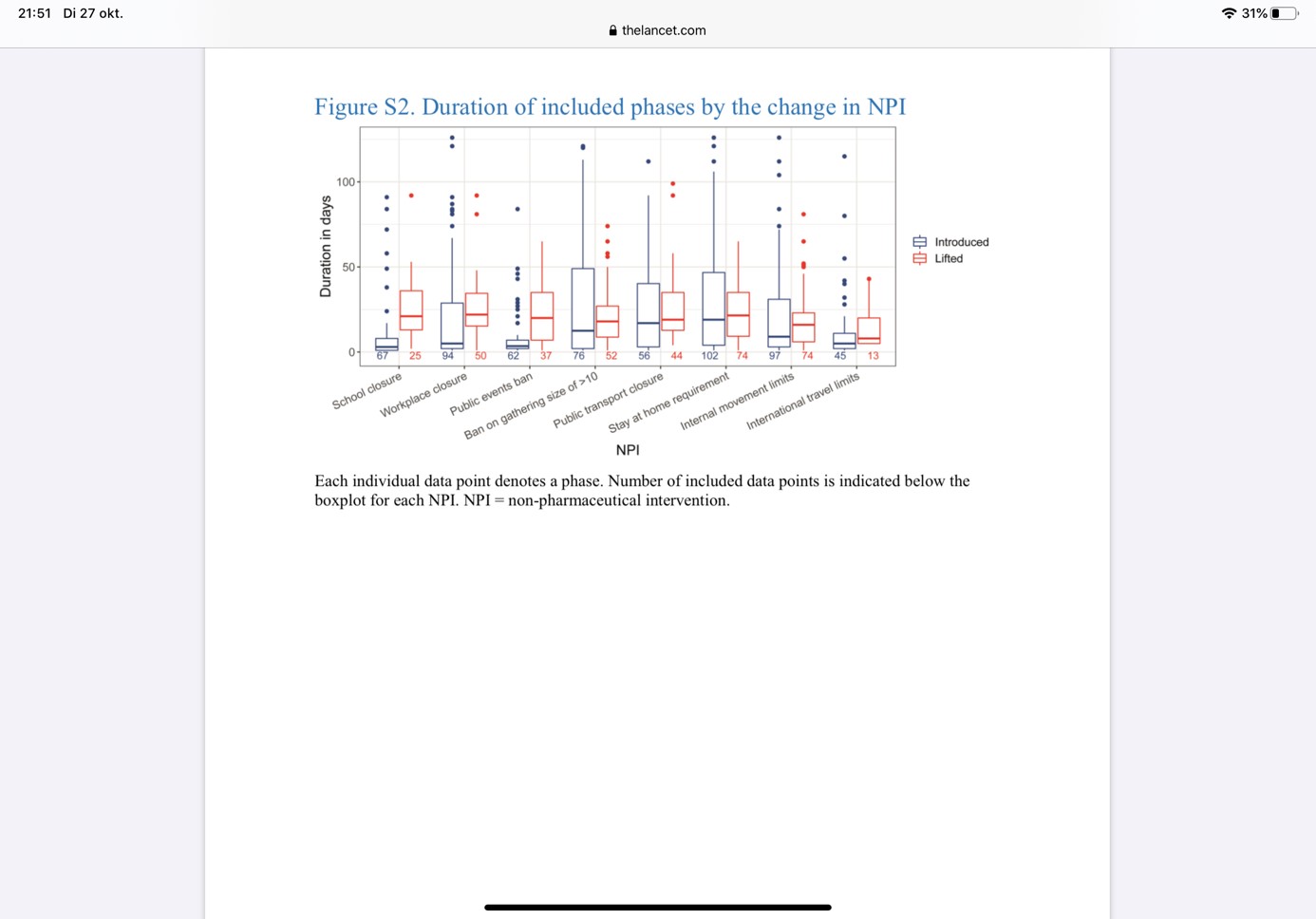
Colleagues from the University of Edinburgh did a really nice job exploring the impact of individual public health interventions on the SARS-CoV-2 reproduction number (R) across 131 countries. Their work fueled the discussion on whether schools should be closed to control transmission. Rightfully so? Read Patricia Bruijning-Verhagens’ take on this study.

For their analyses they used the real-life interventions as they were implemented when the pandemic started and subsequently lifted this summer, inevitably with differences in timing and sequences between countries. Yet, this variation allowed them to explore how each intervention influenced the effective R-value (Reff) over time in each country. A few reflections on the study:

First, we need to understand how comparisons were made; for each country they cut the observation period into time fragments based on the non-pharmaceutical public health interventions (NPIs) that were used. A change in NPI – implemented or lifted – starts a new fragment, which can last from days to months.  For each day in a fragment, they took the Reff from the available country data, and compared the Reff from the last day of a fragment to the Reff on the first day of the new fragment, and subsequently to the Reff values of all subsequent days in that fragment. The result is a daily ratio of old versus new Reff values following a change in NPI.

Next, all Reff ratios were entered in a multivariate model to determine associations between Reff ratios and implementation or lifting of individual NPI. Results can be interpreted as; what is the relative effect of implementing intervention A on Reff, while keeping measures B, C, D, etc. constant.  Importantly, effects are quantified in terms of  RELATIVE reduction/increase in Reff. ABSOLUTE effects of NPI will depend on the Reff at the start of intervention. For example; The Reff ratio for a ban on public gatherings is 0.76 (minus 24%) when we compare the Reff at day 28 after implementation to a situation without bans. Then, if Reff was 3 before implementation, the ban on public gatherings will reduce the Reff to 0.76*3=2.28 at day 28, yielding an absolute reduction in Reff of 0.72. Yet, if Reff was 1.2 at the start, then the absolute reduction will be 0.29 (0.76%*1.2=0.91).

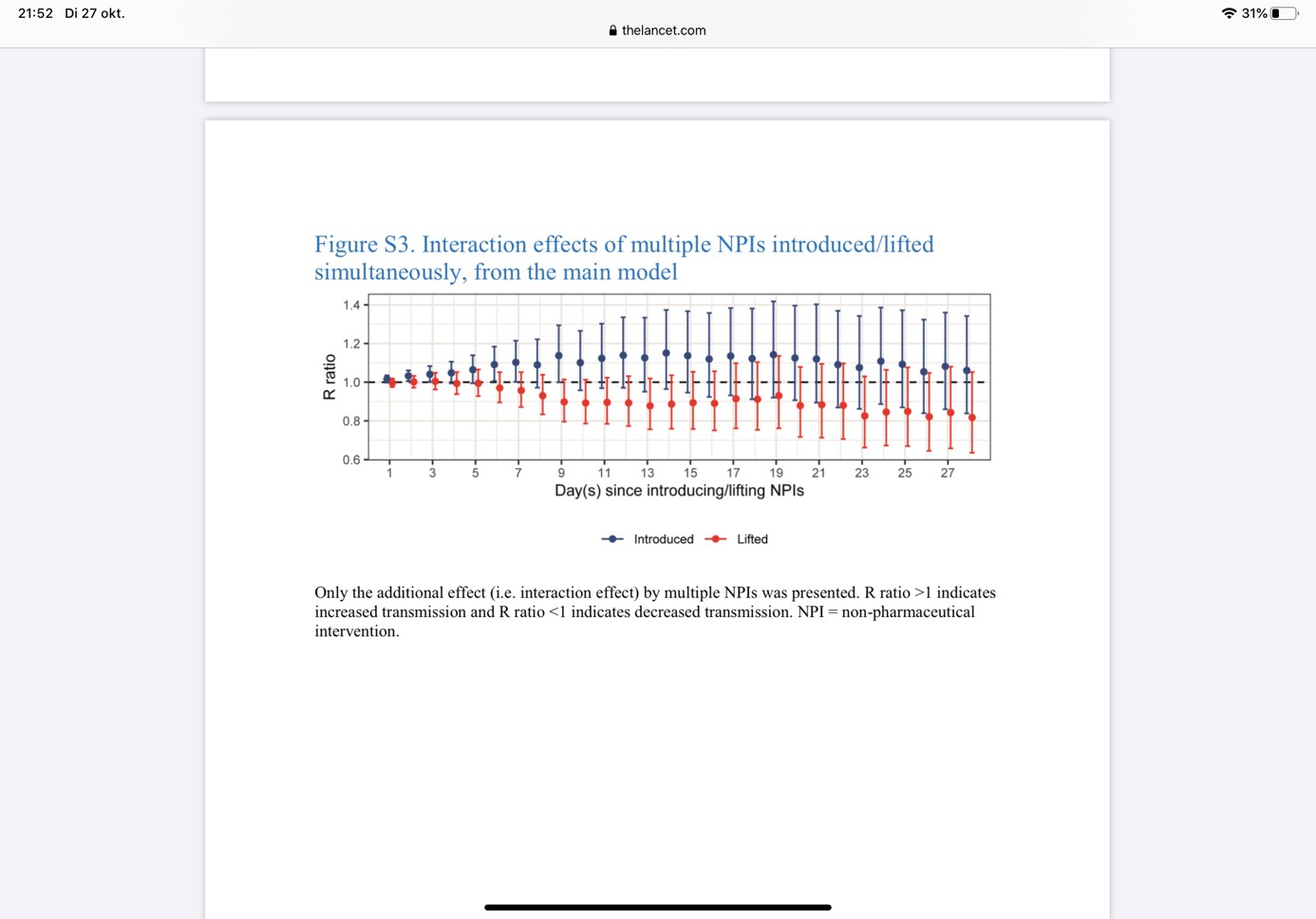
The results of the multivariate model highlight another effect that needs to be considered; whith multiple NPIs implemented/lifted at the same time, their joint effect is smaller than the sum of their individual effects. This is estimated as interaction parameters Z1 and Z2. For instance, closing schools has an Reff ratio of 0.86 on day 14 following closure and the Reff ratio for banning public gatherings is 0.83. The Reff ratio for interaction on day 14 is approximately 1.17 as you can see in the figure below.

So, the interaction eliminates the effect of one of both interventions. The same happens when lifting two interventions at the same time; the joint increase in Reff is less than would be expected on the Reff ratios from each NPI separately. The effect of an NPI may thus differ, depending on the context (i.e. other NPIs in place). An alternative explanation is that the model overestimates the single intervention Reff ratios, because of collinearity in the data. Ideally, one would estimate interaction effects separately for each possible combination of two NPIs, but this requires inclusion of many more parameters in the multivariate model, which were not available. This interaction effect also becomes apparent when we look at the four scenarios of composite NPIs; Moving from scenario candidate 3 to 4, the Reff ratio for day 28 changes by 0.10 only, although two more interventions were added (school closure and stay at home requirements).

An important limitation of the data is that many interventions were implemented or released shortly after one another, seriously limiting the number of informative datapoints and precluding quantification of individual effects of interventions. This is reflected by the wide confidence intervals for many estimates. For instance, schools were already closed at the start of the observation period in 64 of 131 countries and only 25 countries lifted school closure at some point. Moreover, school closure was followed by other interventions within a week in 75% of countries, leaving only 16 countries with more than 7 days to quantify effects of school closure as separate intervention. Furthermore, differences across countries add to heterogeneity in the data and, thus, to imprecision in estimates.

To conclude, this study provides some insight in the effectiveness of some NPIs, but precise effects of individual interventions remains uncertain and will highly depend on the prevailing Reff at the time of implementation/lifting, and other interventions implemented, lifted or maintained. The authors acknowledge some of these limitations and caution that ‘ the impact on R by future reintroduction and re-relaxation of interventions might be substantially different’. Obviously, many readers that claimed major effects of NPI, in particular of school closure, didn’t make it till this stage of the manuscript.

Patricia Bruijning-Verhagen, MD, PhD, is pediatrican and epidemiologist at the Julius Center for Health Sciences and Primary Care, at the UMC Utrecht

COVID-19: Learning rapidly from an overwhelmed healthcare system in Bergamo, Italy

A very sobering piece published in NEJM Catalyst Innovations in Care Delivery (a new digital journal in the NEJM group) describes a catastrophic situation in a hospital in Bergamo, Italy, which has been overrun by COVID-19. We all have much to learn from this experience: about pandemic preparedness, response, and the key role of IPC at all stages of this pandemic.

Continue reading

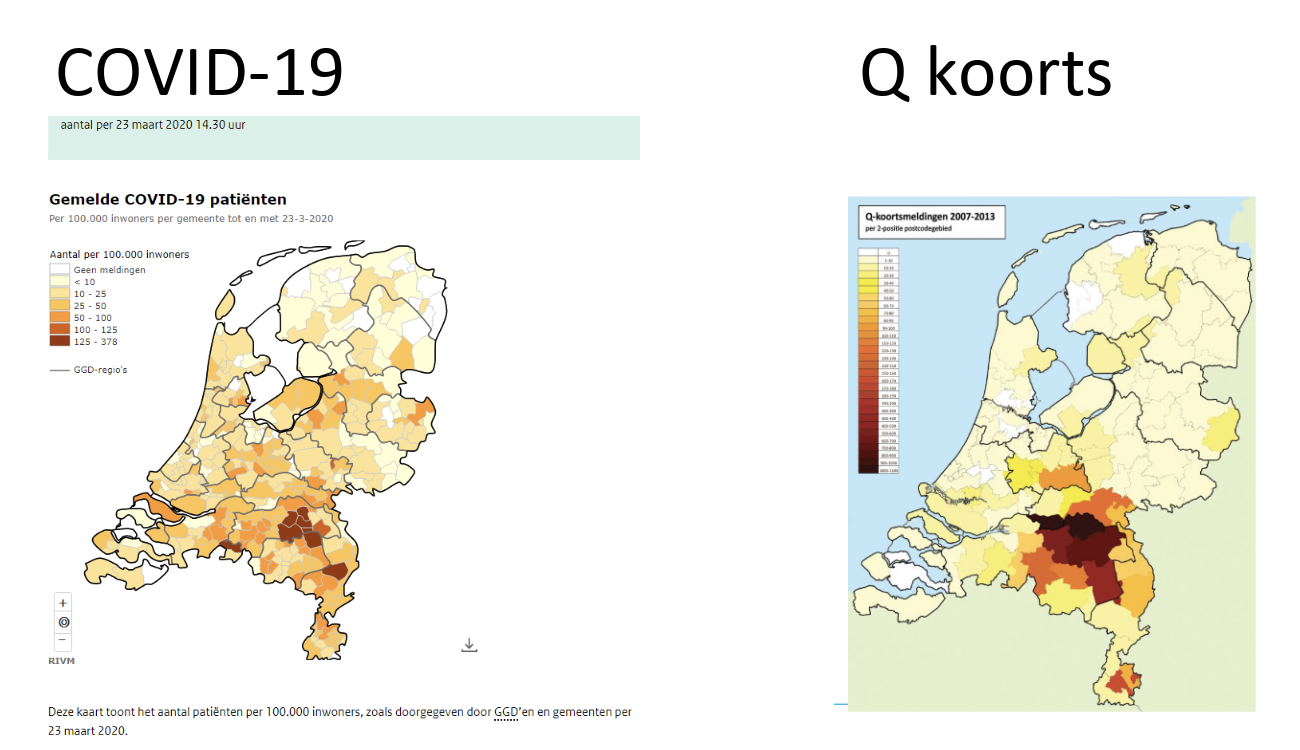
COVID-19 and Q-fever: random observation or something to evaluate?

“The course of an epidemic is defined by a series of key factors, some of which are poorly understood at present for COVID-19” (Roy Anderson Lancet, March 9th)

While several of the factors are obvious and come to mind immediately, others, might at this point be speculation or indiscriminate observations that need further scientific evaluation.

One of the latter category, might be the observation I would like to share in this post. One of the regions of the Netherlands that presently has one of the highest COVID-19 rates, is a region in the South of the country. To our knowledge there is only one thing unusual about that region; About ten years ago, the region was in the midst of the Dutch Q-fever epidemic. Could one of those key factors that we don’t understand and that may lead to area’s with exceptional high rates of COVID-19 be previous infectious diseases such as Q-fever, or more general a higher prevalence of previous long damage, due to infectious diseases? 

Have a look at the graphs and please share your thoughts.

With thanks to my colleague Bert Mulder, Nijmegen

COVID-19 and a lack of PPEs

Schermafbeelding 2020-03-20 om 15.27.13.png

By Andreas Voss, Jan Kluytmans and Alexander Friedrich

As the surge of COVID-19 cases is hitting some of the Dutch hospitals hard, healthcare, in the areas being overwhelmed with cases, experience a shortage of PPEs and especially masks. In other Dutch regions with no or only a few cases, colleagues still believe that life is normal and PPEs can be ordered with a click on the computer. They look with awe at what colleagues in the midst of battling COVID-19 and shortages are facing. In addition, all healthcare-settings that do not usually use a lot of PPE’s (e.g. nursing homes and GPs), will be heavily understocked.

Still, infection control advice seems to be based on standard, safety-maximized procedures, thereby wasting valuable resources. As a consequence, HCWs in the Netherlands are still following these recommendations, by using FFP masks routinely, in low risk situations, while they should be saved for the high-risk procedures.

We believe that it is time to rethink our protocols, based on the fact that we still assume that COVID-19, in general, is based on droplet and contact transmission.

  1. Restricted and risk-based use of FFP masks
  2. Use of surgical masks for normal care of COVID patients
  3. Efficient and extended use of FFP masks and other PPEs
  4. Re-use of FFP masks

Continue reading

Update on COVID-19: part 15, keep a distance

In my country we stopped shaking hands, because of SARS CoV-2, and in a large region people are asked to work at home. Is that justifiable, in light of the evolving pandemic? The answer is YES, according to two publications that appeared yesterday. Continue reading