Reflections from HIS 2014, Part I: Updates on C. difficile, norovirus and other HCAI pathogens

HIS_Web_Banner_Jpeg

The 2014 Healthcare Infection Society (HIS) Conference was in Lyon, France, and combined with SFH2 (The French Society for Hospital Hygiene). Congratulations to all involved (especially Martin Kiernan and Prof Hilary Humphreys) for such a stimulating programme, and enjoyable conference. The abstracts from the oral presentations can be downloaded here, and the posters here. I plan to share some of my reflections on key conference themes over the next few days:

Prof Wing-Hong Seto – Airborne transmission and precautions – facts and myths

Prof Seto’s energy and enthusiasm lit up the stage, just like a few years ago in Geneva for ICPIC. Prof Seto spent his lecture convincingly debunking the idea that airborne transmission of respiratory viruses is common, notwithstanding some data that, prima facie, suggests this. Only very few pathogens require obligate airborne transmission (e.g. TB); some have preferential airborne transmission (e.g. measles); and some have potential airborne transmission (respiratory viruses). There is some evidence that respiratory viruses such as influenza can be transmitted via the airborne route, but the most important route of transmission will depend on context. One important point is that studies demonstrating airborne “transmission” using PCR rather than viral culture as an endpoint, or using artificial aerosol generation should not be taken as definitive evidence of airborne transmission. Prof Seto’s view is that medical masks are sufficient to prevent the transmission of respiratory viruses, as demonstrated by his own work during SARS. Finally, we can forget the requirement for negative pressure isolation rooms: open doors and windows yields a whopping 45 air changes per hour!

Prof Mark Wilcox – Is Clostridium difficile infection (CDI) underestimated due to inappropriate testing algorithms?

Prof Wilcox began by reporting an unusual epidemic: “PCRitis”, which can cloud rather than clarify accurate diagnosis of CDI. Perhaps the most important point made by Prof Wilcox is that the ultimate “gold standard” for CDI should be clinical, and not laboratory based. Prof Wilcox spent most of his time reflecting on the recent multicentre European study of CDI underdiagnosis in Europe. There are some real shockers in here: the reported rate of CDI in Romania was 4 cases per 1000 patient days vs. closer to 100 per 1000 patient days when samples from the same patients were tested in the reference lab. This is no surprise in a sense because only 2/5 local laboratories were using optimal methods. However, even in the UK where around 80% of local labs are using optimal methods, around 2-fold more cases were identified in the reference vs. the local laboratory. Clearly, if we’re going to have a hope of controlling the spread of C. difficile in Europe, laboratory diagnosis needs to improve.

Norovirus

norovirus

Norovirus is especially topical in the UK given the recent PHE announcement about unusually high rates of norovirus in the NHS. The prolific Dr Ben Lopman (CDC) began by explaining the ‘image problem’ that norovirus has in US hospitals, where it is considered an uncommon cause of gastroenteritis. In fact, a systematic review found that norovirus cases around 20% of acute gastroenteritis. However, I would say it’s just not possible to get an accurate assessment of how common norovirus is on a population level due to chronic under-reporting. When we had an outbreak of ”norovirus” in the Otter household, the last thing we felt like doing was submitting a specimen, and I suspect we are not alone in this! Although norovirus is usually mild and self-limiting, it is by no means benign: one Lopman study suggested that it is responsible for 20% of deaths due to gastroenteritis not caused by C. difficile in those ages >65. And then there’s the infection control challenges. Due to the exquisitely low infectious dose, 2g of stool from an infected individual is enough to infect the entire human population! Plus, it is shed in high titre, stable in the environment, and resistant to many disinfectants. Rather depressingly, it seems that effective interventions to control norovirus teeter around the cost-effectiveness threshold. More optimistically though, prospects for vaccines look promising.

Prof Marion Koopmans then described the huge diversity within the “norovirus” family, spanning more phylogenic space than many single species occupy. For chapter and verse on nomenclature, see Norovirus Net. It’s difficult to know what works to control norovirus due to dynamic outbreak settings combined with multiple interventions. One key aspect for control is understanding shedding profiles of infected, recovered and asymptomatic individuals. Whilst all can shed norovirus, much like Ebola, those who are symptomatic are by far the highest risk for transmission. Finally, our inability to culture norovirus in the lab has been an important barrier to understanding the virus; a recent study (in Science no less) suggests that a working lab model for culturing norovirus may be just around the corner.

Dr Lennie Derde – Rapid diagnostics to control spread of MDR bacteria at ICU

Given the turnaround times of conventional culture (24 hours to preliminary results – at best), rapid PCR-based diagnostics make sense in principle. But do they work in practice? There is some evidence that rapid diagnostics may work to reduce MRSA transmission, although other studies suggest that they don’t make a difference. In order to put rapid diagnostics to the test Dr Derde et al. ran the impressive MOSAR study. This study suggest that screening and isolation by conventional or rapid methods does not help to prevent the transmission of MDROs in the ICU, but I don’t think we should take that away from this study, not least due to the fact that many units were already doing screening and isolation during the baseline period!

New insights from whole geneome sequencing (WGS)

WGS is trendy and trending in the infection prevention and control sphere. Prof Derrick Crook gave an engaging overview of the impact that WGS has made. It’s analogous to the manual compilation and drawing of maps to GPS; you wouldn’t dream of drawing a map by hand now that GPS is available! Desktop 15 minute WGS technology will be a reality in a few years, and it will turn our little world upside down. The major limiting step, however, is that mathematics, computer science and computational biology are foreign to most of us. And we are foreign to most of them! But, these issues are worth solving because the WGS carrot is huge, offering to add new insight into our understanding of the epidemiology of pathogens associated with HCAI. For example, Prof Crook WGS study on C. difficile suggests that transmission from symptomatic cases is much less common than you’d expect. So if the C. difficile is not coming from symptomatic cases, where is it coming from? Contact with animals and neonates in the community are plausible sources However, I was surprised that Prof Crook didn’t mention the large burden of asymptomatic carriage of toxigenic C. difficile, which must be a substantial source for cross-transmission in hospitals.

WGS has yielded similar insight into the epidemiology of TB and MRSA, outlined by Drs Timothy Walker and Ewan Harrison, respectively. One challenging idea from Dr Harrison is how much of the “diversity cloud” that exists within an individual is transferred during a transmission event? Finally, WGS can turn a ‘plate of spaghetti’ of epidemiological links to a clear transmission map, as was the case during a CRE outbreak at NIH in the USA.

Look out for some more reflections from HIS posted over the next few days…

What’s trending in the infection prevention and control literature? HIS 2012 -> HIS 2014

I was privileged to speak at the Healthcare Infection Society meeting in France today on ‘What’s trending in the infection prevention and control literature? HIS 2012 -> HIS 2014’. You can download my slides here, and view the recording below:

I have always enjoyed attending these light-hearted summary sessions at other conferences, so I hope I struck the right tone. In order to track some of the trends in the infection prevention and control literature since the last HIS conference (in late 2012), I plugged some search terms into Google trends (Figure).

Figure: Google Trends for all search terms (excluding viruses) (2004 to present). Logos and arrows represent the time of the HIS 2012 and HIS 2014 conferences. Search terms: hospital cleaning; carbapenem resistant Enterobacteriaceae, whole genome sequencing, fecal microbiota transplantation. [Note, I had to spell it ‘wrong’ (fecal v faecal) to detect a trend. Blasted Americans.]what's trending google trends

Based on my search terms, there was one infection control trend that trumped all others: Ebola. If I include in with the other Google search terms, it eclipses all others! Whilst trends in Google searches may not necessarily correlate with trends in the infection prevention and control literature, in this case, it is true that the outbreak of Ebola in West Africa has prompted a lot of publications in the literature – and consumed an awful lot of professional time for all who are connected with hospital infection prevention and control! Aside from Ebola, other trends in the infection prevention and control literature that I covered include MERS-CoV, universal vs. targeted interventions, faecal microbiota transplantation, whole genome sequencing, carbapenem-resistant Enterobacteriaceae (CRE), and some aspects of environmental science. Finally, I looked into my crystal ball and predict some of the trends in the infection prevention and control literature by the time HIS 2016 comes around.

HIS Poster Round: Dealing with contaminated hands, surfaces, water and medical devices

poster round

I was delighted to be asked to lead a poster round at the Healthcare Infection Society (HIS) conference. I was a bit disappointed to see that the poster sessions are tacked on to the end of the day (when everybody’s had enough and really just wants to retreat to their hotel room for an hour before the evening’s activities). My view is that posters are the lifeblood of conferences (and I am not alone in this view); they should have much more prominence, with a “ringfenced” session integrated into the main program.

Anyway, whinge over, I thought I’d share which posters I chose, why I chose them, and what I want to know about them.

You can access the abstracts here.

GENERAL CATEGORY

#3200 Longhurst et al. Hand drying methods in NHS England Trusts, September 2013.

I chose this poster because it’s becoming increasingly clear that the choice of hand drying method can influence the degree of bacterial contamination. Also, whilst I accept the economic and environmental benefits of jet and warm air dryers, they always seem to leave my hands a bit damp. (Perhaps I just have sweaty palms.) Anyway, this is what I want to know about this poster:

  • Why did you feel the need to ‘enforce’ a response by using the Freedom of Information act?
  • Why do you think jet / warm air dryers were rare in clinical areas?
  • Do you think that jet and to a lesser extent warm air dryers result in dangerous dispersal of microbes?

#3349 Tang et al. A 3 year hand hygiene program to increase compliance rate for heatlhcare providers in the A&E Department of Tuen Mun Hospital in Hong Kong.

There’s not a lot of data on hand hygiene compliance in A&E. A 2005 study examined compliance with hand-washing in the TV show ER, reporting a hand hygiene compliance rate of 0.2%. Yep, that’s ZERO POINT TWO PERCENT! Although reality is marginally better (according to this review), there’s work to be done, so I chose this poster mainly because of the impressive impact in improving hand hygiene compliance. My questions are:

  • Which of the barriers to hand hygiene that you mention do you think is most important?
  • Who was on your task-force to decide what to do?
  • How many people completed the questionnaires?
  • How many observations were done in each time period?
  • How do you measure that the awareness of hand hygiene increased?

#3174 Khanafer et al. Hospital management of Clostridium difficile infection: a literature synthesis

This is a novel review of the literature: using the ORION checklist to capture variables that help us to determine what works to control CDI from outbreak reports and intervention studies. Here’s what I want to know:

  • Can we really derive anything useful about which intervention works when you have more than one variable, even if studies are reported in a structured way? (High school science is pretty clear: change one variable at a time!)
  • How can these % reductions be so high when (apparently) only 30% of CDI is hospital-acquired (according to some people’s interpretation of the Oxford WGS difficile study)?
  • Which is the single most important intervention to prevent CDI transmission?

ENVIRONMENT CATEGORY

#3285 Cunningham et al. VRE Outbreak Control – the Need for Speed (Use of Molecular Technology)

Two of my favourite subjects: VRE and rapid diagnostics! Here are my questions:

  • Why bother trying to control VRE? Some pretty persuasive voices are arging that it’s not worth it!
  • Are you sure that rapid diagnostics made the difference? You also introduced enhanced cleaning / disinfection, extra screening, pre-emptive isolation, and extra staff and equipment.
  • How do you explain the four clusters?
  • Did you culture in parallel? If so, what was the sensitivity and specifity of the PCR test?

#3312 Whiteley et al. The problem of rapid ATP systems may be scaling using Relative Light Units (RLU)

This poster wins the prize for the most detailed poster in conference history; I think they’ve squeezed enough words in for a full length article. But the findings are important. All ATP bioluminescence systems are not equal: a way to standardize RELATIVE light unit (RLU) output would be extremely useful.

  • What is ‘coeffecient of variance (CoV)’, and what does it mean?
  • Does lower CoV = a better ATP bioluminescence system?
  • Clearly, hand held luminometers will not match HPLC in terms of accuracy, but what should our ‘CoV’ tolerance be?
  • Do you have a way to distinguish variaibilty of sampling (i.e. pickup of ATP on the swab) from variability in ATP detection by the device?
  • Would ATP correlate better with microbial concentration if device variability were removed (e.g. through HPLC analysis)?

#3393 Maynard et al. The use of Pseudalert® for the routine analysis of water samples by engineers

I like technology and I like innovation, so this is right up my steet. Here’s my questions:

  • How does the limit of detection for Pseudalert (1 cfu / 100 mL) compare with conventional culture, in theory?
  • How much training is required to use it?
  • Why 100 mL for Pseudalert, and 500 mL for culture?
  • Is culture the gold standard method? If so, the specificity of Pseudalert in Hospital 1 is terrible!

DEVICE-RELATED INFECTION CATEGORY

#3197 Farrugia et al. Reducing methicillin resistant Staphylococcus aureus (MRSA) bacteraemia in haemodialysis patients within a high incidence setting

I chose this poster purely for the dramatic reduction in MRSA bacteraemia in a specialist setting. I would like to know:

  • Is the high initial rate explained by haemodyalisis cathethers being left in for too long?
  • ‘Prevalence of CA-MRSA 8.8%’? What does this mean? 8.8% of healthy individuals carrying CA-MRSA, or 8.8% of hospital MRSA is community-associated clones?
  • Lots of interventions – do you have a feel for which was most important?

#3277 Stenger et al. A hydrogel interpenetrating polymer network in vascular catheters loaded with thioridazine and dicloxacillin facilitates slow surface release and inhibits staphylococcal biofilm formation in vitro and in vivo

I am interested in approaches that replace the traditional use of antibiotics with biocides (which have a much lower risk of promoting bacterial resistance). Whilst this catheter was dosed with an antibiotic, I think the technology could theoretically be dosed with any biocide. Also, I’m fascinated by the application of an anti-psychotic drug in infection control:

  • Please explain the principle of ‘interpenetrating polymer network’ (IPN).
  • Could this same technology be used to dose the catheters with any drug or biocide?
  • Can you modify the rate of release?
  • Who on earth decided to see whether an anti-psychotic drug (thioridazine) has antibacterial properties?

If anybody has any answers to my questions, please fire away!

Image: Andrea Wiggins.

Carbapenem-resistant Enterobacteriaceae (CRE): so what should an infection prevention and control team do now?

kleb pneumoGuest blogger Dr Evonne Curran (bio below) writes…

Jon asked me to write on his blog about our column (‘#15: Carbapenemase-producing Enterobacteriaceae’). As he kindly accepted my offer to co-write a column, I accept his to write this blog. I am calling this blog (which contains only my personal views): ‘Carbapenem-resistant Enterobacteriaceae (CRE): so what should an infection prevention and control team do now?’.

The problems with CRE are numerous, and the different actions needed to control or at least delay its endemnicity are likewise legion; the task can seem insurmountable. The approach being taken at national and international level covers much of what is needed. The question for individual infection prevention and control teams (IPCTs) is this: where do you begin to protect a healthcare system that has little capacity (and in some cases little will) to start to solve a problem that essentially has yet to arrive, that has at least 6 names (none of which can be spelt with confidence) and is absent from the CEO’s performance monitoring agenda? The additional challenge for IPCTs is this: it will be difficult for those working in clinical areas to believe that for all the improvement in infection prevention and control that reduced MRSA and C. difficile, still more is required for this new microbiological-kid on the block.

If I were still part of a hospital based IPCT this is where I would start…..

  1. Give it a name and stick to it in all correspondence / education / awareness sessions;
  2. Succinctly provide the reasons as to why this should be on everyone’s radar;
  3. Take a high-reliability approach to strengthening your healthcare system;
  4. Involve patient advocates.

1)      Give it a name and stick to it…

As mentioned in the column (and many times by Jon) there needs to be a name that we can a) all agree on and b) conveys to non-microbiology people the problem and its seriousness. We have to stop fighting about what it is: CPE, CRO, CPE etc, etc.  I don’t know who is on (or how you get on) the micro-organism naming committee, but I am beginning to think they need to make it more democratic and involve people who don’t understand microbiology. There is no perfect name that will keep all microbiologists happy, so let’s stop trying to find one. It’s important that IPCTs have a short name that denotes this big problem and makes this consistent in all documentation. (See this previous blog by Jon for more info on nomenclature surrounding this issue.)

2)      Succinctly provide the reasons as to why this should be on everyone’s radar

I offer the following as a succinct summary for why this should be on everyone’s radar:

  • These resistant organisms inactivate commonly used antibiotics. For any infected patient there are Few Treatment Options and there will eventually be No Treatment Options.
  • They are spread Person to Person by touch, splash or contaminated equipment / environments.
  • The resistance mechanisms are spread between different species of bacteria.
  • They are difficult to detect when people are screened.
  • They cause outbreaks, which are also difficult to detect and very costly to manage.
  • Spread across the world makes at least some transmission here inevitable.

3)      Take a ‘high-reliability’ approach to the problem in your area…

I am not going to regurgitate what is in existing guidelines but offer some high-reliability characteristics.

Sensitivity to operations: Given your patient/client population, consider how and why your healthcare system is vulnerable; share this information within your organisation.

Deference to expertise: Identify who you would go to for expert advice within and outwith your organisation should an incident arise. Keep contact details accessible.

Preoccupation with failure: Consider in which clinical areas you most likely to have an outbreak – visit these clinical areas and see if there can be changes to ways of working that would make outbreaks less likely.

Reluctance to simplify: Look for and don’t dismiss alert signals – this could be data that suggests you may have cases, cross-transmission, that you are insufficiently looking for possible cases or that your antibiotic prescribing data could make your healthcare system more vulnerable.

Commitment to resilience: Good as you and your team are – consider how you can make your systems better at preparedness, prevention and management of outbreaks.

High-reliability theory provides a framework to achieve mindfulness. Google ‘High-Reliability Theory’ and ‘Weick’ for some very useful information.

4)      Involve patient advocates

Patient advocates only really knew about MRSA and Clostridium difficile infection when the media told them. Letting patient advocates know that your team is alert to this emerging threat and that you are taking actions to prevent outbreaks may help. They can also lobby for leaders to take further action if required.

Here ends my first blog! Happy I think to receive comment, suggestions or improvements. Thanks for reading. Of note: Outbreak column 17 is on Cognitive Errors in Outbreak Prevention, Preparedness and Management.

Dr Evonne Curran bio:

curran cropped

Evonne is a practicing infection control nurse (since 1987) and a Doctor of Nursing (since 2010). She is the editor of the Outbreak column in the Journal of Infection Prevention (since 2011).

A postcard from Portugal: “Some days we don’t have any needles on the ICU”

portugal stamp

Most of us know that Portugal is facing a dual threat: high rates of antibiotic-resistant bacteria and financial difficulties. This results in a vicious cycle: there’s no money to address antibiotic resistance, so transmission continues unabated and the antibiotic resistance problem gets worse. You can understand the dilemma from the hospital administrators’ viewpoint: I met an intensivist who confessed that “some days we don’t have any needles”. In this situation, is it better to buy some needles or invest in another infection preventionist?

I recently attended a national infection control meeting in Portugal, where I participated in a forum on “International experiences with HCAI”. You can download my slides here.

MRSA first emerged as a problem in the 1980s in Europe. It became a major problem in many European countries in the 1990s and 2000s so that recent data from ECDC shows high rates of meticillin resistance in S. aureus invasive isolates, especially in some southern European countries; the contrast between the rate of MRSA in the UK and Portugal is stark. In the early 2000s, the rate of MRSA was higher in the UK than in Portugal whereas now, it is much lower in the UK (Figure 1).

Figure 1: Rates of meticillin-resistance in invasive S. aureus in the UK and Portugal. Data from EARS-Net.mrsa uk vs portugal earsnet

Greece, Italy and Portugal are especially affected, with 25 to >50% of invasive S. aureus isolates resistant to methicillin. In the UK, a national strategy has yielded a dramatic reduction in the number of MRSA bloodstream isolates reported to the government in a mandatory reporting scheme (Figure 2).

Figure 2: Dramatic reductions in MRSA bacteraemia in England. But what has made the difference? mrsa bacteraemia whats made the differecnce

Since the national intervention in England was multifactorial, it is not clear what made the most impact, and it seems likely that more than one intervention contributed to the decline. Interventions included increased attention to intravenous line care, cleaning and disinfection of the environment, improved diagnostics (including the introduction of chromeagar and rapid PCR) and a national hand hygiene campaign. Perhaps the single most important intervention was the introduction of MRSA reduction targets, which were very controversial at the time, but put the issue of MRSA higher on the priority list for the hospital administration.

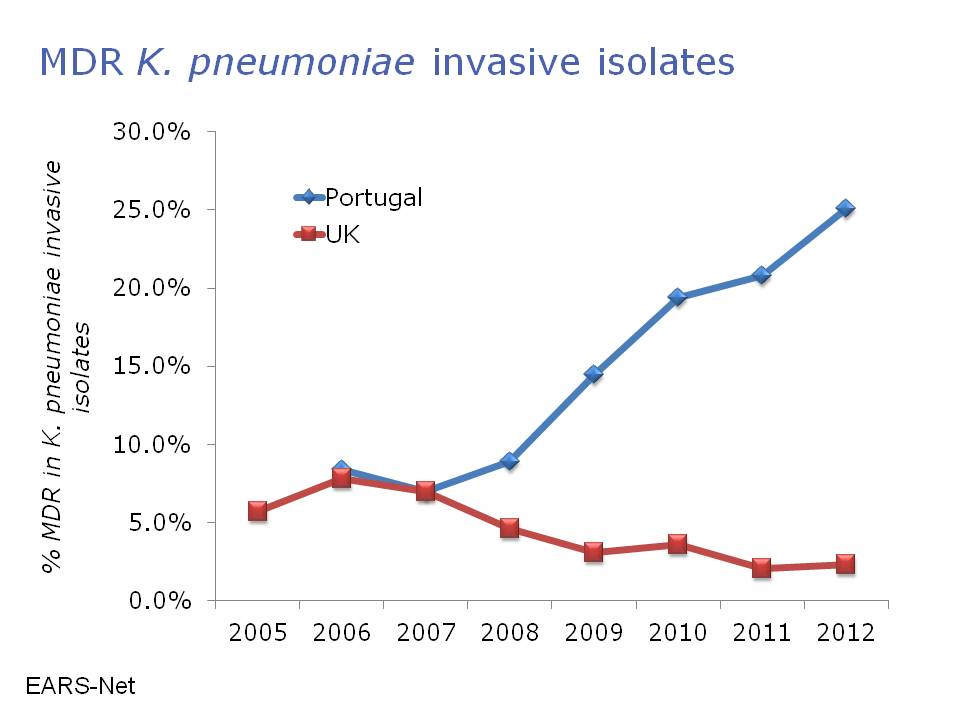
And this issue is not restricted to MRSA. In fact, the threat of the resistant Gram-negatives is even greater than MRSA in many ways. Carbapenem-resistant Enterobacteriaceae are rare currently in Portugal, accounting for 1-5% of invasive K. pneumoniae isolates. However, you get the feeling that it’s only a matter of time: carbapenem-resistant Acinetobacter baumannii are now endemic on many Portugese ICUs, and carbapenem use in Portugal is some of the highest in Europe, with >45% of patients on an antibiotic and >5% of patients on a carbapenem according to the ECDC point prevalence survey. Indeed, there has been a disturbing increase in multidrug-resistant K. pneumoniae in Portugal in recent years (Figure 3).

Figure 3: Disturbing emergence of multidrug-resistant Klebsiella pneumoniae in Portugal. Data from EARS-Net.

mdr kleb uk vs portugal ears net

The reason for these differences between the UK and Portugal is not clear, but may include infection control staffing, antibiotic usage and lower prioritisation by hospitals. Some progress is being made in Portugal with the recent launch of a national strategy to control healthcare-associated infection. However, the financial climate and somewhat fragmented healthcare system (compared with the NHS) will make implementation challenging. But at least it’s a start.

Image: Portugal stamp.

Ebola: infection prevention and control considerations

I gave a webinar yesterday on some of the infection prevention and control considerations related to Ebola. You can view the recording and download the slides here.

Whilst preparing the webinar, it occurred to me that the real game changer in the outbreak that made the world take note was the three transmissions of Ebola in developed healthcare systems outside of West Africa. One occurred in Madrid, Spain in early October, and a further two occurred in Dallas, Texas, a few weeks later. Before these in-hospital transmissions, there was a general feeling that developed healthcare systems could handle Ebola safely. Clearly, that was not the case!

Furthermore, the ratio of secondary transmissions for dealing with Ebola cases in developed healthcare systems isn’t great: of the 13 cases that have been cared for outside of West Africa, three secondary transmissions have occurred.

The outbreak has thrown up some new challenges, outlined below.

Figure: the emerging challenges of the Ebola outbreak (the dark shaded circles indicate the new and emerging challenges).

Ebola challenges

Many of us now find ourselves scrambling to develop Ebola preparedness protocols. These must start at the hospital door, with carefully considered risk assessments for patients presenting with Ebola-like symptoms. We can’t afford to get our full PPE kits out for every patient who presents with a fever, so what should be the trigger for a suspected case? (PHE and CDC have published useful algorithms to help with this, but it’s not straightforward.)

One area of controversy is the appropriate protocols for terminal decontamination following a case of Ebola. Clearly, the most important risk in terms of transmission is direct contact with blood or body fluids from infected patients. However, despite being an enveloped virus, Ebola can surface on dry surfaces for days to weeks under some conditions in laboratory studies. Furthermore, transmission has been associated with indirect contact with contaminated environments. For example, in a recent report from the field, inadequate use of PPE for dealing with surfaces that were grossly contaminated with body fluids from confirmed cases was identified as one of the risk for acquisition. So, we need to make sure that contaminated surfaces are dealt with appropriately, and most hospitals that have dealt with cases outside of West Africa have used hydrogen peroxide vapour for terminal decontamination.

There is a suggestion today that the epi curve may be peaking in Liberia, which is the epicenter of the outbreak in West Africa. Even if that is the case, we can still expect to see more repatriations to developed healthcare systems and perhaps more cases showing up at our hospitals. So, we need to make sure we do everything in our power to prevent secondary in-hospital transmissions.

ID Week 2014 as seen by an Infection Preventionist

id week 2014

Guest Blogger Barley Chironda (bio below) writes…

IDWeek was held this year from Oct 8 to 12, 2014 in Philadelphia. IDWeek is the combined annual meeting of the Infectious Diseases Society of America (IDSA), the Society for Healthcare Epidemiology of America (SHEA), the HIV Medicine Association (HIVMA), and the Pediatric Infectious Diseases Society (PIDS). Given its wide ranging audience, there are many targeted streams that allow a range of topics. The abstract sessions featured over 1700 posters and are now already published and available in Open Forum Infect Dis (Fall 2014) as well as the abstracts from the oral presentations.

I have decided to create ‘buckets’ to best capture the various conference topics that I attended (Global outbreak threats, Surveillance in the hospital and the community, Infection control topic by topic, and Future issues for infection prevention). You will notice an emphasis on the Infection Prevention and Control (IPC) aspects of the sessions that are summarised. Please blame this on the fact that my bread is buttered this way!

Global outbreaks threats

Ebola

Ebola dominated the conference, starting with the jam-packed first talk by Dr Robert Fowler on behalf of the World Health Organization. He shared personal experience of caring for patients in Sierra Leone and supportive care measures that can be implemented in resource-poor settings. This was followed by Bruce Ribner, MD, MPH, of Emory University his talk the Opening Special Plenary Session titled Treating Patients with Ebola Virus Infection in the U.S.: Lessons Learned [1] addressed the unique challenges of how to manage Ebola cases. Dr Ribner drew from the experience at Emory and highlighted all the relevant issues that need critical considerations (see summary of talk). He also mentioned that the PPE type, though important, is part of a multimodal approach to infection control and therefore encouraged healthcare facilities to prepare and practice for the potential of receiving an Ebola patient.

MERS Coronavirus

It has been two years since the first global cases of MERS-CoV were first reported [3]. Dr Tariq Ahmed Madani, from the Ministry of Health, Saudi Arabia, in a talk aptly titled: “MERS Coronavirus – The Second Year” shared what he felt are the main problems that caused the uncontrollable outbreaks in hospitals. He condensed it to three points; i) overcrowded emergency departments, ii) suboptimal infection prevention practices, and iii) atypical presentation of patients. He proceeded to show evidence of camel to human transmission of MERS-CoV [4].

Surveillance in the hospital and the community

An entire symposium was dedicated to the revision of strategies to prevent healthcare-associated infections in acute healthcare titled ‘The Compendium’ [5]. A couple of interesting points were shared under the banner of the symposium.

  • Dr Deborah Yokoe’s talk “Highlights of the Compendium of Strategies to Prevent Healthcare-associated Infections in Acute Care Hospitals: 2014 Updates” [6] shared the complicated collaborative process involved in updating the 2008 recommendations [7] on Hand Hygiene, Clostridium difficile, CLABSI, CAUTI and VAPs.
  • Dr Michael Howell in his talk “From VAP to VAE: Preventing Complications of Mechanical Ventilation” stated the confusion surrounding VAP surveillance is causing incomparable surveillance patterns. Instead of the CDC VAP definition, he offered the alternative, i.e. Ventilator Associated Events (VAE), which the audience felt was a more objective and measurable way of establishing harm related to ventilators [8].

An entire session was dedicated to how technology is now being used to conduct surveillance and gather information on outbreaks. For example, Dr John Brownstein revealed how software applications that are used daily by the public can allow Public Health institutions to predict outbreaks sooner than the current methods of conventional flu surveillance networks. He showed how from a cancelled dinner reservations [7] or public searches online one can deduce that influenza outbreaks are ravaging [10], also showing how a computer algorithm predicted the Ebola Outbreak before the WHO announced it.

Infection control, topic by topic

Clostridium difficile (Cdiff)

  • Dr Tim Peto spoke about the Clinical Treatment and trials of Cdiff, sharing research about the use of whole genomic sequencing (WGS) in evaluating efficacy of new drugs against Cdiff. Dr Peto also partnered with Dr Derrick Crook in showcasing a myriad of applications of WGS, including as an outbreak management tool in infection control.
  • Dr Colleen Kelly shared her study showing that Fecal Microbiota Transplantation appears to be a safe and effective treatment for recurrent, refractory, or severe CDI especially in a high-risk population of immunocompromised patients.
  • Dr Curtis Donskey’s talk was on “Frequent transmission of Clostridium difficile by Asymptomatically colonized Long-Term Care Facility Residents during Hospital Admissions”. In his study, Donskey swabbed all long-term care patients on admission to hospital and realised that asymptomatic patients shed Cdiff spores and often can cause outbreaks [11]. Dr Donskey reminded us of the need to ‘strategize’ on asymptomatic carriage of Cdiff.
  • Dr Trevor Lawley (“Identifying commensal bacteria that provide resistance against Clostridium difficile Infection”) spoke about the advances in understanding of the microbiota in dealing with bacterial infections.

Healthcare cleaning & disinfection

  • Dr Mark Rupp’s “Assessing Cleanliness and Motivating Environmental Service Workers” talk went through various auditing tools including microbiological methods, fluorescence monitoring and basic observation of staff cleaning. He also shared some new studies that show that positive attitude affects the quality of hospital housekeeping. He also shared a study that the time spent cleaning a hospital room does not correlate with the thoroughness of cleaning.
  • Dr Deverick Anderson’s “Evaluating No-Touch Disinfection Systems” went through Ultraviolet, Hydrogen Peroxide Vapour (HPV) and self-disinfecting surfaces. Sharing his data on reducing UV room disinfection time as well as the data on the excellent efficacy of HPV he did caution adoption of impregnated surfaces citing research that more analysis is still needed.

Posters on cleaning & disinfection

  • 1363 The Iowa disinfection cleaning project: opportunities, successes and challenges of a structured programmatic intervention in 56 hospitals.
  • 1366 Surfaces closest to the patient have a higher multi-drug resistant organism (MDRO) bioburden on environmental surfaces in healthcare facilities.
  • 1368 Assessment of environmental cleanliness in outpatient clinics – study showed that more work is needed in outpatient clinics.

Future issues for infection prevention

Stopping contact precautions on MRSA and VRE was a topic raised by Dr Michael Edmond and he covered elements that have been raised on his blog, and featured prominently at the SHEA conference earlier in the year. He concluded that with advances in hand washing and the use of chlorhexidine, there is no need to maintain contact precautions for MRSA and VRE. In addition, it was made clear during the conference that antimicrobial stewardship will play a huge role going forward in ensuring that the antibiotics that are in formulary will still remain effective.

Summary

As an Infection Preventionist, the talks offered plentiful choice and sometimes presented a challenge as to where to go since sessions of interest often ran concurrently. Unfortunately, as cloning is not widely available, I managed to stay in the loop about all talks of interest to me by following the #IDWEEK and #IDWEEK2014 hashtags on Twitter and Instagram, where attendees where tweeting from the various sessions allowing a more complete conference experience. I managed to make a lot of friends at ID Week 2014, and I am looking forward already to ID WEEK 2015!

Barley Chironda Bio

 Barley Chironda

Barley Chironda is a board Certified Infection Preventionist. He is typically found engaged in motivating hospital staff, patients and visitors on proper infection prevention practices and quality improvement interventions related to patient safety. He takes pride in sharing information via social media and is often engaging the public on Twitter™ and LinkedIn™, partaking in resource distribution related to innovative and novel infection prevention strategies. Barley serves as the Education Chair for the Infection Prevention and Control Canada-Greater Toronto Area (IPAC-GTA) Chapter. In his IPAC-GTA role, he has the responsibility to promote conference organization and promote knowledge dissemination. Barley enjoys public speaking, having presented locally and internationally. He possesses exceptional ability to incorporate humour to his presentations. This excellent speaking ability earned him the Best Oral presentation at the 2013 Canadian National Infection Prevention Conference. Follow him on @barleychironda on twitter or contact him through his company www.annexandfoster.com.

References:

  1. Ribner BS. Treating patients with Ebola virus infections in the US: lessons learned. Presented at IDWeek, October 8, 2014. Philadelphia PA.
  2. Hill CE, Burd EM, Kraft CS, et al. Laboratory test support for Ebola patients within a high-containment facility. Lab Medicine 2014:45:e109-111.
  3. Minal KKimberly P. Clinical and Laboratory Findings of the First Imported Case of Middle East Respiratory Syndrome Coronavirus to the United States. Clin Infect Dis2014;pii:ciu635.
  4. Ziad A. Memish, M.D., et al. Family Cluster of Middle East Respiratory Syndrome Coronavirus Infections N Engl J Med 2013;368:2487-2494.
  5. Yokoe DS, Anderrson DJ, Berenholtz SM., et al. Highlights of the Compendium of Strategies to Prevent Healthcare-associated Infections in Acute Care Hospitals: 2014.
  6. McIver DJ, Brownstein JS. Wikipedia Usage Estimates Prevalence of Influenza-Like Illness in the United States in Near Real-Time. PLoS Comput Biol 2014 17;:e1003581.
  7. Nsoesie EO, Buckeridge DL, Brownstein JS Guess Who’s Not Coming to Dinner? Evaluating Online Restaurant Reservations for Disease Surveillance. J Med Internet Res 2014;16(1):e22.
  8. Raoof S, Baumann MH. Ventilator-Associated Events: The New Definition. Am J Crit Care 2014;23:7-9.
  9. Eyre DW, Babakhani F, Griffiths D, .et al Whole-Genome Sequencing Demonstrates That Fidaxomicin Is Superior to Vancomycin for Preventing Reinfection and Relapse of Infection With Clostridium difficile. J Infect Dis 2014;209:1446-1451.
  10. Kelly CR, Ihunnah C, Fischer M, et al. Fecal Microbiota Transplant for Treatment of Clostridium difficile Infection in Immunocompromised Patients. Am J Gastroenterol 2014;109:1065–1071.
  11. Donskey CJ, Venkata CK, Jencsona AJ, et al. Utility of a Commercial PCR Assay and a Clinical Prediction Rule for Detection of Toxigenic Clostridium difficile in Asymptomatic Carriers. J Clin Microbiol 2014;52:315-318.

Selective Digestive Decontamination (SDD) is dead; long live faecal microbiota transplantation (FMT)

crapsules

Ok, so the title may be a little premature, since this blog relates to a study with a sample size of exactly one. However, I do think it spells the beginning of the end for Selective Digestive Decontamination (SDD), especially when applied to suppress gut colonization with antibiotic-resistant bacteria.

A number of groups have looked at using SDD to ‘decolonise’ carriers of multidrug-resistant Gram-negative bacteria such as CRE. In one study, 20 CRE colonized patients in each arm given gentamicin + polymyxin (SDD arm) or placebo (Control arm). The results were rather modest (see chart below). Plus, SDD has substantial downsides in terms of the potential for developing further antibiotic resistance, and ‘collateral’ damage to the gut microbiota.

Figure: Modest impact of SDD to ‘decolonise’ the gastrointestinal tract of CRE carriers.

Saide-Oldes CRE decol

I’ve been waiting for some data on the effectiveness of faecal microbiota transplantation (FMT) to decolonise carriers of antibiotic resistant bacteria for some time. A case report at ID Week related how the ordeal of a 13 year old girl was ended by a faecal microbiota transplantation. After months of persistent colonization and infection, the impact of a single dose of FMT was startling: CRE carriage was eliminated and there was no further bacterial infection.

One of the push-backs against using FMT more regularly is that it’s a crude (in every sense) and labour-intensive procedure compared with an antibiotic capsule. But that was before the invention of ‘crapsules’ (aka oral FMT). Another ID Week abstract reports the successful delivery of oral FMT using crapsules. (And it’s amazing what great dinner party conversation ‘crapsules’ makes. Try it – you’ll see.)

So, I think it’s time for a cluster randomized trial to compare the impact of SDD and FMT; my money is on FMT!

Image: Barbara Krawcowicz.

Autumn 2014 Update


Autumn NY 2014It’s been another busy quarter on the Micro Blog, with posts on Ebola, coverage of Infection Prevention 2014, and updates on multidrug-resistant Gram-negative rods (especially CRE):

As ever, if you have any questions, fire away. We love the interaction!

Image credit: ‘Autumn in New York’.

Journal Roundup September 2014: Ebola, Environmental science, and MDR-GNR

Ebola CDC global

Another month, another Journal Roundup (free and open acces in Journal of Hospital Infection). This month, Ebola tops the bill as the outbreak continues unabated, it seems inevitable that repatriations of healthcare workers from West Africa will continue and increase. The big journals discuss the appropriate level of PPE, and how to test experimental medicines, amongst other things.

A number of useful environmental science updates feature in the Roundup. For example, an age-old question is whether contaminated hands or surfaces contribute most to transmission. A modeling study found that improvements in hand hygiene compliance are about twice as effective in preventing the transmission of multidrug-resistant organisms compared with improvements in environmental hygiene. So hands are more important right? Well, as the single most important intervention to prevent transmission, then yes.

Several studies on the theme of multidrug resistant Gram-negative rods (MDR-GNR) serve mainly to highlight the limitations in the evidence base for establishing what works to prevent MDR-GNR. One of the major problems here is that ‘MDR-GNR’ is a heterogeneous group comprised of several species and resistance mechanisms, not to mention strain variation. The prevention and control prospects for MDR-GNR are different to pathogens like MRSA, VRE and C. difficile. You need to cover all bases – and there are more bases to cover!

The Reviews and Guidelines section includes a thoughtful piece considering the “hygiene hypothesis” vs. the idea of “biome depletion”, the inadequate level of funding in HCAI research, infection control practice in the ER, the cost of CDI, prospects of phage therapy and interrupting regulatory RNA function.

And finally, a UK study finds pretty high levels of ATP on the beverage trolley. So time to ban the beverage trolley as an infection control risk (along with flowers, pets and child visitors)? Not yet – it’s not that surprising to find ATP (which may originate from food, not microbes) on a beverage trolley. That said, if they’d found a lot of MRSA or, worse, CRE then I’d think twice about a cuppa!

Image credit: CDC Global.