Do you know your CRO from your CPO from your CRE from your CPE?

Carbapenems are a class of beta-lactam antibiotic with a broad spectrum of activity against Gram-positive and Gram-negative bacteria. Whilst carbapenems are used for the treatment of Gram-positive infections, the emergence of Gram-negative bacteria with resistance to the carbapenem antibiotics is a health issue that has prompted unusually dramatic health warnings from the US CDC, Public Health England (PHE) and the European CDC (ECDC). However, the various acronyms employed to describe the subtleties of the problem are a minefield for the uninitiated:

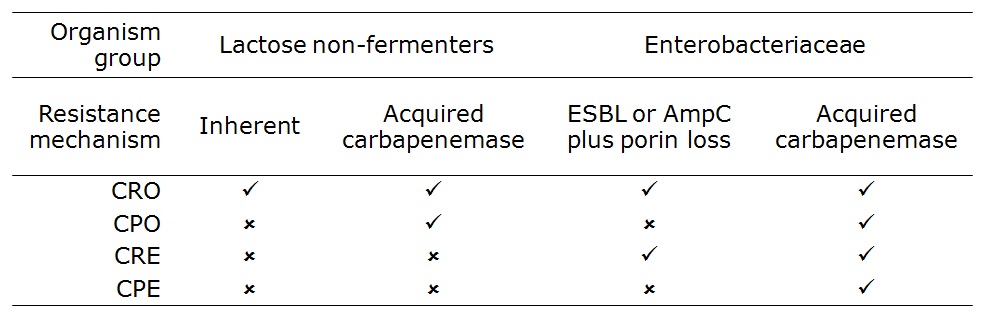
Carbapenem-resistant organism (CRO) – Gram-negative bacteria* including the Enterobacteriaceae (such as Klebsiella pneumoniae and Escherichia coli) and non-fermenters (such as Acinetobacter baumannii, Pseudomonas aeroginosa and Stenotrophomonas maltophilia) that are resistant to carbapenems by any mechanism. The non-fermenters can be inherently resistant to carbapenems, or they can acquire carbapenemases (typically KPC, VIM, NDM and OXA-48 types). Enterobacteriaceae do not have inherent resistance but may be resistant to carbapenems through the production of an acquired carbapenemase or the production of an ESBL or AmpC combined with porin loss.

Carbapenemase-producing organism (CPO) – Enterobacteriaceae and non-fermeters that are resistant to carbapenems by means of an acquired carbapenemase.

Carbapenem-resistant Enterobacteriaceae (CRE) – Enterobacteriaceae that are resistant to carbapenems by any mechanism, including the production of an acquired carbapenemase or the production of an ESBL or AmpC combined with porin loss.

Carbapenemase-producing Enterobacteriaceae (CPE) – Enterobacteriaceae that are resistant to carbapenems by means of an acquired carbapenemase.

The image below tries to graphically represent the relative size of these groups (not to scale!), and the table provides a summary of their distinguishing features:
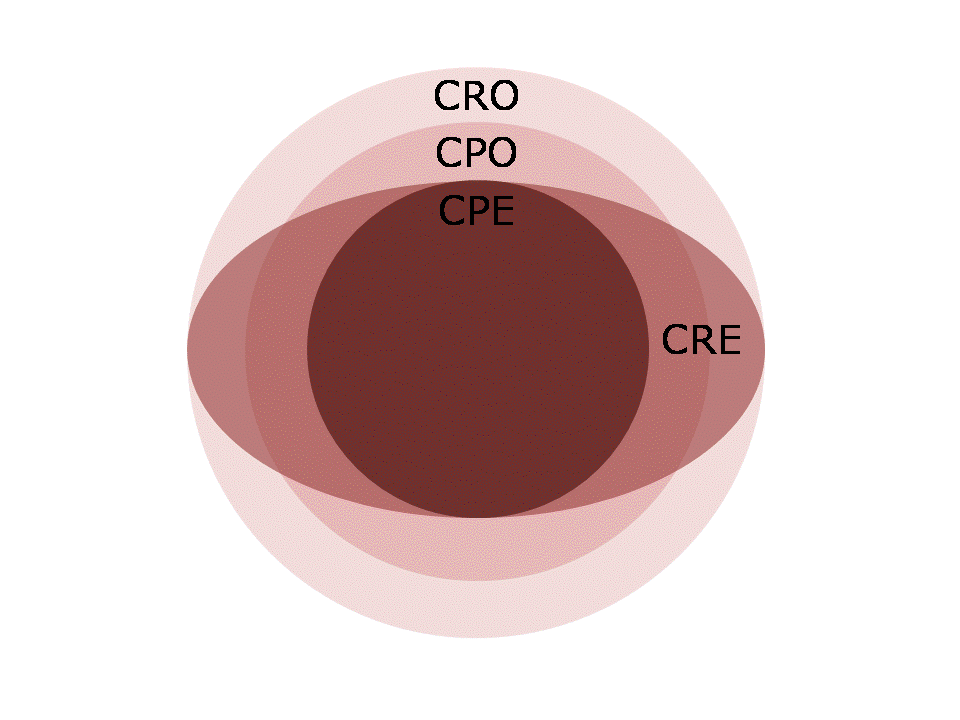
CRE etc

CRE table

“O” or “E”

The US CDC and European CDC seem to favour ‘CRE’ as a generic term for this problem, whereas the PHE in the UK seems to favour ‘CRO’. Clearly, each term has a defined meaning and context will determine which is technically correct. But which is most useful as a generic term?

The epidemiology of the non-fermenters and the Enterobacteriaceae is different, with the non-fermenters tending only to cause problems in very sick patients, usually in critical care settings. Meanwhile, the Enterobacteriaceae are more able to cause infections in a wider range of patients both inside and outside the hospital. Hence, the emergence of carbapenem resistance is more concerning in the Enterobacteriaceae, as demonstrated by rapid national and international spread of KPC-producing K. pneumoniae.

“R” or “P”

Amongst the Enterobacteriaceae, whilst carbapenem-resistance due to the production of an ESBL or AmpC combined with porin loss may lead to treatment failure, it is often unstable and may impose a fitness cost, meaning that these strains rarely spread. Hence, carbapenem resistance conferred by an acquired carbapenemases is the key problem.

So, for me, CPE would be the most suitable generic term for this emerging problem. However, since the US CDC and the ECDC seem to have gone with CRE, and the vast majority of CRE will be CPE, let’s go with CRE shall we?


[* Whilst Gram-positive bacteria that are resistant to carbapenems (such as MRSA) could be described as ‘CROs’, these terms are reserved to describe Gram-negative bacteria.]

Dissecting the CRE epidemic in Italy

Italy flagCarbapenem-resistant Enterobacteriaceae (CRE) present unique challenges to infection prevention and control. Firstly, unlike MRSA and C. difficile, CRE can be caused by multiple genetic determinants (typically KPC, VIM, NDM and OXA-48 types) in multiple species. The combination of resistance determinants and species may have distinct characteristics with transmission and control implications. Further, there is a larger pool of resistance determinants for horizontal transfer. Secondly, CRE colonize the gastrointestinal tract, so deconlonization therapy is likely to be limited to suppressing the amount of CRE in the gut; elimination of the carrier state, which has been a mainstay of prevention and control interventions for MRSA, seems unlikely. Thirdly, pan-drug resistant CRE has already been reported and the pipeline for new agents is virtually empty, meaning that effective therapeutic options will be increasingly limited.

Data from EARS-Net suggests that the prevalence of CRE among bloodstream infections is low in most parts of Europe, with a gradual year-on-year increase. In Greece though, rates are exceptionally high, with the proportion of K. pneumoniae invasive isolates resistant to carbapenems increasing from 27.8% in 2005 to 68.2% in 2011. Also, rates in Cyprus are on the rise with 0% reported in 2006 up to to 15.7% in 2011. In the UK, rates of carbapenem resistance amongst K. pneumoniae have remained consistently <1% for the same period. Disturbingly, there has been a dramatic increase in the prevalence of carbapenem-resistant K. pneumoniae in the last few years in Italy, from 1% in 2009 to 15% in 2010 to 27% in 2011.

CRE Europe [Chart: Changes in proportion of carbapenem resistance in K. pneumoniae invasive isolates. Data from EARS-Net.]

A recent Eurosurveillance article reports a national survey of carbapenem resistance in Italy. 25 laboratories across the country participated and analyzed all consecutive, non-duplicate Enterobacteriaceae clinical isolates for six weeks in mid 2011. A total of 7,154 isolates were collected from inpatients and 6,595 isolates from outpatients. The highlight findings are:

  • 3.5% of inpatient isolates and 0.3% of outpatient isolates carbapenem resistant.
  • Carbapenem-resistant K. pneumoniae (CR-KP) the most problematic CRE, with 11.9% of K. pneumoniae isolates CR.
  • Substantial geographical variation in resistance rate, ranging from 0 to 33% for CR-KP.
  • KPC accounted for 90% of CRE enzymes; one CR-KPC clone predominated (CC-258).
  • Resistance to other agents was common amongst KPC-producing K. pneumoniae; 22% were resistant/non-susceptible to colistin, 21% to tigecycline and 16% to gentamicin; 1.5% were non-susceptible to all three.

This study raises several challenging questions. What do you do with a CR-KP isolate causing an infection that is also resistant to colistin, gentamicin and tigecycline? This seems to be true pan-resistance, with supportive care the only option.

Why is KP the outstanding CRE, specifically the CC-258 clone? What does it have that the other CRE lack? K. pneumoniae seems to survive better on surfaces that other Enterobacteriaceae, and has been associated with more hospital outbreaks than other Enterobacteriaceae historically. However, further research is required to answer this question.

Can the worrying trend of CRE in Italy be reversed? An aggressive, national intervention was successful in Israel, and there are some local success stories in Italy. However, brining the situation under control in Italy will require an aggressive, national programme that must be implemented immediately. Otherwise, CR-KP will quickly become endemic and probably impossible to bring under control.

The authors should be complimented for performing a timely study, but I do wonder whether the situation is considerably worse now, 12 months later, given the shape of the national epi curve.

Citation: Giani T, Pini B, Arena F, Conte V, Bracco S, Migliavacca R, the AMCLI-CRE Survey Participants, Pantosti A, Pagani L, Luzzaro F, Rossolini GM. Epidemic diffusion of KPC carbapenemase-producing Klebsiella pneumoniae in Italy: results of the first countrywide survey, 15 May to 30 June 2011. Euro Surveill 2013;18(22):pii=20489.

Image permission: Original image obtained from http://www.freestock.ca.

Carbapenem-Resistant Enterobacteriaceae (CRE) in US hospitals

Enterobacteriaceae are a family of bacteria that commonly cause infections in health-care settings as well as in the community. The family includes more than 70 genera but Escherichia coli, Klebsiella species, and Enterobacter species are the most common in healthcare settings. Until recently, carbapenems have been the treatment of choice for serious infections due to these organisms. However, resistance to these agents has emerged in the Enterobacteriaceae family by various mechanisms and is now a major concern worldwide as infections caused by carbapenem-resistant Enterobacteriaceae (CRE) are difficult to treat and are associated with significant morbidity and mortality.

mmwr

A recent CDC MMWR report used three different surveillance systems to describe the extent of CRE spread among acute-care hospitals in the US as well as the proportion of clinical isolates resistant to carbapenems. They found that while CRE are relatively uncommon, they have spread throughout the US and their rates have increased during the past decade. During the first 6 months of 2012, 4.6% of the 3,918 US acute-care hospitals performing surveillance for either CAUTIs or CLABSIs reported at least once CRE to the National Healthcare Safety Network (NHSN). CRE were more often reported from long-term acute-care hospitals (17.8%) and the percentage of hospitals reporting CRE was highest in the Northeast of the US and among larger and teaching hospitals. Data from NHSN and the Nosocomial Infection Surveillance system (NNIS) showed that the rate of carbapenem resistance among Enterobacteriaceae increased from 1.2% in 2001 to 4.2% in 2011, most of this increase was among Klebsiella species (from 1.6% to 10.4%).

Data from population based surveillance suggest that most (96%) clinical CRE isolates came from cultures collected outside of the hospital from patient with substantial health-care exposure, particularly recent hospitalization (72%). Although nearly all patients with CRE were currently or recently treated in a healthcare setting, these organisms have the potential to spread into the community among healthy individuals.

A combination of infection control strategies applied on national level are needed to control the rise of carbapenem resistance among the Enterobacteriaceae and the spread of CRE. These include active case detection, contact precautions for colonized or infected patients and patient, and staff cohorting as well as strict antibiotic stewardship in all settings. Particular attention should be given to long-term acute-care hospitals which have historically had less developed infection prevention programs. Such coordinated infection prevention and control programs implemented on a national level have been shown to be effective for controlling the rise of CRE, for instance the containment of KPC-producing strains which emerged in 2006 in Israel.

Article citation

Centers for Disease Control and Prevention (CDC): Vital Signs: Carbapenem-Resistant Enterobacteriaceae. MMWR. 2013;62:165-170.

No need to worry about environmental contamination with Enterobacteriaceae…or is there?

It was once thought that only bacterial endospores would survive on dry hospital surfaces for extended periods (measured in days and weeks rather than hours). Microbiological data indicates that a range of vegetative bacteria can survive on dry surfaces for extended periods. Whilst differing testing methods and conditions make comparison of survival times between studies difficult, it is clear that non-fermenting Gram-negative bacteria (such as Acinetobacter baumannii and Pseudomonas aeruginosa) survive considerably longer than the Enterobacteriaceae (such as Klebsiella pneumoniae and Escherichia coli).  However, the Enterobacteriaceae can survive for more than a month on dry surfaces. Indeed, a 2009 laboratory study highlighted substantial strain variation in the survival of K. pneumoniae, with the survival of three strains ranging from a 6-log reduction inside 3 weeks to a 1-log reduction over six weeks.

Several recent studies have evaluated environmental contamination with ESBL-producing Enterobacteriaceae. One French study evaluated surface contamination on five standardized sites surrounding patients infected or colonized with ESBL-producing Klebsiella spp. (n=48) or ESBL-producing E. coli (n=46). Environmental contamination was significantly more likely in the rooms of Klebsiella spp. patients (31% of 48 rooms positive; 6% of 240 sites positive) vs. E. coli patients (4% of 46 rooms positive; 1% of 230 sites sites). Multiple regression identified carriage of ESBL-producing K. pneuomiae as the only independent predictor of ESBL environmental contamination (adjusted odds ratio=10.38, 95% confidence interval = 1.24-228.58). Surprisingly, only 52% of the ESBL-producing isolates were identical to the patients in the room, suggesting survival of ESBL-producing bacteria from prior occupants or importation into the room. Another French study with a similar design identified comparable rates of contamination, and also found that contamination was significantly more likely with K. pneumoniae than with E. coli.

environmental sampling

Environmental contamination with C. difficile spores, VRE and non-fermenting Gram-negative bacteria is now a well-established route of transmission. Whilst the same cannot be said for the Enterobacteriaceae, these studies combined with an Israeli article recently featured on this Micro Blog, show that environmental contamination with Enterobacteriaceae may be more important than previously thought. These findings are particularly important in light of the recent global spread of carbapenemase-producing K. pneumoniae.

Article citations:

Guet-Revillet H, Le Monnier A, Breton N et al. Environmental contamination with extended-spectrum beta-lactamases: is there any difference between Escherichia coli and Klebsiella spp? Am J Infect Control 2012; 40: 845-848.

Gbaguidi-Haore H, Talon D, Hocquet D, Bertrand X. Hospital environmental contamination with Enterobacteriaceae producing extended-spectrum β-lactamase. Am J Infect Cont 2013; Jan 18 [Epub ahead of print].

Where the wild things are

Carbapenem-resistant Enterobacteriaceae (CRE) are a major threat to public health worldwide and Israel is among the countries with the highest rates of these pathogens. A concerted campaign has done a good job of bringing the national outbreak under control, but problems persist1. An Israeli hospital investigated the extent of environmental contamination with CRE in the vicinity of 34 CRE-carriers using two different sampling methods; contact plates and swabs (with or without enrichment). Pilot sampling was performed to identify the five sites that were most likely to be contaminated (pillow, crotch and leg area on the bed, personal bedside table and infusion pump). To investigate the effect of cleaning on the recovery of CRE, the five sites were sampled at two different times; 4 and 24 hr after rooms were cleaned and patient cloths and sheets were changed.

12-PDR-A290-278

The study detected CRE in the surrounding environment of most (88%) of the patients sampled, showing that a high proportion of carriers shed these pathogens into their environment which can then be transmitted. Recovery was highest in the carrier’s immediate environment with the patient bed being the most contaminated. Not surprisingly, recovery of CRE from the environment was reduced when sampling was done 4 hr after cleaning compared to 24 hr after cleaning (21% of sites contaminated vs 27%). However these results also highlight the speed by which the patient environment is re-contaminated with CRE after cleaning. The study also showed that the choice of the detection method is also important and reported that contact plates were more efficient at recovering CRE than swabs even with enrichment broth.

The high rate of recovery of CRE from the environment in this study is surprising. Hence, hospitals with CRE-carriers should expect the environment in the vicinity of these patients to be contaminated. Regular and thorough cleaning of the patient environment and equipment should be an integral part of the hospital’s infection control strategy to reduce the spread of these pathogens.

Article citation:

Lerner A, Adler A, Abu-Hanna Jet al.Environmental contaminationby carbapenem-resistantenterobacteriaceae. J Clin Microbiol 2013;51:177-81.

References

1.       Schwaber MJ, Lev B, Israeli Aet al. Containment of a country-wide outbreak of carbapenem-resistant Klebsiella pneumoniae in Israeli hospitals via a nationally implemented intervention. Clin Infect Dis 2011; 52: 848-855.