A postcard from Portugal: “Some days we don’t have any needles on the ICU”

portugal stamp

Most of us know that Portugal is facing a dual threat: high rates of antibiotic-resistant bacteria and financial difficulties. This results in a vicious cycle: there’s no money to address antibiotic resistance, so transmission continues unabated and the antibiotic resistance problem gets worse. You can understand the dilemma from the hospital administrators’ viewpoint: I met an intensivist who confessed that “some days we don’t have any needles”. In this situation, is it better to buy some needles or invest in another infection preventionist?

I recently attended a national infection control meeting in Portugal, where I participated in a forum on “International experiences with HCAI”. You can download my slides here.

MRSA first emerged as a problem in the 1980s in Europe. It became a major problem in many European countries in the 1990s and 2000s so that recent data from ECDC shows high rates of meticillin resistance in S. aureus invasive isolates, especially in some southern European countries; the contrast between the rate of MRSA in the UK and Portugal is stark. In the early 2000s, the rate of MRSA was higher in the UK than in Portugal whereas now, it is much lower in the UK (Figure 1).

Figure 1: Rates of meticillin-resistance in invasive S. aureus in the UK and Portugal. Data from EARS-Net.mrsa uk vs portugal earsnet

Greece, Italy and Portugal are especially affected, with 25 to >50% of invasive S. aureus isolates resistant to methicillin. In the UK, a national strategy has yielded a dramatic reduction in the number of MRSA bloodstream isolates reported to the government in a mandatory reporting scheme (Figure 2).

Figure 2: Dramatic reductions in MRSA bacteraemia in England. But what has made the difference? mrsa bacteraemia whats made the differecnce

Since the national intervention in England was multifactorial, it is not clear what made the most impact, and it seems likely that more than one intervention contributed to the decline. Interventions included increased attention to intravenous line care, cleaning and disinfection of the environment, improved diagnostics (including the introduction of chromeagar and rapid PCR) and a national hand hygiene campaign. Perhaps the single most important intervention was the introduction of MRSA reduction targets, which were very controversial at the time, but put the issue of MRSA higher on the priority list for the hospital administration.

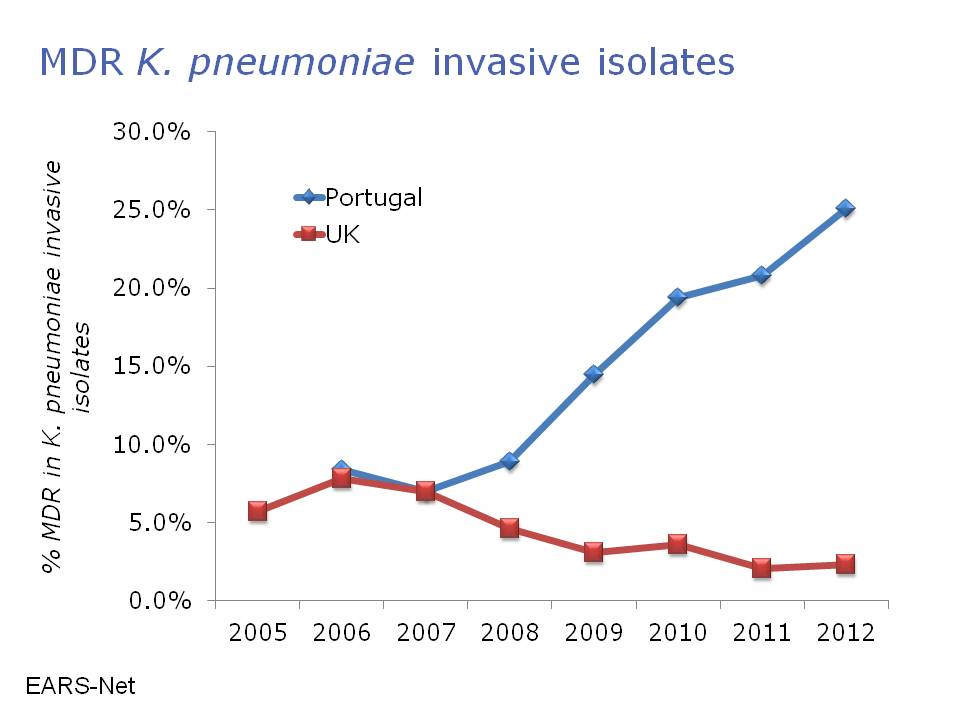
And this issue is not restricted to MRSA. In fact, the threat of the resistant Gram-negatives is even greater than MRSA in many ways. Carbapenem-resistant Enterobacteriaceae are rare currently in Portugal, accounting for 1-5% of invasive K. pneumoniae isolates. However, you get the feeling that it’s only a matter of time: carbapenem-resistant Acinetobacter baumannii are now endemic on many Portugese ICUs, and carbapenem use in Portugal is some of the highest in Europe, with >45% of patients on an antibiotic and >5% of patients on a carbapenem according to the ECDC point prevalence survey. Indeed, there has been a disturbing increase in multidrug-resistant K. pneumoniae in Portugal in recent years (Figure 3).

Figure 3: Disturbing emergence of multidrug-resistant Klebsiella pneumoniae in Portugal. Data from EARS-Net.

mdr kleb uk vs portugal ears net

The reason for these differences between the UK and Portugal is not clear, but may include infection control staffing, antibiotic usage and lower prioritisation by hospitals. Some progress is being made in Portugal with the recent launch of a national strategy to control healthcare-associated infection. However, the financial climate and somewhat fragmented healthcare system (compared with the NHS) will make implementation challenging. But at least it’s a start.

Image: Portugal stamp.

Ebola: infection prevention and control considerations

I gave a webinar yesterday on some of the infection prevention and control considerations related to Ebola. You can view the recording and download the slides here.

Whilst preparing the webinar, it occurred to me that the real game changer in the outbreak that made the world take note was the three transmissions of Ebola in developed healthcare systems outside of West Africa. One occurred in Madrid, Spain in early October, and a further two occurred in Dallas, Texas, a few weeks later. Before these in-hospital transmissions, there was a general feeling that developed healthcare systems could handle Ebola safely. Clearly, that was not the case!

Furthermore, the ratio of secondary transmissions for dealing with Ebola cases in developed healthcare systems isn’t great: of the 13 cases that have been cared for outside of West Africa, three secondary transmissions have occurred.

The outbreak has thrown up some new challenges, outlined below.

Figure: the emerging challenges of the Ebola outbreak (the dark shaded circles indicate the new and emerging challenges).

Ebola challenges

Many of us now find ourselves scrambling to develop Ebola preparedness protocols. These must start at the hospital door, with carefully considered risk assessments for patients presenting with Ebola-like symptoms. We can’t afford to get our full PPE kits out for every patient who presents with a fever, so what should be the trigger for a suspected case? (PHE and CDC have published useful algorithms to help with this, but it’s not straightforward.)

One area of controversy is the appropriate protocols for terminal decontamination following a case of Ebola. Clearly, the most important risk in terms of transmission is direct contact with blood or body fluids from infected patients. However, despite being an enveloped virus, Ebola can surface on dry surfaces for days to weeks under some conditions in laboratory studies. Furthermore, transmission has been associated with indirect contact with contaminated environments. For example, in a recent report from the field, inadequate use of PPE for dealing with surfaces that were grossly contaminated with body fluids from confirmed cases was identified as one of the risk for acquisition. So, we need to make sure that contaminated surfaces are dealt with appropriately, and most hospitals that have dealt with cases outside of West Africa have used hydrogen peroxide vapour for terminal decontamination.

There is a suggestion today that the epi curve may be peaking in Liberia, which is the epicenter of the outbreak in West Africa. Even if that is the case, we can still expect to see more repatriations to developed healthcare systems and perhaps more cases showing up at our hospitals. So, we need to make sure we do everything in our power to prevent secondary in-hospital transmissions.

ID Week 2014 as seen by an Infection Preventionist

id week 2014

Guest Blogger Barley Chironda (bio below) writes…

IDWeek was held this year from Oct 8 to 12, 2014 in Philadelphia. IDWeek is the combined annual meeting of the Infectious Diseases Society of America (IDSA), the Society for Healthcare Epidemiology of America (SHEA), the HIV Medicine Association (HIVMA), and the Pediatric Infectious Diseases Society (PIDS). Given its wide ranging audience, there are many targeted streams that allow a range of topics. The abstract sessions featured over 1700 posters and are now already published and available in Open Forum Infect Dis (Fall 2014) as well as the abstracts from the oral presentations.

I have decided to create ‘buckets’ to best capture the various conference topics that I attended (Global outbreak threats, Surveillance in the hospital and the community, Infection control topic by topic, and Future issues for infection prevention). You will notice an emphasis on the Infection Prevention and Control (IPC) aspects of the sessions that are summarised. Please blame this on the fact that my bread is buttered this way!

Global outbreaks threats

Ebola

Ebola dominated the conference, starting with the jam-packed first talk by Dr Robert Fowler on behalf of the World Health Organization. He shared personal experience of caring for patients in Sierra Leone and supportive care measures that can be implemented in resource-poor settings. This was followed by Bruce Ribner, MD, MPH, of Emory University his talk the Opening Special Plenary Session titled Treating Patients with Ebola Virus Infection in the U.S.: Lessons Learned [1] addressed the unique challenges of how to manage Ebola cases. Dr Ribner drew from the experience at Emory and highlighted all the relevant issues that need critical considerations (see summary of talk). He also mentioned that the PPE type, though important, is part of a multimodal approach to infection control and therefore encouraged healthcare facilities to prepare and practice for the potential of receiving an Ebola patient.

MERS Coronavirus

It has been two years since the first global cases of MERS-CoV were first reported [3]. Dr Tariq Ahmed Madani, from the Ministry of Health, Saudi Arabia, in a talk aptly titled: “MERS Coronavirus – The Second Year” shared what he felt are the main problems that caused the uncontrollable outbreaks in hospitals. He condensed it to three points; i) overcrowded emergency departments, ii) suboptimal infection prevention practices, and iii) atypical presentation of patients. He proceeded to show evidence of camel to human transmission of MERS-CoV [4].

Surveillance in the hospital and the community

An entire symposium was dedicated to the revision of strategies to prevent healthcare-associated infections in acute healthcare titled ‘The Compendium’ [5]. A couple of interesting points were shared under the banner of the symposium.

  • Dr Deborah Yokoe’s talk “Highlights of the Compendium of Strategies to Prevent Healthcare-associated Infections in Acute Care Hospitals: 2014 Updates” [6] shared the complicated collaborative process involved in updating the 2008 recommendations [7] on Hand Hygiene, Clostridium difficile, CLABSI, CAUTI and VAPs.
  • Dr Michael Howell in his talk “From VAP to VAE: Preventing Complications of Mechanical Ventilation” stated the confusion surrounding VAP surveillance is causing incomparable surveillance patterns. Instead of the CDC VAP definition, he offered the alternative, i.e. Ventilator Associated Events (VAE), which the audience felt was a more objective and measurable way of establishing harm related to ventilators [8].

An entire session was dedicated to how technology is now being used to conduct surveillance and gather information on outbreaks. For example, Dr John Brownstein revealed how software applications that are used daily by the public can allow Public Health institutions to predict outbreaks sooner than the current methods of conventional flu surveillance networks. He showed how from a cancelled dinner reservations [7] or public searches online one can deduce that influenza outbreaks are ravaging [10], also showing how a computer algorithm predicted the Ebola Outbreak before the WHO announced it.

Infection control, topic by topic

Clostridium difficile (Cdiff)

  • Dr Tim Peto spoke about the Clinical Treatment and trials of Cdiff, sharing research about the use of whole genomic sequencing (WGS) in evaluating efficacy of new drugs against Cdiff. Dr Peto also partnered with Dr Derrick Crook in showcasing a myriad of applications of WGS, including as an outbreak management tool in infection control.
  • Dr Colleen Kelly shared her study showing that Fecal Microbiota Transplantation appears to be a safe and effective treatment for recurrent, refractory, or severe CDI especially in a high-risk population of immunocompromised patients.
  • Dr Curtis Donskey’s talk was on “Frequent transmission of Clostridium difficile by Asymptomatically colonized Long-Term Care Facility Residents during Hospital Admissions”. In his study, Donskey swabbed all long-term care patients on admission to hospital and realised that asymptomatic patients shed Cdiff spores and often can cause outbreaks [11]. Dr Donskey reminded us of the need to ‘strategize’ on asymptomatic carriage of Cdiff.
  • Dr Trevor Lawley (“Identifying commensal bacteria that provide resistance against Clostridium difficile Infection”) spoke about the advances in understanding of the microbiota in dealing with bacterial infections.

Healthcare cleaning & disinfection

  • Dr Mark Rupp’s “Assessing Cleanliness and Motivating Environmental Service Workers” talk went through various auditing tools including microbiological methods, fluorescence monitoring and basic observation of staff cleaning. He also shared some new studies that show that positive attitude affects the quality of hospital housekeeping. He also shared a study that the time spent cleaning a hospital room does not correlate with the thoroughness of cleaning.
  • Dr Deverick Anderson’s “Evaluating No-Touch Disinfection Systems” went through Ultraviolet, Hydrogen Peroxide Vapour (HPV) and self-disinfecting surfaces. Sharing his data on reducing UV room disinfection time as well as the data on the excellent efficacy of HPV he did caution adoption of impregnated surfaces citing research that more analysis is still needed.

Posters on cleaning & disinfection

  • 1363 The Iowa disinfection cleaning project: opportunities, successes and challenges of a structured programmatic intervention in 56 hospitals.
  • 1366 Surfaces closest to the patient have a higher multi-drug resistant organism (MDRO) bioburden on environmental surfaces in healthcare facilities.
  • 1368 Assessment of environmental cleanliness in outpatient clinics – study showed that more work is needed in outpatient clinics.

Future issues for infection prevention

Stopping contact precautions on MRSA and VRE was a topic raised by Dr Michael Edmond and he covered elements that have been raised on his blog, and featured prominently at the SHEA conference earlier in the year. He concluded that with advances in hand washing and the use of chlorhexidine, there is no need to maintain contact precautions for MRSA and VRE. In addition, it was made clear during the conference that antimicrobial stewardship will play a huge role going forward in ensuring that the antibiotics that are in formulary will still remain effective.

Summary

As an Infection Preventionist, the talks offered plentiful choice and sometimes presented a challenge as to where to go since sessions of interest often ran concurrently. Unfortunately, as cloning is not widely available, I managed to stay in the loop about all talks of interest to me by following the #IDWEEK and #IDWEEK2014 hashtags on Twitter and Instagram, where attendees where tweeting from the various sessions allowing a more complete conference experience. I managed to make a lot of friends at ID Week 2014, and I am looking forward already to ID WEEK 2015!

Barley Chironda Bio

 Barley Chironda

Barley Chironda is a board Certified Infection Preventionist. He is typically found engaged in motivating hospital staff, patients and visitors on proper infection prevention practices and quality improvement interventions related to patient safety. He takes pride in sharing information via social media and is often engaging the public on Twitter™ and LinkedIn™, partaking in resource distribution related to innovative and novel infection prevention strategies. Barley serves as the Education Chair for the Infection Prevention and Control Canada-Greater Toronto Area (IPAC-GTA) Chapter. In his IPAC-GTA role, he has the responsibility to promote conference organization and promote knowledge dissemination. Barley enjoys public speaking, having presented locally and internationally. He possesses exceptional ability to incorporate humour to his presentations. This excellent speaking ability earned him the Best Oral presentation at the 2013 Canadian National Infection Prevention Conference. Follow him on @barleychironda on twitter or contact him through his company www.annexandfoster.com.

References:

  1. Ribner BS. Treating patients with Ebola virus infections in the US: lessons learned. Presented at IDWeek, October 8, 2014. Philadelphia PA.
  2. Hill CE, Burd EM, Kraft CS, et al. Laboratory test support for Ebola patients within a high-containment facility. Lab Medicine 2014:45:e109-111.
  3. Minal KKimberly P. Clinical and Laboratory Findings of the First Imported Case of Middle East Respiratory Syndrome Coronavirus to the United States. Clin Infect Dis2014;pii:ciu635.
  4. Ziad A. Memish, M.D., et al. Family Cluster of Middle East Respiratory Syndrome Coronavirus Infections N Engl J Med 2013;368:2487-2494.
  5. Yokoe DS, Anderrson DJ, Berenholtz SM., et al. Highlights of the Compendium of Strategies to Prevent Healthcare-associated Infections in Acute Care Hospitals: 2014.
  6. McIver DJ, Brownstein JS. Wikipedia Usage Estimates Prevalence of Influenza-Like Illness in the United States in Near Real-Time. PLoS Comput Biol 2014 17;:e1003581.
  7. Nsoesie EO, Buckeridge DL, Brownstein JS Guess Who’s Not Coming to Dinner? Evaluating Online Restaurant Reservations for Disease Surveillance. J Med Internet Res 2014;16(1):e22.
  8. Raoof S, Baumann MH. Ventilator-Associated Events: The New Definition. Am J Crit Care 2014;23:7-9.
  9. Eyre DW, Babakhani F, Griffiths D, .et al Whole-Genome Sequencing Demonstrates That Fidaxomicin Is Superior to Vancomycin for Preventing Reinfection and Relapse of Infection With Clostridium difficile. J Infect Dis 2014;209:1446-1451.
  10. Kelly CR, Ihunnah C, Fischer M, et al. Fecal Microbiota Transplant for Treatment of Clostridium difficile Infection in Immunocompromised Patients. Am J Gastroenterol 2014;109:1065–1071.
  11. Donskey CJ, Venkata CK, Jencsona AJ, et al. Utility of a Commercial PCR Assay and a Clinical Prediction Rule for Detection of Toxigenic Clostridium difficile in Asymptomatic Carriers. J Clin Microbiol 2014;52:315-318.

Selective Digestive Decontamination (SDD) is dead; long live faecal microbiota transplantation (FMT)

crapsules

Ok, so the title may be a little premature, since this blog relates to a study with a sample size of exactly one. However, I do think it spells the beginning of the end for Selective Digestive Decontamination (SDD), especially when applied to suppress gut colonization with antibiotic-resistant bacteria.

A number of groups have looked at using SDD to ‘decolonise’ carriers of multidrug-resistant Gram-negative bacteria such as CRE. In one study, 20 CRE colonized patients in each arm given gentamicin + polymyxin (SDD arm) or placebo (Control arm). The results were rather modest (see chart below). Plus, SDD has substantial downsides in terms of the potential for developing further antibiotic resistance, and ‘collateral’ damage to the gut microbiota.

Figure: Modest impact of SDD to ‘decolonise’ the gastrointestinal tract of CRE carriers.

Saide-Oldes CRE decol

I’ve been waiting for some data on the effectiveness of faecal microbiota transplantation (FMT) to decolonise carriers of antibiotic resistant bacteria for some time. A case report at ID Week related how the ordeal of a 13 year old girl was ended by a faecal microbiota transplantation. After months of persistent colonization and infection, the impact of a single dose of FMT was startling: CRE carriage was eliminated and there was no further bacterial infection.

One of the push-backs against using FMT more regularly is that it’s a crude (in every sense) and labour-intensive procedure compared with an antibiotic capsule. But that was before the invention of ‘crapsules’ (aka oral FMT). Another ID Week abstract reports the successful delivery of oral FMT using crapsules. (And it’s amazing what great dinner party conversation ‘crapsules’ makes. Try it – you’ll see.)

So, I think it’s time for a cluster randomized trial to compare the impact of SDD and FMT; my money is on FMT!

Image: Barbara Krawcowicz.

Autumn 2014 Update


Autumn NY 2014It’s been another busy quarter on the Micro Blog, with posts on Ebola, coverage of Infection Prevention 2014, and updates on multidrug-resistant Gram-negative rods (especially CRE):

As ever, if you have any questions, fire away. We love the interaction!

Image credit: ‘Autumn in New York’.

Journal Roundup September 2014: Ebola, Environmental science, and MDR-GNR

Ebola CDC global

Another month, another Journal Roundup (free and open acces in Journal of Hospital Infection). This month, Ebola tops the bill as the outbreak continues unabated, it seems inevitable that repatriations of healthcare workers from West Africa will continue and increase. The big journals discuss the appropriate level of PPE, and how to test experimental medicines, amongst other things.

A number of useful environmental science updates feature in the Roundup. For example, an age-old question is whether contaminated hands or surfaces contribute most to transmission. A modeling study found that improvements in hand hygiene compliance are about twice as effective in preventing the transmission of multidrug-resistant organisms compared with improvements in environmental hygiene. So hands are more important right? Well, as the single most important intervention to prevent transmission, then yes.

Several studies on the theme of multidrug resistant Gram-negative rods (MDR-GNR) serve mainly to highlight the limitations in the evidence base for establishing what works to prevent MDR-GNR. One of the major problems here is that ‘MDR-GNR’ is a heterogeneous group comprised of several species and resistance mechanisms, not to mention strain variation. The prevention and control prospects for MDR-GNR are different to pathogens like MRSA, VRE and C. difficile. You need to cover all bases – and there are more bases to cover!

The Reviews and Guidelines section includes a thoughtful piece considering the “hygiene hypothesis” vs. the idea of “biome depletion”, the inadequate level of funding in HCAI research, infection control practice in the ER, the cost of CDI, prospects of phage therapy and interrupting regulatory RNA function.

And finally, a UK study finds pretty high levels of ATP on the beverage trolley. So time to ban the beverage trolley as an infection control risk (along with flowers, pets and child visitors)? Not yet – it’s not that surprising to find ATP (which may originate from food, not microbes) on a beverage trolley. That said, if they’d found a lot of MRSA or, worse, CRE then I’d think twice about a cuppa!

Image credit: CDC Global.

Infection Prevention 2014: Some highlights

ip2014

Another Infection Prevention Conference has been and gone; here are a few highlights. Worth noting that all of the submitted abstracts are published in an open access Journal of Infection Prevention supplement.

Opening talks

The now past-president Jules Storr kicked off the Conference with an inspiring talk on “real” leadership, which isn’t about CEOs and eminent professors. Real leadership inspires people to wash their hands in the dead of night when nobody’s looking. Roselinde Torres’ TED talk is worth a look (‘What it takes to be a great leader’) and ‘How to behave and why’ by the fantastically named Munro Leaf contains some leadership lessons from 1946!

Next up, IPS Patron Prof Didier Pittet challenged us to change our education methods to meet the changing (and dare I say somewhat fickle) needs of a rapidly changing world! Generation “We” (born 1980-2000, thus including me) require multimodal approaches to keep us engaged, and would probably rather watch a webinar than come to a conference! But, if you’d like to go ‘Old Skool’, there’s always Didier’s new book.

The highlight of the conference for me was Dr Jason Leitch’s address on developing a safety culture. A culture of safety has been embedded into other industries (e.g. airline, hotel and military) so why not healthcare? It’s a much quoted stat that a 747’s worth of people die from HCAI each [insert time period to suit your data]. So how many planes need to go down before we adopt a culture of safety? A culture of safety has a language to go with it – only the air traffic controller can say actually say “take-off”, and then only once. Perhaps only the IV nurse should be allowed to say “Catheter”, and only at the point of insertion!

Dr Michael Borg then took to the stage to parallel antibiotic resistance with Star Wars: a battle of intergalactic scale! Michael spent some time discussing the impressive reductions achieved in his hospital on multidrug-resistant A. baumannii, applying the principles of the ESCMID guidelines, with a particular focus on environmental issues. However, the new and more challenging threat comes from the carbapenem-resistant Enterobacteriaceae – aka the Death Star [note, pretty sure Dr Borg didn’t actually say that, but I think it’s a good fit with his analogy]. So what to do? Be an Ewok! Small and ostensibly insignificant, but surprisingly powerful as a collective force.

Cotteral Lecture – Dr Evonne Curran

Dr Evonne Curran delivered the Cotteral Lecture, entitled “The times they are a changing”. Reflecting on her thorough reviews of some older literature to write her outbreak columns on MRSA and CRE, Evonne reminded us how far we’ve come but how far we have yet to go. It wasn’t so long ago that we were questioning whether C. difficile was infectious (and now we’re asking a similar question from a different angle)! Equally, in 1990, installing one sink on a ward increased the number of sinks by 100%. Yet there can be no cause for complacency: we haven’t reached base camp for the CRE epi curve! Evonne didn’t quite finish on a song, but she did finish on a Hand Hygiene Haiku:

‘Five moments for hands

For infection prevention 

Essential for all’

Universal gloves and gowns

Dr Dev Anderson (Duke) gave an engaging lecture on the impressive ‘Benefits of Universal Gloves and Gowns’ (BUGG) study. This cluster randomized controlled trial design is likely to be the gold-standard assessment of infection prevention and control interventions. The problem with this powerful design is that studies need to be large to be powered appropriately. This study involved 20 ICUs and still failed to meet the primary end point (a reduction in MRSA / VRE acquisition). So will ICUs around the world be switching to universal gloves and gowns? On the basis of this study, combined with the well-publicized downsides of “contact precautions”, no. A targeted approach to contact precautions is better…

As if to reinforce the message of judicious use of gloves, Jennie Wilson’s talk highlighted that using gloves badly is worse than not using gloves at all! Some of the staff perceptions surrounding glove use were enlightening, including the classic: “when I wear gloves, I don’t need to wash my hands as often”. Hmmm.

CRE stream

Or should I say CPE stream? Or perhaps CPC is more to your fancy? This excellent stream kicked off with Dr Bharat Patel assisting in us in navigating the ‘acronym minefield’ that is multidrug-resistant Gram-negative bacteria. An informal poll of the audience prior to Dr Patel’s talk suggested that only a handful would be comfortable explaining the difference between CRE and CPE to a colleague. Hopefully, this was remedied by the talk!

Then, Dr Tara Palmore (NIH, USA), Dr Andrew Dodgson (Manchester) and Erika Grobler & Ogra Marufu (King’s College Hospital, London) provided a series of ‘views from the trenches’ of CRE prevention and control. Dr Palmore described the fascinating utility of whole genome sequencing to dissect the outbreak more or less in real time. She also highlighted the use of ‘monitors’ whose sole job it was to ensure compliance with hand hygiene and PPE at room entry and exit! Dr Dodgson described the ongoing CRE problems in Manchester. My key message from Dr Dodgson was not to bother with contact screening when you identify a new case: just go ahead and screen the whole ward – more than once. Finally, Erika and Ogra gave their perspective on control challenges. They are now screening all paediatric admissions to their hospital for CRE carriage, which is not a popular or easy policy, but they consider it to be a cornerstone of effective control. As we all wrestle to implement the principles of the Toolkit, this session provided useful advice from those in the know.

Oral presentations

I didn’t make it to all of the oral presentations, but I was impressed by the ones that I saw. (Remember, you can view all of the accepted abstracts from the submitted oral and poster presentation in the Journal of Infection Prevention supplement.)

  • Donald Bunyan: E. coli bacteraemia in Scotland: nearly 50% classified as “community”; but how many of these were frequent fliers?
  • Angela Beal: Pulsed-xenon UV (Xenex): good reduction in total aerobic count, but less effective out of line of sight & 39% of sites VRE contaminated after process. Is this satisfactory?
  • John Chewins: spraying aqueous oxygen peroxide (aka ozone) onto chronic wounds less likely to withdraw from RCT due to infection and improves patient’s quality of life scores.
  • Jo Keward: introduction of semi-permanent Pods reduces missed isolation days by 60% on the Alder Hey HDU.
  • Andrea Whitfield: Service User Involvement in HCAI research: A necessary evil to get your grant or vital for top class research?

Use of disinfectants and HCAI – Dr David Weber

Dr Weber began by reviewing the compelling data that contaminated surfaces contribute to the transmission of some hospital pathogens. An age-old question is whether contamination of hands or surfaces is more important in transmission. A recent modeling study helps to answer this, suggesting that hands are generally more important, but that this will depend on pathogen and setting. Getting the best out of hospital cleaning and disinfection is a simple equation: ‘Product + Practice = Perfection’. The problem is the ‘practice’ part of that equation; it’s difficult to assure process repeatability. This is where new technologies such as automated room disinfection systems, and antimicrobial surfaces can come in most handy. Finally, Dr Weber pointed us towards the AJIC and ICHE recent special editions on all things environmental.

Ayliffe Lecture – Dr Stephanie Dancer

Dr Stephanie Dancer began the Ayliffe Lecture by reiterating a wish that I had earlier in the conference: for genetically modified visible microbes on surfaces! That way we’d all be able to see the long survival and low infectious dose exhibited by many hospital pathogens. As we come towards the end of antibiotics, we need to move from cure to prevention. Remember, mortality due to S. aureus bloodstream infection was once 80% and may be so again as we lose more antibiotics. We need intervention bundles (aka ‘intervention umbrellas’) but not all solutions are possible, practical, affordable or acceptable. A good dose of evidence and common sense is required to find and implement interventions that work!

The BIG debate: universal vs. targeted interventions (Dr Gould vs. Dr Otter)

I think that Dr Gould and I achieved our purpose of presenting both sides of the debate without coming to physical blows. I found myself on uncomfortable ground arguing for a “No” vote in Glasgow following the Scottish “In/Out” referendum. I think my decision to wear a bow tie (see image below) in recognition of Dr Gould’s signature neck-wear lightened the mood!

Figure: My choice of neck wear

Scotland debate

I’ve laid my arguments for targeted interventions out in a separate blog, but in short, universal interventions are appealing but fail to demonstrate short-term, long-term and cost-effectiveness. Targeted interventions have been shown to be effective in reducing transmission, preserve the activity of our precious antimicrobial agents, require less modification of human behaviour, and are cheaper and less resource-intensive. So, on balance, I favour targeted interventions for infection prevention and control.

Closing talks

Rose George gave an engaging talk ‘examining the unmentionables’. It’s eye-opening to think that 40% of the world population lacks adequate sanitation; open defecation is all too common with no privacy, dignity or safety! The flushing toilet, believe it or not, was voted the biggest medical advance of the last 200 years by the BMJ. Investing in sanitation makes financial sense too, with $1 invested in sanitation yields $6. You can see Rose’s TED talk here.

IPS Patron Tricia Hart and incoming president Heather Loveday rounded off the conference, exhorting us to examine our attitude and approach to infection and control. I left the conference feeling that IPS is in good hands with Heather at the helm.

Universal vs. targeted interventions in infection prevention and control: the case for a targeted strategy

Today, I participated in a debate with Professor Ian Gould on universal vs. targeted interventions for infection prevention and control at Infection Prevention 2014. I was arguing for a targeted approach, and you can download my slides here, and you can listen to a recording of the talks here.

Universal interventions are appealing: they make no discrimination between patients, there’s a clear message for staff, and you have no way of knowing reliably who is colonized anyway! However, for me to get behind a universal intervention, it would have to demonstrate short-term, long-term and cost-effectiveness.

Before getting into the details of my argument, it is worth defining what we mean by ‘universal’ or ‘targeted’ interventions (see Table 1, below). It’s important to note that an intervention can be targeted either to an individual (e.g. chlorhexidine given to decolonize the skin of a patient known to be colonized with MRSA) or targeted to a population (e.g. chlorhexidine given to all patients in high risk settings, such as the ICU). Screening is an interesting one. It’s easy to mistake screening as a universal strategy when it’s applied to all patients (as is common in the NHS), but it’s fundamentally a targeted strategy to identify patients for an intervention (such as isolation and / or decolonization). A truly universal strategy has no need of screening.

Table 1: defining universal and targeted interventions.universal vs. targeted definitions_cropped

Short-term effectiveness

Short-term effectiveness can be difficult to measure. What is the standard for demonstrating short-term effectiveness? Most common interventions lack accepted standards for demonstrating short-term effectiveness, and the results may well be different as setting and pathogen varies. However, there are some universal approaches that have effectively failed at the first hurdle and not demonstrated even short-term effectiveness. For example, ‘selective’ digestive decontamination has been applied to try to decolonize carriers of resistant Gram-negatives. Although this clearly has some impact, and reduces colonization, it seems to temporarily suppress the level of resistant bacteria in the gut flora, not decolonize the patient. Similarly, the use of universal gloves and gowns failed to meet the primary endpoint in a cluster randomized controlled study (the BUGG study).

Long-term effectiveness

A number of universal strategies that have demonstrated some level of short-term effectiveness fail in terms of long-term effectiveness due to the promotion of bacterial resistance (or reduced susceptibility). For example, selective digestive decontamination on a group of patients resulted in a sharp increase in gentamicin resistance, and perhaps more worryingly an increase in colistin resistance. Furthermore, a microbiomic analysis of a patient undergoing selective digestive decontamination identified a seven-fold increase in the abundance of aminoglycoside resistance genes in the ‘resistome’.

Another way in which universal strategies that are effective in the short-term may fail in the long-term is due to reliance on human beings to maintain compliance with protocols. This is relatively easy during studies, where staff have both support and scrutiny to drive performance. When the spotlight is off and they’re on their own, performance is less impressive. We can see this type of “reverse Hawthorne effect” in compliance with contact precautions, and in hand and environmental hygiene.

Cost effectiveness

Once a strategy has demonstrated both short-term and long-term effectiveness, it must demonstrate cost effectiveness before widespread adoption. Even if you disagree with me and consider screening to be a universal strategy for MRSA when applied to all patients at the time of admission, it has failed to demonstrate cost-effectiveness in almost all scenarios. Economic analysis using the standard threshold of £30,000 per Quality Adjusted Life Year (QALY) has shown that screening all admissions for MRSA is not effective for teaching or acute hospitals at current, high or low prevalence. Universal screening was only cost-effective for specialist hospitals (the vast minority), and then only at some levels of MRSA prevalence. For this reason, the Department of Health is going to reverse its recommendation for universal screening of all hospital admissions.

Summary

I can’t think of a single universal intervention that has demonstrated short-term, long-term and cost effectiveness (see Table 2). Decolonization using chlorhexidine comes close, but almost all studies of this intervention have been performed in an ICU setting, where this intervention is applied to a targeted population. I would be uncomfortable about using chlorhexidine for daily bathing of all hospital patients due to the risk of promoting reduced bacterial susceptibility.

Table 2: short-term, long-term and cost-effectiveness of universal interventions.universal vs targeted debate summary_cropped

Targeted interventions have been shown to be effective in reducing transmission, preserve the activity of our precious antimicrobial agents, require less modification of human behaviour, and are cheaper and less resource-intensive. So, on balance, I favour targeted interventions for infection prevention and control.

How to assess scientific posters: a practical guide

Posters are a hugely important part of scientific congresses. The submitted abstracts that get accepted as oral presentations are always only a fraction of the science available at conferences. And which abstracts get selected as oral presentations are, to a degree, at the whim of the abstract assessment committee and procedures. So, there will be some gems amongst the posters that have the potential to change practice.

I gave a talk at IPS today: a practical guide to assessing scientific posters. You can download my slides here. But they will only tell part of the story. The idea was for the session to be a practical workshop to arm those who are new to infection prevention and control with the tools to maximize their conference experience in terms of accessing submitted science.

I covered the publication process: concept -> research -> abstract -> poster -> paper -> “post-publication peer review”. It was interesting to think in more detail about what makes a good poster. Clearly, first and foremost, a poster must be visual. If it doesn’t look good visually, then it’s not a good poster. That said, what looks “good” is somewhat subjective, but I think some basic themes emerge in terms of visual presentation:

  • Eye catching – draws the viewer in
  • Graphical, not text based
  • Not cluttered
  • Good use of colour
  • Clear ‘flow’ from one section to the next
  • Key findings communicated clearly
  • Contains more detailed information for those that want it
  • Correct size for the board (check the guidelines!)
  • Not an essay / epic; it’s designed to stimulate discussion
  • No intricate fonts that are difficult to read
  • Watch out for fuzzy low-res graphics
  • You can’t include all your data – be selective

And then there’s the scientific content. Really, this is the same question as what makes a good abstract or, indeed paper. The following criteria may be useful in this regard:

Table: what makes a good poster (or abstract, or paper) in terms of content?How to assess a poster_cropped

So, I hope the participants found this session useful.

Tending the human microbiome

Atomic antibiotics

This isn’t hot off the press (a 2012 review article by Tosh & McDonald) but it’s probably more important now than when first published, given our rapid advances in understanding of the importance of the microbiome in human health over the last year or two.

A couple of clear principles emerge from the review:

  • A happy, healthy human microbiome is characterized by diversity (both in terms of number of different species, and diversity within the species), and composed mainly of bacteria that we’re not familiar with – Fermicutes and Bacteroidetes).
  • Antibiotics have a profound and sustained effect on the human microbiome (even those that are typically associated with no or few side effects). This results in a reduction in both diversity and change in composition, which is bad news for human health. In particular, this leave the gut more open to colonization with unwanted intruders aka antibiotic resistant bacteria.

The future of anti-infective therapy according to Tosh and McDonald is in:

(1)     Developing and using more microbiome-sparing antimicrobial therapy. The idea of ‘selective digestive decontamination’ flies in the face of this objective.

(2)     Developing techniques to maintain and restore indigenous microbiota. A lot of progress has been made here, for example, in the case of faecal microbiota transplantation (FMT) for the treatment of recurrent CDI.

(3)     Discovering and exploiting host protective mechanisms normally afforded by an intact microbiome.

Rather than obliterate our microbiome with overuse of antibiotic “Atomic bombs”, we need to carefully tend individual and collective microbiomes in order to make them resistant to the increasing queue of antibiotic resistant colonizers!

Article citation: Tosh PK, McDonald LC. Infection control in the multidrug-resistant era: tending the human microbiome. Clin Infect Dis 2012;54:707-713.

Image credit: Modified from ‘Mushroom cloud‘.