
A very enjoyable few days in Edinburgh this week for the Federation of Infection Societies / Healthcare Infections Society (FIS/HIS) meeting. Some reflections follow…
A very enjoyable few days in Edinburgh this week for the Federation of Infection Societies / Healthcare Infections Society (FIS/HIS) meeting. Some reflections follow…
 It’s the most Chunderful time of the year (or maybe not). The Norovirus ‘season’ will still be on us and a few points are well worth reflecting on. A recent systematic review of Norovirus risk in high and middle-income countries asserts that there may be as many as 12.5 million infections annually these countries alone, with possibly as many as 2.2 million outpatient visits related to the illness. Personally I have always liked having a bit of norovirus around. Keeps the staff on their toes and gives a good indicator of how IPC is really being performed rather than another set of 99% compliant hand hygiene audits.
 Outbreak of Mycobacterium chimaera Infection After Open-Chest Heart Surgery
Reported by Andreas Widmer in Basel and now published by Hugo Sax and colleagues (CID April 15th, 2015), the amazing story of open-cheat heart surgery, Mycobacterium chimaera infections (years after the operation!), and contaminated heater-coolers in your operating room.
While the Swiss were first, we know by now that this problem is unfortunately not limited to the Alp region, but furthermore present e.g. in the Netherlands. If your hospital has a program for open-chest heart surgery, now is the time to check your heater-coolers, to avoid further airborne transmission of M. chimaera from contaminated heater-cooler units.

 The August edition of the Journal of Hosptial Infection Journal Roundup is now available, featuring:
I’ve written three editions of the Journal of Hosptial Infection Roundup now (June, July and August), so there’s a few examples to review. You can read about my methods for producing the Roundup in the blog accompanying the June edition. I thought that now would be a good time to get some feedback, specifically:
Any feedback that you have would be most appreciated. Please either submit a comment below or email me.
Photo credit: ‘Fist bump’.
I recently came across a fascinating review article published in 1963 mainly about outbreaks of Salmonellosis during the 1950s. The review focuses on epidemics that were traced to contaminated surfaces, including ingested, contact and inhaled transmission routes. A number of interesting epidemics stand out:

Figure: A chopping board at risk of persistent microbial contamination due to surface damage.
Although most outbreaks covered in the review relate to ancient catering-related outbreaks of Salmonella, there may be some useful learning for hospital epidemiology today, specifically CRE. It’s rare although not unheard of to find Salmonella carrying a carbapeneamase (i.e. Salmonella CRE). However, Salmonella is a member of the Enterobacteriaceae, so the involvement of contaminated surfaces during outbreaks of Salmonella suggests that contaminated surfaces may also be important during outbreaks of CRE.
It’s interesting that even back in the 1960s contaminated surfaces were recognized as potentially important in epidemics, whereas by the 1980s, the role of contaminated surfaces in endemic transmission was considered negligible. It’s difficult to know whether experts of the 1960s (perhaps there are some reading this?) would have considered contaminated surfaces important in both epidemic and endemic transmission? I suspect so, and we just lost sight of that in the 1980s and 90s.
Article citation: Sanborn WR. The relation of surface contamination to the transmission of disease. Am J Public Health Nations Health 1963;53:1278-1283.
Image: Ben Hosking.
 Earlier this year, I wrote about an outbreak of norovirus in a US car dealership. There, the outbreak was traced to a toddler “spraying” norovirus around a public restroom and baby-changing station. Regrettably, I now have my own experience to relate.
Last Wednesday (let’s call it outbreak day 1), our 18-month old toddler “sprayed” projective vomit around our porch. My wife cleaned up the mess (not with dry paper towels, as in the US car dealership outbreak but with detergent and water). On outbreak day 3, 36 hours later, my wife presented (grumpily) with acute gastroenteritis. We made every effort to limit domestic horizontal transmission (including regular bleach disinfection of contact surfaces in the bathroom and cohorting of personal effects) but to no avail; a little over 24 hours later on outbreak day 4, I endured acute gastroenteritis.
What do we learn from this?
Could we have done a better job of preventing the spread of this acute bout of gastroenteritis through the Otter household? Probably, through better outbreak identification and more stringent cohorting (perhaps with universal gowns and gloves, and liberal use of masks). But really, I’m just counting our blessings that we didn’t all get it at the same time.
Drs Tara Palmore and David Henderson have written an engaging ‘view from the trenches’ in CID reflecting on their efforts to control an ongoing outbreak of CRE at the NIH Clinical Center, beginning in 2011.
The review outlines their interventions, including:
The authors discuss the problem of determining which of these interventions worked, since they were implemented more or less simultaneously; the so-called “kitchen sink” approach (Figure). A recent systematic review performed by ECDC identified this problem in virtually all studies evaluating control interventions for CRE.
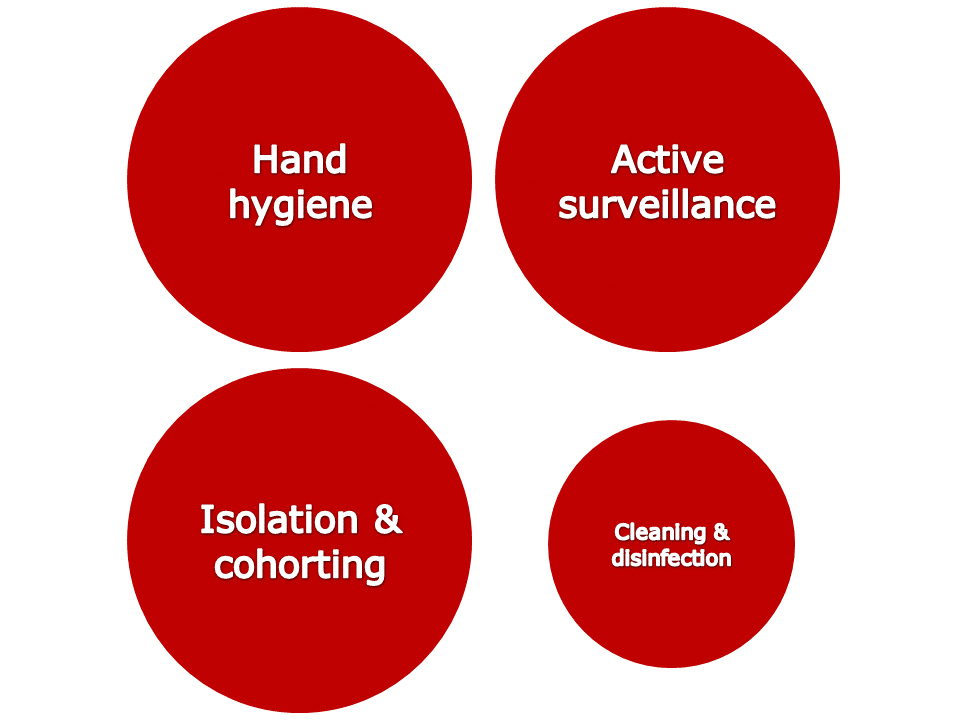 Figure. Perceived relative importance of outbreak control interventions at NIH.
There’s an interesting section on the ‘unintended consequences’ of publishing in report, including the inevitable scaremongering in some parts of the lay-press. It wasn’t all bad though; this is an unusually detailed article based on the original NIH outbreak report in the Washingtonian.
Some reflections from me:
Article citation: Palmore TN, Henderson DK. Managing Transmission of Carbapenem-Resistant Enterobacteriaceae in Healthcare Settings: A View From the Trenches. Clin Infect Dis 2013 in press.
 An outbreak report in the Journal of Infectious Diseases tells the fascinating story of a norovirus outbreak in a car (auto*) dealership in Oregon that was initially thought to be foodborne, but was eventually traced to contaminated surfaces on a baby changing table (diaper changing station*) in a public toilet (restroom*). The outbreak had a startlingly high attack rate, affecting 75% of 16 employees who attended a team meeting. A thorough investigation of the restaurant that provided the sandwiches for lunch turned out to be a blind alley following the recollection of a staff member of a toddler with “spraying” diarrhoea using the baby changing table in the public toilet of the dealership. The (generous) mother left the mess for the staff member to clean up, which was accomplished using, wait for it, dry paper towels.
The environmental investigation included samples from the baby changing table in the dealership and some ‘control’ samples from 14 baby changing tables in public toilets throughout the state. Norovirus of the same genotype as the outbreak strain was identified from the baby changing table in the car dealership, but norovirus was not identified from the control baby changing tables.
Some limitations of the outbreak include the fact that it is difficult to disentangle the relative importance of the environmental reservoir and secondary transmission via contaminated food. The PCR method used for environmental sampling does not assure that the norovirus RNA identified on the baby changing table was viable. Also, the environmental norovirus isolates could not be sequenced meaning that they could not be sequence-matched with the patient isolates.
Perhaps the most shocking part of the story is that the image of visible soiling on the baby changing table (after two rounds of cleaning) was consistently viewed on baby changing tables in public toilets. Or perhaps it’s even more shocking that only 3 of the 12 affected individuals actually took time off work. As a “survivor” of a norovirus outbreak that swept through the Otter household in 2012, I can vouch for the fact that a) you need to take time off work and b) you ought to take time off work!
One important discussion point was the finding of Dr Carling’s group that baby changing tables were least likely to be cleaned on cruise ships, a setting in which persistent norovirus outbreaks are common. This outbreak report and Dr Carling’s earlier work highlight an important deficiency in how to clean and disinfect baby changing tables in public toilets. As a frequent user over the past 14 months, I can vouch for the fact that, much like a hospital bed, turnover is high which pressurizes effective terminal disinfection! I agree with the authors that disinfection with a chlorine-containing disinfectant would be ideal, but question whether this is feasible in practice.
There’s surprisingly little data supporting the role of environmental contamination in the transmission of norovirus. I’m persuaded by the various outbreaks affecting separate cohorts of patients / staff on cruise ships or aeroplanes, but this outbreak is even more compelling due to the environmental findings. Quantifying the role of the environment in the transmission of norovirus is difficult to study because it always occurs in outbreaks (hence difficult to perform a controlled study). But I’d be interested to see whether the “prior room occupancy” concept that has been established for other environmentally-associated pathogens holds true for norovirus.
Article citation: Repp KK, Hostetler TP, Keene WE. A norovirus outbreak related to contaminated surfaces. J Infect Dis 2013;208:295-298.
Also, take a look at Dr Repp’s blog.
* = for my American readers! Current data indicates that around 40% of the readers of this blog are US based, 40% are UK based and 20% are rest of world!
 Reflections on Infection Prevention and Control