I’ve written this post in preparation for Wednesday’s IPS Journal Club (register here). The paper that I have chosen for the Journal Club is this one in the Journal of Infection Prevention, comparing the risk of SARS-CoV-2 dispersal through the air with an inhaler vs. nebuliser.
Continue readingAGP
Managing ventilation in the context of COVID-19: a HIS audience-led webinar
The next in the series of the HIS audience-led webinar on all-things ventilation in the management of COVID-19 went out recently. The panel consisted of:
- Peter Hoffman – Consultant Clinical Scientist, London
- Dr Chris Lynch – Graham Ayliffe Training Fellow, Sheffield Teaching Hospitals
- Professor Catherine Noakes – Professor of Environmental Engineering for Buildings, University of Leeds
- Karren Staniforth – Clinical Scientist, Nottingham University Hospitals NHS Trust
- Dr James Price (chair) – Consultant in Infection Prevention & Control and Antimicrobial Stewardship, Imperial College Healthcare NHS Trust
The webinar video is below:
Considering the role of environmental contamination in the spread of COVID-19
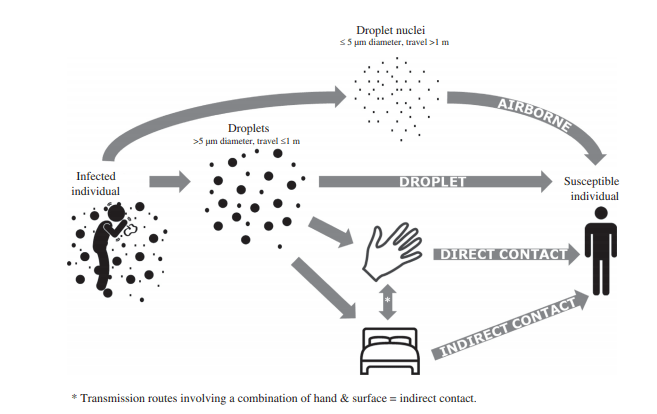
We know that respiratory viruses can be spread through droplets, occasionally aerosols, and contact routes (see Figure 1). But what is the relative importance of these transmission routes for the SARS-CoV-2 virus, which causes COVID-19? A new pre-print paper published yesterday provides evidence that the stability of the SARS-CoV-2 coronavirus is broadly comparable to the ‘original’ SARS coronavirus (SARS-CoV-1) on dry surfaces and in aerosols. This paper supports an important role for dry surface contamination and aerosols in the spread of SARS-CoV-2, and suggests that improved environmental persistence isn’t the key to the relative success of SARS-CoV-2 over SARS-CoV-1.
Figure 1: Transmission routes of respiratory viruses (from this review article).
 Reflections on Infection Prevention and Control