Are beards bug traps? Au contraire!

As the owner of a relatively new beard (see picture below), I was alarmed to hear that my beard is probably as contaminated with faeces as a toilet brush. Fortunately, a Journal of Hospital Infection study from 2014 turns this on its head, showing that those wearing beards are actually less likely to be colonised with staphylococci!

Me and my beard

Twitter01f6551v2

Continue reading

Aiding decision-making in urinary catheter placement

16715157934_57fc5b3c71_z
Photo credit: Dialysis Technician Salary

Anything that assists clinical staff in making the decision as to which device to use when considering an indwelling urinary catheter is to be welcomed and the latest guidance comes from the prolific group at Ann Arbor. Using the RAND/UCLA Appropriateness Method, a system of identifying the most fitting option in the absence of ‘gold standard’ RCTs, the authors have produced a practical and helpful guide that fills a gap, since existing guidance does take into account commonly-encountered patient characteristics, such as the bariatric or oedematous patient, that make lists of ‘appropriate indications’ in current guidelines challenging to implement.

Continue reading

Voss + Kiernan + Otter = Reflections on Infection Prevention and Control!

ReflectionsIPC

Not so long ago, we (that is Andreas Voss, Martin Kiernan and Jon Otter) put our heads together and started talking along the lines of “a team is greater than the sum of its parts”…and the “Reflections” blog was conceived.

We are all keen bloggers with hopefully complimentary interests and expertise so we hope that you will enjoy our new blog.

Do please sign up for email notifications and look out for tweets hashtagged #ReflectionsIPC.

Also, please submit lots of comments – we love the discussion.

Finally, if you have something that you want to get off your chest, we’d love to host some Guest Blogs from time to time, so do get in touch.

Mycobacterium chimaera & Open-Chest Heart Surgery

20_det_heater_C_v1_Outbreak of Mycobacterium chimaera Infection After Open-Chest Heart Surgery

Reported by Andreas Widmer in Basel and now published by Hugo Sax and colleagues (CID April 15th, 2015), the amazing story of open-cheat heart surgery, Mycobacterium chimaera infections (years after the operation!), and contaminated heater-coolers in your operating room.

While the Swiss were first, we know by now that this problem is unfortunately not limited to the Alp region, but furthermore present e.g. in the Netherlands.   If your hospital has a program for open-chest heart surgery, now is the time to check your heater-coolers, to avoid further airborne transmission of M. chimaera from contaminated heater-cooler units.

Schermafbeelding 2015-05-06 om 11.50.47

Hand Hygiene, Surfaces and Modelling

maximum-occupancy-capacity-sign-s-0307

Interesting publication being highlighted as part of the WHO hand hygiene day in Leeds, UK suggests through modelling that the type of care, number of surface contacts and the distribution of surface pathogens are most likely to affect the relative quantity of pathogens accried on hands. The paper is published in ‘Indoor Air’, (not a journal that inhabits my bedside table) and we do have to remember that, as G.E.P Box stated, “Essentially, all models are wrong. But some are useful”.

Continue reading

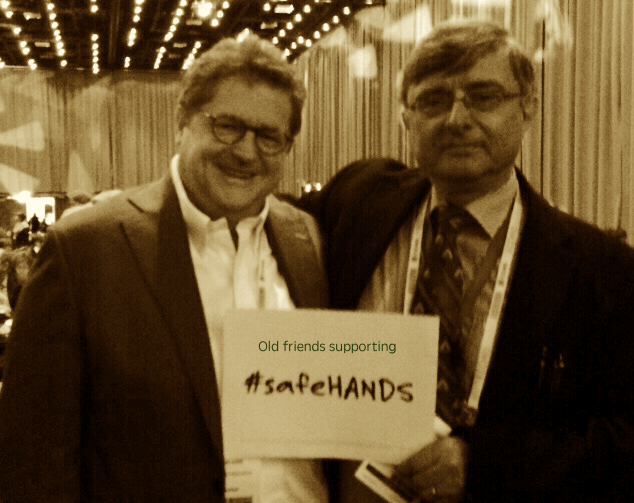
5th May Hand Hygiene Day

safehandsDear friends and colleagues, The Hand Hygiene day on the 5th of May is approaching. However, this year is different. 2015 is the 10th anniversary of the WHO Clean Care is Safe Care program and we would like you to help us commemorate this day. We are simply asking you to participate to the #safeHANDS campaign by taking your photo using WHO #safeHANDS board and posting it on the website (see below) or on the social media Twitter or Instagram to remind the world that hand hygiene saves lives. It is as simple as that. You can also organize a Hand Sanitizing Relay and even beat a GUINNESS WORLD RECORD. Here are links providing you all information: 1) WHO campaign webpage:  http://www.who.int/gpsc/5may/EN_PSP_GPSC1_5May_2015/en/ 2) Where to post your pictures: http://www.CleanHandsSaveLives.org/safehands/ 3) The safeHANDS campaign promotion clip: http://tinyurl.com/safeHANDSclip 4) The Hand Sanitizing Relay – possible Guinness World Record explanatory clip:  http://tinyurl.com/HHRelay

WHO Antimicrobial Resistance Analysis

Schermafbeelding 2015-05-03 om 17.47.41

Over a 2-year period, from 2013 to 2014, WHO undertook an initial “country situation analysis” in order to determine the extent to which effective practices and structures to address antimicrobial resistance have been put in place and where gaps remain. 

A survey was conducted in countries in all six WHO regions and focused on the building blocks that are considered prerequisites to combat antimicrobial resistance: a comprehensive national plan, laboratory capacity to undertake surveillance for resistant microorganisms, access to safe, effective antimicrobial medicines, control of the misuse of these medicines, awareness and understanding among the general public and effective infection prevention and control programmes.

Link to document: http://www.who.int/drugresistance/documents/situationanalysis/en/


The cat and mouse of antibiotic resistance (Tom never does catch Jerry…)

tom and jerryProf Laura Piddock’s team from Birmingham recently published a Nature review on molecular mechanisms of antibiotic resistance. If you’re struggling to tell your KPC from your NDM, this review is for you. Continue reading

Ebola – Hands on, ICPIC Pre-meeting workshop

Schermafbeelding 2015-04-07 om 12.25.10

Just before the start of ICPIC 2015

June 16, 2015 (10:00-16:50)

Field experiences with Ebola virus disease in West Africa (10:00-12:45)

Moderators : Prof. Benedetta Allegranzi ; Prof. Babacar Ndoye

1) Ebola epidemic in West Africa and WHO Ebola response roadmap (10:00)

Prof. Benedetta Allegranzi, WHO Patient Safety, WHO, Geneva

2) Using the core components of infection control programmes during the Ebola outbreak

Dr. Sergei Eremin, medical officer, WHO, Geneva (10:25)

3) Main lessons from Médecins-Sans-Frontières (MSF) engagement (10:50)

Hugues Robert, Médecins-Sans-Frontières (Doctors without Borders), MSF Switzerland

Continue reading

Pigs & Antibiotics – Food for Thought


PICTURE 2ARIC just published an interesting article that tried to estimate the antibiotic consumption in Chinese pig breading (http://www.aricjournal.com/content/4/1/17).

Since the article is based on a US model, I believe that it needed a word of caution/explanation.  Have a look at the editorial:  http://www.aricjournal.com/content/4/1/16