In preparation for next Wednesday’s Journal Club in partnership with the Healthcare Infection Society around water hygiene (details and registration here), I’ve reviewed this article in the Journal of Hospital Infection. It’s an excellent narrative review on the use of continuous monitoring of key parameters related to water hygiene (e.g. water temperature and flow). Continuous monitoring seems like part of the future of safe water hygiene!
Continue readingWater
Collateral damage in a waterless ICU!
In recent months I’ve read a lot about the infection risks associated with sinks and drains in areas of healthcare organisations which house some of our most sick and vulnerable patients. The retrospective study carried out in Germany, comparing hospital acquired infection (HAI) rates in 552 intensive Care Units (ICUs) with and without sinks was perhaps the most compelling, concluding that ICU rooms with sinks were associated with a higher rate of HAIs (in comparison to those without sinks). I’ve also read with interest how many healthcare organisations have tackled the infection risk posed by sinks and water through the implementation of water-free or water light (which I personally prefer) systems. More and more evidence is emerging that this approach has merit in reducing the transmission of HAIs in ICUs, with a recent systematic review suggesting that sink removal and other water-free interventions in ICUs, helped terminate infection outbreaks.
Continue readingExploring barriers to “water free” care
There is an increasingly strong rationale for going “water free” (or at least “water lite”) in our delivery of critical care to reduce the risk of antibiotic-resistant Gram-negative infections. But it’s a challenging concept in quite a few ways. In fact, when I’ve suggested it in the past, there has been a palpable gasp and quite a few objections raised! So I was struck by a recent JHI study exploring barriers to implementing water free care.
Continue readingHow much of a drain are sinks on our healthcare organisations?
The role of wastewater systems in the transmission of healthcare associated infections (HCAIs) has been an interest of mine for several years but it was this paper published in JHI last year which highlighted just how big their contribution could be.
Papers keep coming to support the link between sinks and HCAIs. This recent paper in JHI, examined rates of HCAIs caused by Pseudomonas aeruginosa in six intensive care units (ICUs) in Ontario, Canada. Specifically, the authors investigated the role of sinks in the transmission of P. aeruginosa HCAIs.
The paper was an enjoyable read as there was real rigor in the methodology relating to the microbiological analysis of the ICU sinks, something which Dr Jon Otter and I have discussed the importance of previously. The study used a combination of microbiological sampling and whole genome sequencing as part of prospective cohort study to investigate transmission. I also really liked how the authors defined important terminology used in the analysis, providing clear differentiation between ICU acquired infections and sink acquired infections.
Over the 10-month study there were 4,263 admissions to the six ICUs involved, and 72 (1.4%) P. aeruginosa HCAIs were identified. Unsurprisingly patients who were colonised with P. aeruginosa were more likely to develop and infection and infected patients spent longer in ICU. Analysis of P. aeruginosa HCAIs found that 5-7% of infections came from a sink reservoir. The authors concluded that this rate of infection was likely to be underestimated due to challenges with sampling of the environment and when assessing patient acquisition. The authors also point out that toilets were not included in their sampling analysis, something which I blogged about the risk of recently. I tend to agree with the authors that this infection rate is underestimated given other studies have reported higher infection rates.
To conclude we have another paper which confirms the role of sinks in the transmission of infections. We need to do more to reduce the risk of these transmissions given the burden to patients and the drain on our healthcare organisations. An additional day stay in ICU has been estimated to cost £1621. We need more research into cost effective interventions to reduce the risk of transmission to reduce the sink and infection burden on our healthcare organisations.
Towards standardisation of hospital wastewater sampling
Another guest post from Dr Phil Norville (bio below)…
Very few weeks go by without me reading a paper discussing a multidrug-resistant outbreak that is linked to contaminated water or wastewater systems. The most recent was an outbreak of Achromobacter species in 22 patients which was linked to water in contaminated tubes of a medical pressurizer (used for urology surgery). It was one the reasons Jon and I wrote a letter to the Journal of Hospital Infection calling for a move towards the standardisation of wastewater sampling.
Continue readingLifting the lid on toilets and healthcare-associated infections
Guest blogger, Dr Phil Norville (bio below) writes…
Wastewater systems (sinks, showers and more recently toilets) are attracting attention as their role in healthcare associated infections (HCAIs) continues to gathers evidence. In this blog we take a closer look at toilets and their potential role in transmission, as well highlighting some of the current challenges facing healthcare organisations around wastewater management.
Continue readingWater-free critical care demands our attention
This post follows hot on the heels of several other posts highlighting the potential benefits of water free care. A new retrospective cohort study in German ICUs has concluded that patients cared for in ICU single rooms or bays without sinks have fewer HCAI. Another nail in the coffin for sinks!
Continue reading“Gonna take you right in to the sink splash zone” (duh duh duh)
A great new little study has just been published in Infection Prevention in Practice by Mark Garvey and colleagues up in Birmingham investigating the sink splash zone in the ICU. The study certainly does identify elements of danger in the sink splash zone, and provides evidence of tangible transmission risk for Pseudomonas and other water-borne pathogens in the ICU.
Continue readingSummer break – don’t go near the water?
I trust you are enjoying a well-deserved summer break or packing your bags to take off. In case you missed this paper in the daily list of new ones on biorxiv, it tells you where to swim safely and where not. Elena Buelow, from Germany, a former PhD student in our lab in Utrecht and now post-doc in Limoges, France, reported. So, if you are floating quietly in a pittoresque small river and you see a hospital building on the hill near the next bend in the river, are you still in safe waters? Continue reading
That sinking feeling
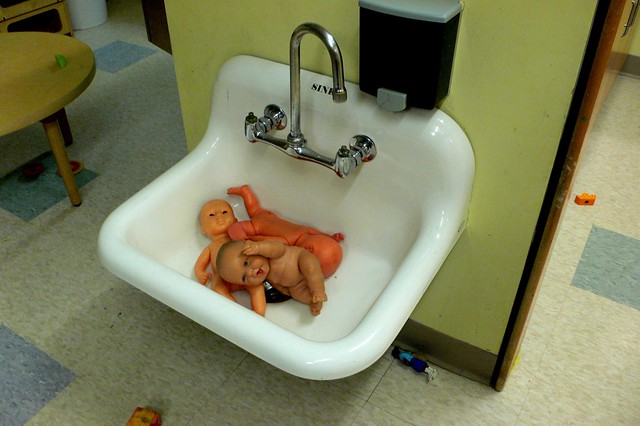
I’m at ECCMID in Amsterdam currently listening to a nice report of an OXA-48 Klebsiella pneumoniae outbreak in Gran Canaria in which sinks were found to be contaminated and replaced. Earlier today I listened to a nice paper on how sinks that drain slowly are more likely to contaminate the local environment for up to 1 metre from Paz Aranega Bou who, together with Ginny Moore and other colleagues has published this nice paper . So many papers on sinks now and I do wonder if we have lost sight of what they do and what they really are.
 Reflections on Infection Prevention and Control