Maple syrup to fight antimicrobial resistance

Schermafbeelding 2015-05-16 om 20.23.49

I always knew it. Pancakes with maple syrup are so good, they must be “healthy”.

Canadian researchers took a different look at North American maple tree syrup. They published that the phenolic compounds contained in the syrup potentiates antimicrobial susceptibility by increasing outer-membrane permeability and effectively inhibit efflux pump activity, in addition to reducing biofilm formation.

After all the research into the antimicrobial activity of foods & spices (e.g. garlic), I am happy to see a less smelly product being promoted. In addition, this may explain why antimicrobial resistance is low in the Netherlands, a country with a proud tradition of pancake restaurants everywhere.

Seriously, antimicrobial activities have been reported from many extracts of “food & spices”, but none really made it into clinical practice. So far the mushrooms seem to be winning. Go Penicillium.

Schermafbeelding 2015-05-16 om 20.35.01

Photo: wikipedia

Reflections from the front line: why doctors don’t listen to the ‘impending doom’ of antibiotic resistance

Coming-Storm

Guest blogger and Acute Medicine trainee Dr Nicola Fawcett (bio below) writes…I’ve just returned from the European Conference for Clinical Microbiology and Infectious Diseases (ECCMID) in Copenhagen. I got the chance to pop into a few sessions on my first love in Microbiology – Stewardship and behaviour change. Before you all think I’m crazy, I’ll just add that I’m actually a trainee in Acute Medicine – I started out in the overlap area of how you change antibiotic use in acute admissions.

Continue reading

WHO Antimicrobial Resistance Analysis

Schermafbeelding 2015-05-03 om 17.47.41

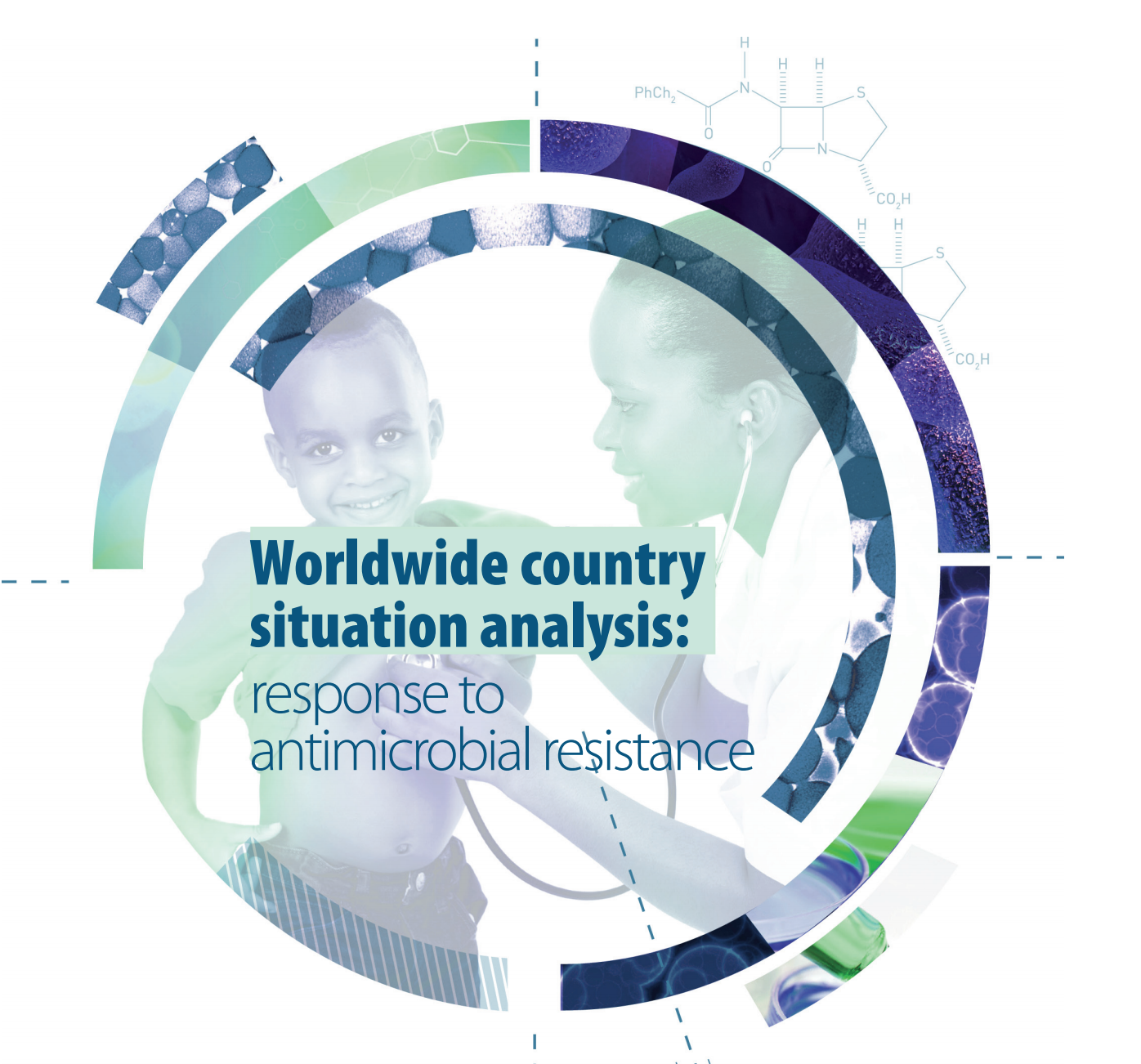
Over a 2-year period, from 2013 to 2014, WHO undertook an initial “country situation analysis” in order to determine the extent to which effective practices and structures to address antimicrobial resistance have been put in place and where gaps remain. 

A survey was conducted in countries in all six WHO regions and focused on the building blocks that are considered prerequisites to combat antimicrobial resistance: a comprehensive national plan, laboratory capacity to undertake surveillance for resistant microorganisms, access to safe, effective antimicrobial medicines, control of the misuse of these medicines, awareness and understanding among the general public and effective infection prevention and control programmes.

Link to document: http://www.who.int/drugresistance/documents/situationanalysis/en/


The cat and mouse of antibiotic resistance (Tom never does catch Jerry…)

tom and jerryProf Laura Piddock’s team from Birmingham recently published a Nature review on molecular mechanisms of antibiotic resistance. If you’re struggling to tell your KPC from your NDM, this review is for you. Continue reading

Pigs & Antibiotics – Food for Thought


PICTURE 2ARIC just published an interesting article that tried to estimate the antibiotic consumption in Chinese pig breading (http://www.aricjournal.com/content/4/1/17).

Since the article is based on a US model, I believe that it needed a word of caution/explanation.  Have a look at the editorial:  http://www.aricjournal.com/content/4/1/16

What does it take to get an infection prevention and control service into shape?

mrsaWhilst the organisation of an infection control service isn’t everybody’s cup of tea, it is mine now. So, what are the key elements of a successful programme? A thoughtful review in Lancet ID penned by an all-star cast (including Zingg, Holmes & Pittet to name but a few) provides a framework for answering this question. Their systematic review yielded 10 key components:

  1. Organisation of infection control at the hospital level;
  2. Bed occupancy, staffing, workload, and employment of pool or agency nurses;
  3. Availability of and ease of access to materials and equipment and optimum ergonomics;
  4. Appropriate use of guidelines;
  5. Education and training;
  6. Auditing;
  7. Surveillance and feedback;
  8. Multimodal and multidisciplinary prevention programmes that include behavioural change;
  9. Engagement of champions;
  10. Positive organisational culture.

None of these are especially surprising, or that difficult to implement. It’s strange in a way that we know from multiple studies that high bed occupancy results in more transmission (specifically of MRSA). So why don’t we just reduce the rate of bed occupancy? If you account for the extended length of stay for patients who become infected, it would probably result in a net increase in patient throughput. Similarly, understaffing results in more transmission (again, specifically of MRSA). So why don’t we just make sure we hit adequate levels of staffing? I suspect the answer here is short-sighted accountancy combined with a genuine lack of the right staff to fill the necessary vacancies.

I’ve always found it a bit odd that the mere act of performing surveillance and reporting the results back to wards reduces HCAI – but there’s a fair amount of data behind this. I suspect it has to do with the type of people we are dealing with: busy healthcare professionals. If their unit’s rate of MRSA (or whatever) is, in the politest possible sense, in their face, they’re more likely to do something about it.

Finally, nurturing a positive organisational culture is crucial but somewhat philosophical. How do you measure whether your organisation has a positive culture? Perhaps perception is reality here, so the best approach is probably to consider organisational positivity as a highly transmissible infectious agent!

Over the top and into the trenches

moving IIAfter 12 years working for Bioquell (and part-time at Guy’s and St. Thomas’ / King’s College London since commencing my PhD in 2005), it’s time for me to move onto pastures new. Next week I’ll start working in a leadership role in Infection Prevention and Control at Imperial College NHS Trust in London. It’s a very exciting move for me and I can’t wait to get going. I thought that now would be a good time to reflect on the water under the bridge of the last decade or so (and I hope you’ll forgive my self-indulgence).

Over the last decade, the rate of MRSA and C. difficile infection (CDI) in the UK have fallen dramatically.1,2 At the peak of the MRSA epidemic in the early 2000s, there were more than 2000 MRSA bloodstream infections per quarter in England; now there are 10-fold less.2 It’s not certain how this has been achieved, but a combination of factors, including increased governmental focus, are likely responsible. Whilst MRSA is now rare in the UK this is not the case in other European countries and in many other parts of the world, where MRSA remains common.3

In recent years, a new and more troublesome bacterial threat has emerged: carbapenem-resistant Enterobacteriaceae (CRE).4 CRE present the “triple threat” of high levels of antibiotic resistance (including pan-drug resistant strains against which no antibiotics are left), severe clinical consequences (around half of patients with a CRE bloodstream infection will die), and the potential for rapid regional and national spread (illustrated by national outbreaks in Italy, Greece and Israel).4-6 CRE have been described as “nightmare bacteria” by the US CDC and have prompted unprecedented action from CDC, Public Health England (PHE) and other public health agencies, including a national Patient Safety Alert and a letter to all hospital Chief Executives in the UK to ensure that new CRE guidelines are implemented.7,8

Continue reading

We need new antibiotics for Gram-negative, not Gram-positive bacteria

gram stain pos and neg

The threat from antibiotic resistance is more pink than purple. You probably need to be a microbiologist to get this: Gram-positive bacteria (such as MRSA and C. difficile) stain purple in the Gram stain, whereas Gram-negative bacteria (such as Klebsiella pneumoniae and Acinetobacter baumannii*) stain pink. All of the international concern surrounding antibiotic resistance from the WHO, CDC, PHE and others have focused our mind on one threat in particular: carbapenem-resistant Enterobacteriaceae (CRE). The Enterobacteriaceae family of bacteria are all Gram-negative, so we need to focus our drug discovery towards the Gram-negatives rather than the Gram-positives.

I blogged last week on the fanfare surrounding the discovery of Teixobactin. Whilst it looks promising, it’s still a long way from the pharmacy shelves, is most certainly not “resistance-proof” and, most importantly, only active against Gram-positive bacteria. I’ve received some useful comments in response to the blog pointing me in the direction of another novel antibiotic, Brilacidin.

Brilacidin is a novel antibiotic class that is in many ways more promising than Teixobactin, not least due to its activity against both Gram-positive and Gram-negative bacteria. Furthermore, it’s much closer to the pharmacy shelves, having undergone promising Phase 2b clinical trials (showing broadly comparable efficacy to daptomycin for the treatment of acute bacterial skin and skin structure infections).

Brilacidin is not without its problems though. Firstly, it is not active against A. baumannii. This is important, since multidrug-resistant – especially carbapenem-resistant – A. baumannii is a serious problem in ICUs around the world. Secondly, although the antibiotic is truly novel (working on the principle of ‘defensin-mimetics’), manufacturer claims that resistance is ‘unlikely’ are as fanciful as the “resistance-proof” claims associated with Teixobactin. Every class of antibiotics was novel once. And resistance has developed to them all!

There are some other emerging options for the antimicrobial therapy of multidrug-resistant Gram-negative bacteria. A number of beta-lactamase inhibitors combined with existing antibiotics are currently at various phases of the clinical trials process (for example, avibactam and MK-7655). Again though, although promising, beta-lactamase inhibitors have limitations, the most important being their specificity. For example, these inhibitors are effective against only some beta-lactamases (and have a blind spot for the metallo beta-lactamases such as NDM-1).

So, there is no silver bullet coming through the pipeline. And there will be no silver bullet. However clever we are in discovering or designing new antibiotics, some bacteria will always find a way to become resistant. It would be naive to think otherwise. Drug discovery is one part of our response to the rising threat of antibiotic resistance, but we ultimately need to focus on prevention over cure.

* Actually, A. baumannii is a bit “Gram-variable” so is somewhat pinky-purpley – but let’s not get too hung up on that. 

Image credit and caption: Marc Perkins. ‘Gram stain demonstration slide. A slide demonstrating the gram stain. On the slide are two species of bacteria, one of which is a gram positive coccus (Staphylococcus aureus, stained dark purple) and the other a gram-negative bacillus (Escherichia coli, stained pink). Seen at approximately 1,000x magnification.’

Teixobactin: a “resistance proof” antibiotic? No chance!

It’s not often that I feature a mighty Nature paper on this ‘lil old blog, but this is a big one. A team from Northeastern University in Boston and a small company called NovoBiotic Pharmaceuticals have discovered a truly novel antibiotic, called ‘teixobactin’.

The finding stems from the fact that 99% of microbes in the external environment cannot be cultured in the laboratory. In order to overcome this problem, the authors ingeniously brought the laboratory to the soil by using the iChip (pictured below). The iChip is a way of capturing the growth of a microbe in its natural environment. Curiously, once grown in the iChip, most of the colonies could then be sub-cultured in the laboratory. When using the iChip, around 50% of the microbes in the soil can be cultured (compared with 1% using conventional methods).

ichip

The authors then screened extracts from an awful lot of isolates (10,000) for antimicrobial activity, and found one that stood out: ‘teixobactin’. It’s a novel cell wall inhibitor that interrupts peptidoglycan synthesis not by targeting proteins (such as the enzymes targeted by β-lactams), but by targeting lipids.

Teixobactin has impressive activity against a range of Gram-positive pathogens of importance to healthcare including S. aureus, E. faecium / faecalis, various streptococci, M. tuberculosis and, importantly, C. difficile. The authors found that teixobactin had equivalent activity to oxacillin (methicillin) in vitro, and superior activity to vancomycin both in vitro and in an animal model.

However, there are some problems:

  • Firstly, and most importantly, there is no activity against Gram-negative bacteria. Since the source microbe, the newly described Elftheria terrae, is a Gram-negative bacterium, this is no surprise, otherwise it would inhibit itself in the soil!
  • Secondly, the antibiotic is still a long way from the clinic, and has to undergo a series of rigorous human clinical trials before reaching the pharmacy shelves.
  • Thirdly, the authors made the promising discovery that they did not identify reduced susceptibility to teixobactin despite serial passage to sub-inhibitory doses for 27 days. The press have had a field day with this, and are talking in terms of “resistance resistant” antibiotics. But this is too much: the authors parallel the potential for resistance to teixobactin with the potential for resistance to vancomycin – and we are increasingly seeing clinically meaningful reduced susceptibility to vancomycin. There’s a rather obscure and quite frightening study showing that vancomycin resistance could be just around the corner: the study found that S. aureus exposed to sub-lethal doses of chlorhexidine as a surface biofilm became resistant to vancomycin after 48 hours (MIC >128 mg/L). So, bacteria will become resistant to whatever we throw at them, to a lesser or greater degree, given time and sub-lethal exposure.

So, teixobactin represents and exciting and huge leap forward in the process of antibiotic drug discovery – and we can expect more novel antibiotics to follow. However, we’d be foolish to think that resistance to teixobactin will not emerge in time.

Citation: Ling LL, Schneider T, Peoples AJ et al. A new antibiotic kills pathogens without detectable resistance. Nature 2015.

Image: NBC news.

ECDC data shows progressive, depressing increase in antibiotic resistance in Europe

The ECDC recently released their 2013 report, which includes 2013 data. The data are on the whole fairly depressing for more parts of Europe, with high and increasing rates of resistance to important antibiotics in common bacteria. So it was not surprising to see ECDC issue a corresponding press release focusing on worrying resistance to last-line antibiotics.

I’ve chosen a few illustrative countries from this useful interactive database. Carbapenem resistance in Enterobacteriaceae (i.e. CRE) is one of the most concerning challenges facing us right now. So it’s not good to see continued high rates of carbapenem resistance in K. pneumoniae in Greece, and the seemingly inexorable increase in Italy (Figure 1). It’s worth noting that these are invasive isolates, the majority of which would be bloodstream infections. And the mortality rate for a CRE bloodstream infection is around 50%

Figure 1: Susceptibility of Klebsiella pneumoniae invasive isolates to carbapenemsEARS-Net 2014 CRE

In some ways, the steady increase in multidrug-resistant K. pneumoniae from many parts of Europe, illustrated in Figure 2, is even more concerning than the sharp increases in CRE in some parts of Europe. If you draw a mental trend line for Italy and Portugal, it doesn’t look good.

Figure 2: Multidrug-resistant Klebsiella pneumoniae invasive isolates (resistant to third-generation cephalosporins, fluoroquinolones and aminoglycosides)EARS-Net MDR Kleb
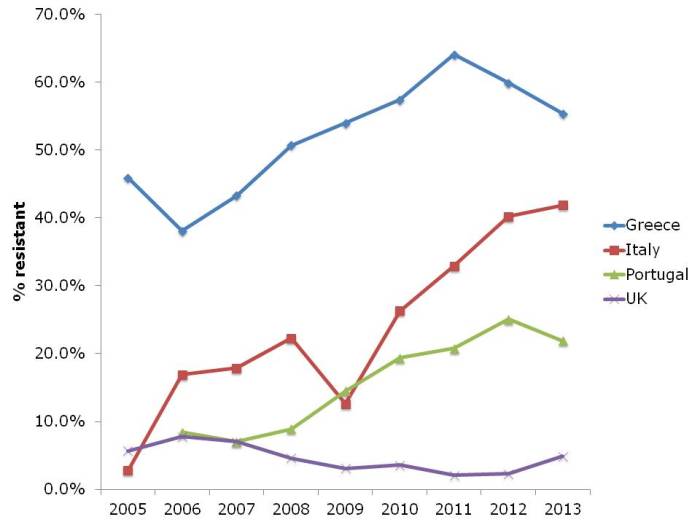
The picture for P. aeruginosa (and I suspect the other non-fermenters like A. baumannii, which isn’t included in EARS-Net) in terms of carbapenem resistance is different to the Enterobacteriaceae (Figure 3). Rates are high in Greece, intermediate in Italy and Portugal, and low in the UK. But the trend is stable.

Figure 3: Susceptibility of Pseudomonas aeruginosa invasive isolates to carbapenemsEARS-Net 2014 CRPA
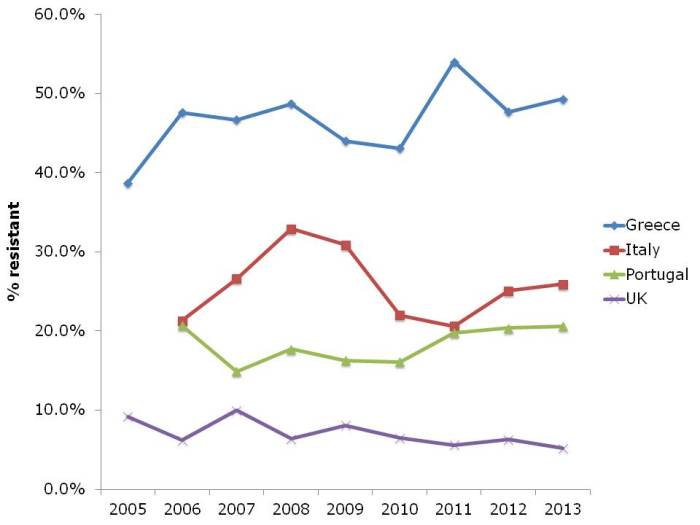
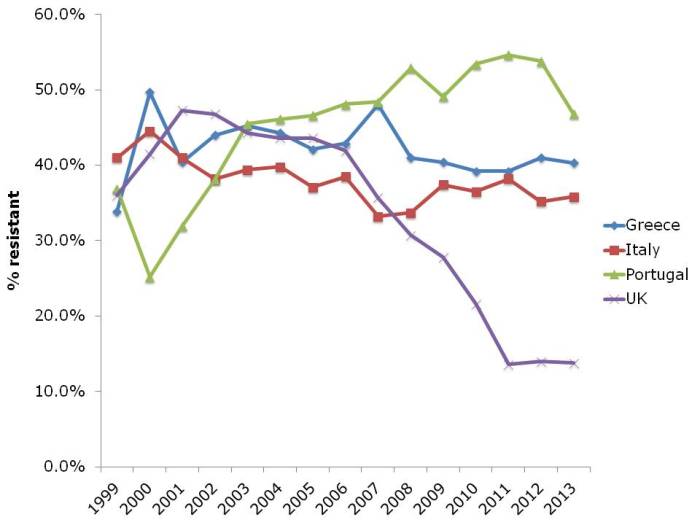
And let’s not forget about MRSA (Figure 4). The UK and some other European countries have done a tremendous job in reducing the transmission of MRSA. This has had an interesting and somewhat unexpected effect on the rate of methicillin-resistance in S. aureus, which has also reduced considerably. I suspect this is a consequence of interrupting the transmission of MRSA, but failing to prevent the spread of MSSA. Put another way, if MRSA and MSSA fell in tandem, the rate of methicillin-resistance in S. aureus would remain constant. The impressive reductions of MRSA reported in the UK have not been replicated everywhere in Europe. Portugal in particular increased from less than the UK in the early 2000s to more than the UK today. There is some evidence that the national campaign in Portugal to reduce healthcare-associated MRSA is making some impact, with a notable reduction in MRSA rate in 2013.

Figure 4: Susceptibility of Staphylococcus aureus invasive isolates to methicillin (i.e. MRSA rate)EARS-Net 2014 MRSA
In summary, it’s not all doom and gloom. The reductions in MRSA in the UK and elsewhere show that reducing the transmission of these antibiotic resistant bacteria can be done. But it takes considerable investment and national focus. Without this, it’s difficult to see the trends in antibiotic resistance, including to last-line agents, continuing to increase in some parts of Europe.