Guest blogger Dr Isabella Centeleghe shares her thoughts on biofilms and sinks in preparation for the next Journal Club (register here).
Continue readingenvironmental contamination
Longitudinal environmental sampling in a paediatric BMT unit identifies computer equipment as the most contaminated site!
A new study in JHI reports the findings of longitudinal environmental sampling in a paediatric BMT unit. Perhaps unsurprisingly, sites associated with frequent contact by staff (especially computer equipment) had the highest bacterial counts. These sites also had the highest bacterial diversity suggesting they are accumulating contamination from multiple sources, and acting as a bacterial possible interchange. But computer equipment is diligently cleaned and disinfected after each use, right…?
Continue readingHow dirty is your QWERTY?
I was recently involved in a study to examine the microbial profile of computer keyboards in a multi-centre study in the UK. The findings have just been published in the Journal of Hospital Infection.
Continue readingSummer break – don’t go near the water?
I trust you are enjoying a well-deserved summer break or packing your bags to take off. In case you missed this paper in the daily list of new ones on biorxiv, it tells you where to swim safely and where not. Elena Buelow, from Germany, a former PhD student in our lab in Utrecht and now post-doc in Limoges, France, reported. So, if you are floating quietly in a pittoresque small river and you see a hospital building on the hill near the next bend in the river, are you still in safe waters? Continue reading
That sinking feeling
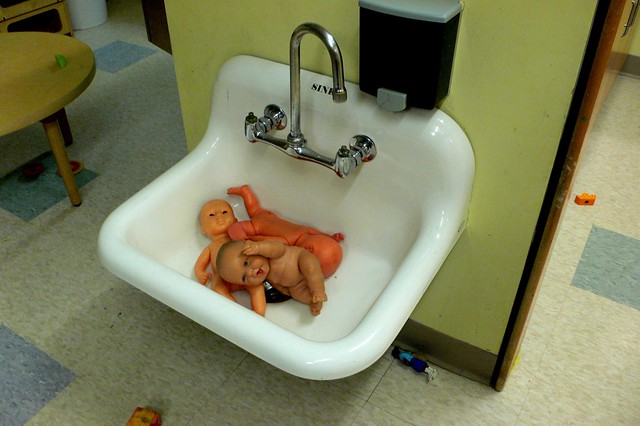
I’m at ECCMID in Amsterdam currently listening to a nice report of an OXA-48 Klebsiella pneumoniae outbreak in Gran Canaria in which sinks were found to be contaminated and replaced. Earlier today I listened to a nice paper on how sinks that drain slowly are more likely to contaminate the local environment for up to 1 metre from Paz Aranega Bou who, together with Ginny Moore and other colleagues has published this nice paper . So many papers on sinks now and I do wonder if we have lost sight of what they do and what they really are.
“Why Dutch hospitals are so good at beating superbugs”
It is with great pleasure that I ask your attention for this article that appeared in the Economist. Yes, we still have low resistance rates in our hospitals and if you’re interested in how that happened, read it. The prosaic composition contains two parts; a very realistic thriller-like opening, followed by a second part with a rather unrealistic explanation. Both parts are separated by a short sentence of absolute nonsense. Time for a review. Continue reading
Attacking the fecal veneer (part 2)
Last year (Jan 17, 2017) I blogged on an excellent pragmatic cluster-randomized crossover study in which 4 patient room cleaning strategies were tested for their effectiveness to reduce acquisition of bacterial carriage for the incoming patients. The authors’ conclusion was that “enhanced terminal room disinfection decreases the risk of pathogen acquisition”, which I interpreted as “Not for C. diff, may be for MRSA and yes for VRE.” Now the same group published the effects of these interventions on infection/colonization with these pathogens in ALL patients admitted to the hospital during the study period, see. Authors’ conclusion this time: “Enhanced terminal room disinfection with UV in a targeted subset of high-risk rooms led to a decrease in hospital-wide incidence of C difficile and VRE.” Really? Continue reading
Antibiotic resistance after the toilet is flushed
Last week Jon ended his reflection with a grade A recommendation to close the toilet lid before flushing, as the best way to minimize the potential impact of “toilet flushing plumes”. Even better: do not flush at all. This week we take it from there, in a discovery of what happens subsequently. Let’s take the loo with the highest likelihood of being soiled with antibiotic-resistant bacteria (ARB) and antimicrobial resistance genes (ARGs): the hospital loo. Elena Buelow, former Phd student in our group and now post-doc in Limoges, France, quantified how hospital sewage contributes to the quantity and diversity of ARGs in the general sewerage system. The work was published on-line today.
Continue reading
Chinese carbapenamases: Fly like an eagle
I blogged on mcr-1 (colistin resistance) in China last week, to share the latest reassuring data. Well, the paper on which todays’ blog is printed will be used to wrap tomorrows’ market fish (typical Dutch expression). Nicolle Stoesser (Oxford) send me the latest news, coming from a Nature Microbiology study providing evidence for the potential of spread of carbapenamases by flies and birds. Not reassuring at all, and potentially with major consequences. Continue reading
ESBL on meat: be aware of filet Americain
Tabloids have repeatedly warned the people for superbugs on chicken meat, after researchers had convincingly shown that the chicken filets that we buy are contaminated with ESBL-producing bacteria, mainly E. coli. Widely considered a public health threat, it was a decisive argument to insist on reductions in antibiotic use in the agricultural industry in the Netherlands. Yet, whether meat contamination constitutes a risk for human health is unknown. This was now quantified, with surprising results. Continue reading
 Reflections on Infection Prevention and Control