Guest blogger Barley Chironda (bio below) writes…
IDWeek has become a cherished tradition for me, much like festivals and holidays, especially when food is involved. Attending this annual meeting for infectious disease health professionals every October and sharing my notes has become a bit of a ritual. This year, the meeting was held in Los Angeles, where the traditional red carpet was rolled out—not for Hollywood actors, but for experts in infectious diseases.
My tradition of sharing IDWeek insights began in 2014 in Philadelphia and continued in 2018 in San Francisco. Now, in 2024, I call San Francisco home after living in Toronto, Canada, for the past twenty years. Let’s keep this tradition of sharing going!
IDWeek is a joint meeting of several organizations, including the Infectious Diseases Society of America, the Society for Healthcare Epidemiology of America, the HIV Medicine Association, the Pediatric Infectious Diseases Society, and the Society of Infectious Diseases Pharmacists. The theme for IDWeek 2024, “Advancing Science, Improving Care,” was evident throughout the conference sessions. As a Healthcare Infection Preventionist, I found the multitude and magnitude of issues both within and outside our control to be particularly grounding. For those who prefer a quick overview, here is a pictorial summary for you (Fig 1).
Fig1: Pictorial summary IDWeek 2024 Summary.
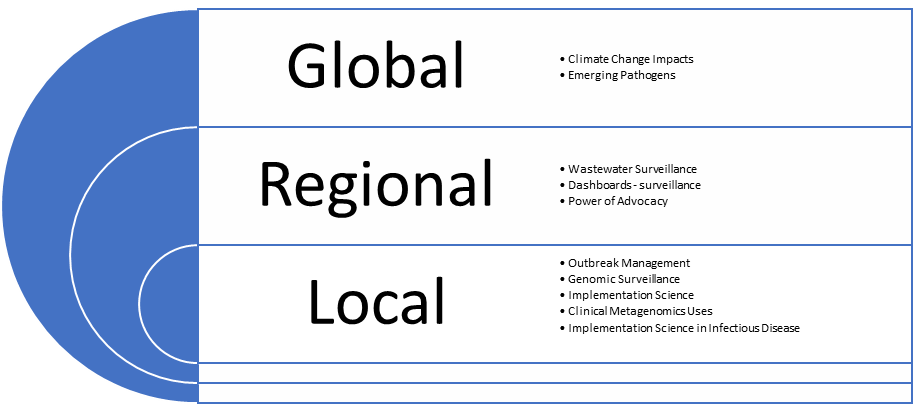
GLOBAL
Two issues I will cover under the global section of this post are the impact of climate change on infectious diseases and emerging pathogens. The impact of climate change on infectious diseases was a significant focus at IDWeek 2024. It was encouraging to see a One Health approach, featuring presentations by world-renowned veterinary experts, including Michail Lionakis, MD, ScD, Anders Koch, MD, PhD, MPH and Emily Jenkins, PhD, DVM, Jan C. Semenza, PhD, MS, MPH and Carina Blackmore, DVM, PhD. On the issue of emerging pathogens, Timothy M. Uyeki MD, MPH, MPP, emphasized the need for virologic and disease surveillance.
Climate Change Impacts:
Here are some key points discussed:
- Vector-Borne Diseases: Warmer temperatures and changing precipitation patterns are expanding the habitats of vectors like mosquitoes and ticks. This is leading to increased incidences of diseases such as Dengue, Zika, Chikungunya, and Lyme in areas that previously did not have these diseases.
- Waterborne Diseases: Extreme weather events, such as floods and hurricanes, are increasing the risk of waterborne diseases like leptospirosis. Floodwaters introduce contamination and pathogens, ultimately leading to disease.
- Dust-Borne Diseases: Prolonged droughts and dry conditions are contributing to the spread of dust-borne diseases like Valley fever (coccidioidomycosis).
- General Trends: Climate change is altering the timing and geographic distribution of infectious diseases.
Emerging pathogens:
Here are some key points discussed:
- H5N1Virus currently spreading in dairy cattle farms was a recurring topic throughout the agenda. Timothy M. Uyeki MD, MPH, MPP delivered a brilliant keynote titled “Human Infections with Highly Pathogenic Avian Influenza A(H5N1) Viruses and Pandemic Influenza Threats.” He highlighted the need for vigilance and enhanced virologic and disease surveillance for H5N1 and other novel influenza A viruses at the animal-human interface, especially in swine. He noted that there is currently no ongoing sporadic animal-to-human transmission and no limited human-to-human transmission, but there is a wide spectrum of disease severity worldwide. Dr. Uyeki also explained that H5N1receptors are found in the lower respiratory tract and conjunctiva, which accounts for the conjunctivitis observed in dairy workers. PPE instructions have already been updated accordingly.
- The Marburg Virus, confirmed on September 27, 2024, by the Rwanda Ministry of Health, is of great concern. In a video stream, Dr. Sabin Nsanzimana, Rwanda’s Minister of Health, provided an update and discussed mitigation efforts, including contact tracing and the use of new therapeutics and trial vaccines. He stated that Rwanda has had 61 cases with 14 fatalities so far, nine of whom were healthcare workers. Dr. Nsanzimana urged attendees, “We need to run faster than the next outbreak so that we’re ready with better tools.”
- Mpox: Placide Mbala-Kingebeni, MD, PhD provided a comprehensive history and case management overview, with Olivier Tshiani, MD and Timothy Wilkin, MD MPH, offering recommendations for healthcare workers. They emphasized that proper adherence to infection prevention and PPE protocols is sufficient, negating the need for healthcare worker vaccination. However, in cases where infrastructure does not allow for proper infection control, a case-by-case consideration is necessary.
- NETEC: (National Emerging Special Pathogens Training and Education Center) gave a presentation sharing tools and resources aimed at meeting compliance for managing special pathogens. See resources here. Kari Simonsen, MD, MBA, provided a holistic example of hospital preparedness, sharing tools on handling waste and adherence to the recently released Joint Commissions special pathogen focus
REGIONAL
Several regional considerations were discussed, particularly focusing on the roles and resources available for wastewater surveillance. Another important issue raised was the significance of advocacy, especially relevant since the United States is in an election year. One of the sessions I thoroughly enjoyed was titled “Hot Breakfast and Hot Topics: Advocacy in an Election Year.” The session highlighted the crucial role of advocacy in shaping policies that support the infectious disease community and enhance public health outcomes.
Wastewater Surveillance:
Here are some notable findings:
- Avian Influenza Detection: Wastewater surveillance detected H5N1 avian flu in Texas two weeks before cases were reported and a month before the virus was confirmed. This early detection could potentially accelerate public health responses.
- Norovirus Monitoring: Studies have shown that wastewater surveillance is accurate for detecting norovirus, providing a reliable method for monitoring outbreaks.
- Zoonotic Influenza: Monitoring for zoonotic influenza in wastewater has enabled earlier identification and response to human outbreaks. This was particularly evident in the detection of bird flu in wastewater before the first reported outbreak among Texas dairy cattle.
Dashboards – Wastewater Surveillance
Here are notable wastewater surveillance resources worth exploring in this area are:
- National Wastewater Surveillance System (NWSS): Managed by the CDC, this resource provides comprehensive information on how wastewater surveillance works, its benefits, and current data on various pathogens.
- Waste Water Scan is a partnership involving municipal systems, public health entities, and Emory and Stanford universities. Currently, 148 sites across 40 states are represented, covering 11.85% of the U.S. population.
Roles of Various Surveillance:
The diagram below (Fig 2) offers valuable insights and data for understanding and implementing wastewater surveillance. Marlene K Wolfe, MSc, PhD , Allison Wheeler, MSPH and Alexander Yu, MD, MPH, provided valuable share-outs on this topic, excellently moderated by fellow Canadian Susy S. Hota, MD MSc.
Fig 2: Role of various surveillance (Image from Alexander Yu, MD, MPH)

Power of Advocacy:
Key highlights:
- Federal Policy Improvements: Insights were shared on how advocacy can influence federal policies affecting spending and priorities for infectious disease physicians, scientists, patients, and public health.
- Tools for Advocacy: The session provided practical tips and strategies for effective advocacy, emphasizing the importance of building relationships with policymakers, and leveraging the election year to advance public health agendas. Similar tools for Infection Prevention Advocacy from APIC were also discussed.
- Engagement and Mobilization: Speakers highlighted the need for increased engagement and mobilization of healthcare professionals to advocate for critical issues, such as funding for infectious disease research and public health initiatives.
LOCAL
Lastly, this section will address concerns at the hospital level: outbreak management, Whole Genome Sequencing (WGS), clinical metagenomics (CMg), and implementation science. Some outbreaks we encounter in our respective hospitals can be managed using WGS. Costi Sifri, MD and Alex Sundermann, DrPH, CIC facilitated a symposium featuring discussions on enhanced detection hardware and software within WGS and ideas on developing a business case to launch WGS in your facility.
I will also discuss a new concept I first heard of during IDWeek 2024: clinical metagenomics (CMg). CMg is an advanced diagnostic approach that uses next-generation sequencing (NGS) to analyze the genetic material (DNA or RNA) from clinical samples. This method allows for the comprehensive identification of all microorganisms present in a sample, including bacteria, viruses, fungi, and parasites, without the need for prior culturing. Excellent work by Etienne Ruppe, PharmD, PhD, Catherine Hogan, MD, MSc, FRCPC and David C. Gaston, MD PhD, showcased this innovative tool and highlighted several use cases for this technology. Clinical metagenomics has the potential to revolutionize infectious disease diagnostics by offering a more comprehensive and rapid method for identifying pathogens and understanding their resistance profiles.
Outbreak Management:
Here are some highlights:
- Drains and Sinks: These areas are still an issue. One-third of patients in a region in Canada were involved in genomic clusters, as presented by Conrad Izydorczyk, PhD, with drains seeming to represent a significant reservoir. Having patient items and supplies around the sink splash zone was noted again as a possible cause, shared by Steven D. Langerman, MD
- Nontuberculous Mycobacteria(NTM) Outbreaks: A symposium dedicated to NTM outbreaks highlighted the importance of mitigating risks and having a water management plan wherever water is involved. Meghan Baker, MD, ScD , Kiran Perkins, MD, MPH and Kevin L Winthrop, MD, MPH, emphasized that detecting NTM outbreaks requires astute clinicians or advanced systems like WGS; otherwise, outbreaks can go undetected.
WGS:
Key highlights:
- Enhanced Detection System for Healthcare-Associated Transmission (EDS-HAT): Lee Harrison, MD, described in detail how this system integrates WGS with machine learning and electronic health records to identify outbreak transmission. The intent is to continue expanding to real-time WGS and to include respiratory viral tests.
- Making a Business Case for WGS: For facilities looking to implement their own WGS, Lilian M. Abbo, MD, MBA provided an excellent recap of the business case, persuasion, and influence that led to the WGS launch at her facility. Her example was not only relevant to acquiring WGS but also served as a masterclass in pitching for any initiative. She emphasized the importance of timing, knowing your audience, and using plain business English rather than complex terminology.
Clinical Metagenomics Uses:
Key points:
- Broad Detection: It can detect a wide range of pathogens simultaneously, making it particularly useful for diagnosing infections with unknown causes.
- Rapid Results: By bypassing the need for culturing, clinical metagenomics can provide faster diagnostic results compared to traditional methods.
- Antimicrobial Resistance: It can identify antimicrobial resistance genes, helping clinicians choose the most effective treatments.
- Microbiome Analysis: This approach also allows for the study of the human microbiome, providing insights into how microbial communities affect health and disease.
Implementation Science:
Key highlights:
- Role of Dissemination and Implementation: Elvin H. Geng, MD, MPH, who has published extensively on the topic, discussed the importance of dissemination and implementation in infectious disease. He highlighted the need to adopt proficiency in implementation science to effectively showcase and apply solutions and interventions.
- Bridging the Knowledge-Practice Gap: E. Yoko Furuya, MD, MS, expanded on this by using examples from Ignaz Semmelweis and hospital cleaning improvements. She illustrated the gap between knowledge and practice, utilizing the Theoretical Domain Framework as a tool for troubleshooting and investigating implementation problems.
- Virtual Reality (VR) and Extended Reality (XR) for Training: Kimberly Hieftje, PhD of XR Peds, discussed the use of VR and XR technologies for infection prevention, control training, and education. These technologies create immersive training environments, allowing healthcare professionals to practice infection control procedures in a realistic, risk-free setting, thereby improving their skills and preparedness. Andrea S. Greenfield, MSN, RN-BC, CIC, also highlighted the use of VR for training workers on cleaning shared equipment, complementing interactive learning and remote training capabilities.
Conclusion:
In conclusion, IDWeek 2024 did not disappoint. The conference set the tone by addressing emerging threats while reiterating the fundamentals. Discussions on emerging pathogens and the importance of cleaning shared equipment left me contemplating the many big, global, and complex issues that will require advanced skills to implement, improve, and prevent infections.
I am optimistic but also realize that a lot of work will need to be done to upskill infection prevention for the looming threats. I did not include posters in my sharing and will likely come back with a part two to share insights from the poster hall, which featured thousands of posters with some useful items. I know because I clocked 7,388 steps in the poster exhibit hall! I am already counting down to the next IDWeek in Atlanta in 2024.
Bio: Barley Chironda

LinkedIn: Barley Chironda RPN, MSc
Barley Chironda, a Registered Practical Nurse, is the National Infection Preventionist and Clinical Solutions Director with Clorox Healthcare. He supports hospitals across the USA in implementing proper infection prevention practices. Barley holds a Master of Science in Infection Control from Essex University in the UK. He has also worked as a Frontline Infection Prevention Manager Nurse and as a Manager for Healthcare Medical Device Reprocessing Management.
Discover more from Reflections on Infection Prevention and Control
Subscribe to get the latest posts sent to your email.
 Reflections on Infection Prevention and Control